
Six dead pothos in two years. A spider plant that turned to mush within weeks. A “low-light” fern that looked like it had been through a drought by the third Tuesday. If your bathroom has no window, or a frosted glass slit that lets in about as much light as a refrigerator door — you already know how this story goes. The plants die, you feel guilty, and the Plastic succulent from Target starts looking like a reasonable life choice.
The problem isn’t you. The problem is bad advice. The internet is flooded with “low-light plant” lists that were written for rooms with north-facing windows, not actual darkness. A bathroom with no natural light is a fundamentally different environment, and most plants sold as “shade tolerant” still need ambient daylight to photosynthesize. So when someone tells you pothos is unkillable, they’re right, in most rooms. Not yours.
After years of failed experiments (and a fair amount of genuine frustration), I landed on three species that don’t just survive a windowless bathroom, they genuinely seem unbothered by it. Here’s what I’ve learned, and why these particular plants work where Everything else fails.
Key takeaways
- Popular “low-light” plants actually need ambient daylight—most don’t work in true darkness
- Three species evolved to thrive in near-total darkness and genuinely don’t care about your bathroom’s conditions
- One simple LED bulb and proper drainage solves what seemed like an impossible plant-growing problem
Understanding What “No Light” Actually Means for Plants
Most plant care guides use the word “low light” to describe conditions that would still register as moderate light to a plant scientist. True low-light conditions, a bathroom with artificial lighting only, or a frosted window that never gets direct or indirect sun — present a real photosynthetic challenge. Plants need light to convert carbon dioxide and water into sugars. Without it, they can’t grow, can’t repair themselves, and eventually can’t maintain basic cellular function.
What saves the three species below is a combination of traits: extremely low metabolic rates, tolerance for irregular watering, and in some cases, an evolutionary history spent on the forest floor under dense canopies where light barely filters through at all. They’re not thriving on nothing, they’re built for near-nothing.
One useful reframe: if your bathroom has artificial lighting on for four to eight hours a day, that counts. Plants can photosynthesize under fluorescent and LED grow-spectrum bulbs. It’s weak, but it’s enough for the right species. Swap out a standard bulb for a full-spectrum LED (they’re cheap and widely available), and you give even the most light-starved plant a fighting chance.
The Three Species That Actually Survived
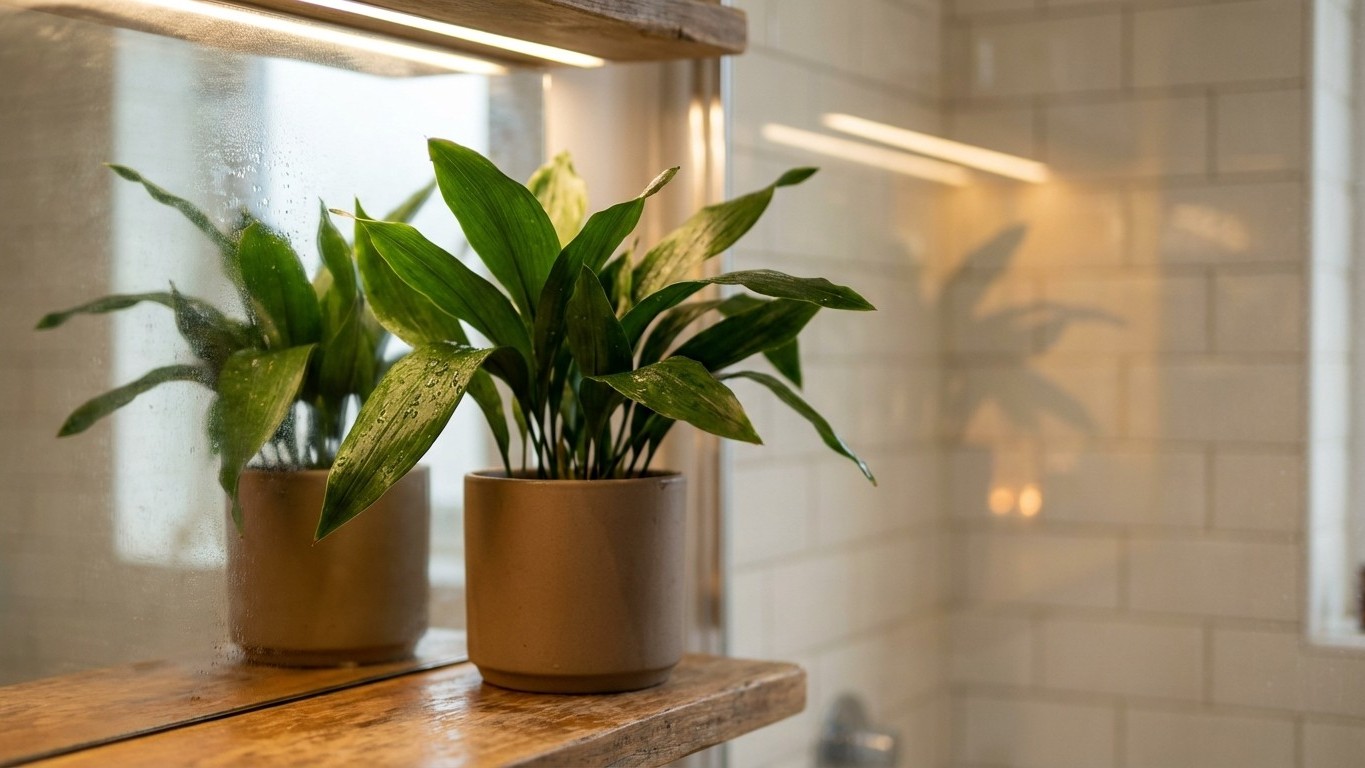
The first is cast iron plant (Aspidistra elatior). The name is not marketing. Victorian-era gardeners used this plant in gaslit hallways and coal-dusted parlors, environments that would kill almost anything else. It grows slowly, almost imperceptibly, and it does not care about your humidity level, your irregular watering schedule, or the fact that your Bathroom light is a single 40-watt bulb you forget to turn on half the time. The cast iron plant asks for almost nothing: water when the soil feels dry, wipe the leaves occasionally to remove dust, and leave it alone. It won’t trail dramatically or produce bright flowers, but in a windowless bathroom, drama isn’t what you need. Reliability is.
The second is ZZ plant (Zamioculcas zamiifolia). This one gets recommended constantly, but usually dismissed because people assume it needs more light than their space offers. The truth is that ZZ plants store water in their rhizomes (thick underground stems that look almost like potatoes), which means they can go weeks without water and continue functioning when light is scarce. They’re native to the semi-arid regions of eastern Africa, where surviving drought and shade simultaneously is a baseline skill. In a windowless bathroom, the humidity actually works in their favor, they don’t dry out as quickly as they would in a living room. The glossy, dark green leaves look deliberately styled, which is a nice side effect of a plant that’s mostly just waiting for you to forget it exists.
The third is Chinese evergreen (Aglaonema), specifically the darker-leafed varieties. This is where a small but important distinction matters: the bright pink and red cultivars of Aglaonema need more light to maintain their coloration. The deep green varieties, the ones that look almost like they’ve been dipped in forest shadow — are among the most adaptable houseplants in existence. They’ve been growing on the floors of Southeast Asian rainforests for millions of years. A windowless bathroom with a light timer is practically luxurious by comparison. They tolerate overwatering better than most, which is relevant in a high-humidity room where soil dries slowly.
The Setup That Makes the Difference
Choosing the right species is only half the equation. The other half is not overcomplicating the care. In a windowless bathroom, the biggest killer isn’t darkness, it’s root rot from soil that stays wet too long because there’s no sunlight to accelerate evaporation. The fix is straightforward: use a well-draining Potting-soil-after-discovering-these-plants-thrive-in-just-water/”>Potting mix (adding perlite to a standard mix works well), choose pots with drainage holes, and water less frequently than you think you should. Every two to three weeks is a reasonable baseline for all three species mentioned here.
A full-spectrum LED bulb on a simple timer, six hours on, eighteen off, makes a measurable difference. Plants respond to light cycles, and giving them a consistent rhythm mimics natural conditions enough to support basic growth. It costs less than a latte to set up.
The last thing worth mentioning: bathroom plants live in a strange microclimate. Showers spike the humidity for twenty minutes, then it drops back. Temperatures fluctuate. This volatility, oddly, doesn’t seem to bother the three species above. They’ve evolved in dynamic forest environments where conditions shift constantly. What they can’t handle is sustained neglect combined with waterlogged roots, which, incidentally, is exactly what well-meaning plant owners tend to inflict on them.
The question worth sitting with: how many other “impossible” spaces in your home have you written off because the advice you found was written for someone else’s conditions?