
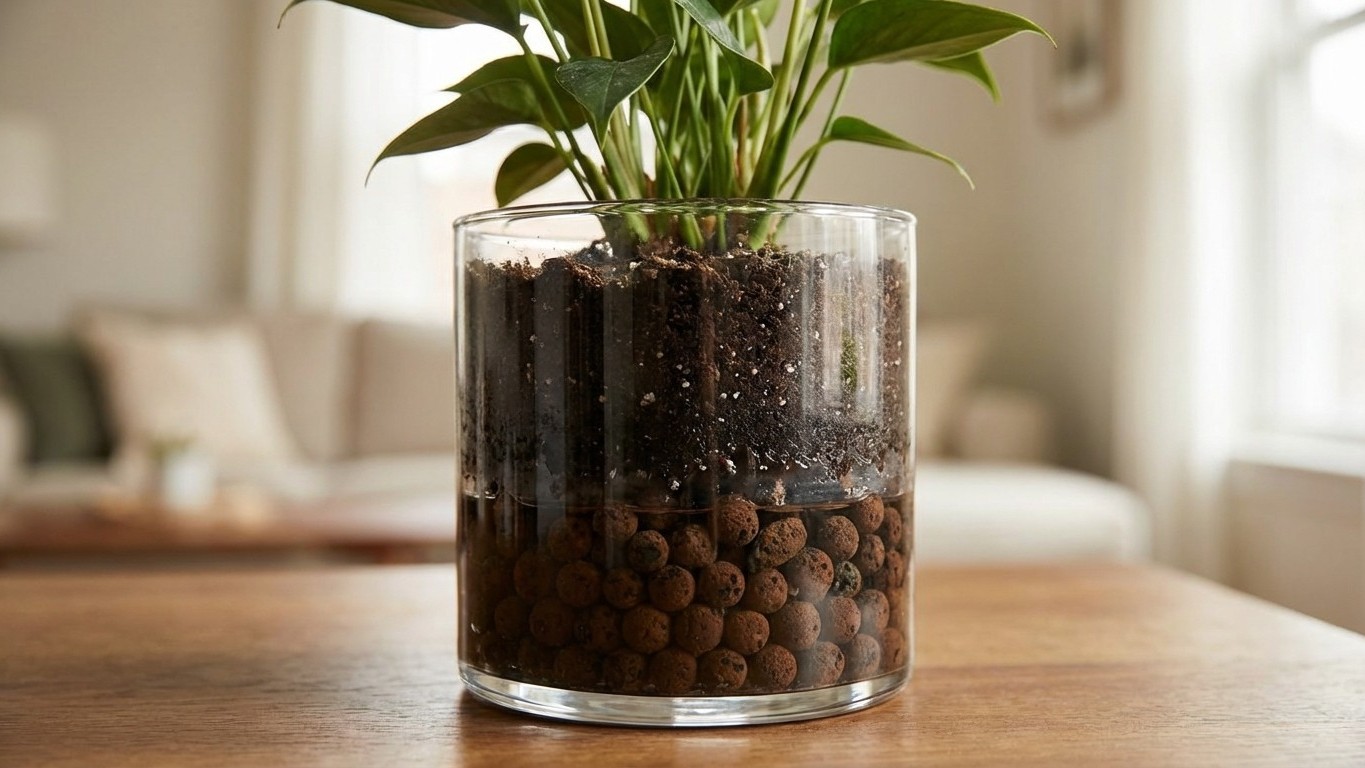
gardeners have been doing it for decades. Before filling a pot with soil, they line the bottom with a layer of clay balls, gravel, or pebbles, convinced this creates a drainage buffer that protects roots from sitting in water. The intention is good. The outcome, according to plant science, is the opposite of what most people expect.
Key takeaways
- What gardeners thought was a drainage solution actually traps water in a ‘perched water table’ that saturates the root zone
- Root rot fungi thrive in the exact anaerobic conditions created by drainage layers—damage happens silently before visible symptoms appear
- The myth persists through generations and hydroponic confusion, but soil science has known the truth since the 1990s
The Perched Water Table Problem
Soil physics has a name for what actually happens: the perched water table effect. Water moving through a growing medium doesn’t simply drain into a coarser layer below. Instead, it stops, held by surface tension at the boundary between two materials with different particle sizes. The fine soil above refuses to release its moisture until it reaches near-saturation, at which point water finally drops down. The practical result is that the bottom few inches of your potting mix stay wetter, not drier, when you add a gravel or clay ball layer underneath.
Think of it like a kitchen sponge sitting on a pile of marbles. The sponge won’t release its water into the air pockets between the marbles until gravity wins out over surface tension, which requires significantly more water than you’d expect. Your pot operates on the same principle. Adding that coarse layer effectively raises the floor of the saturated zone, squeezing it upward into the root zone rather than pushing it down and out.
This was documented in research going back to the 1990s, including work published in soil science literature examining container growing media. The consensus among horticultural scientists has been consistent: a layer of gravel or coarse material at the bottom of a pot does not improve drainage. Drainage improves when the pot has adequate drainage holes and the growing medium is uniformly well-structured throughout.
What Your Plant’s Roots Are Actually Experiencing
Plant roots need two things most people don’t think about together: water and oxygen. Healthy potting mix, when properly watered, holds moisture in small pores while larger pores stay air-filled, letting roots breathe. The moment those larger pores flood and stay flooded, roots suffocate. Not metaphorically. Oxygen deprivation triggers cell death in root tips within hours, depending on the species.
A perched water layer sitting right above your clay balls is exactly the anaerobic environment that causes root rot. The fungi and bacteria responsible for root rot (Pythium and Phytophthora are the usual suspects) thrive in these waterlogged, low-oxygen conditions. So the drainage layer meant to prevent root problems Actually creates the ideal conditions for them.
Here’s the part that frustrates careful plant owners: the damage isn’t immediately visible. A plant can suffer significant root loss before showing any above-ground symptoms. By the time leaves yellow, droop, or drop, the root system is often already compromised. Many people interpret those symptoms as underwatering, add more water, and accelerate the problem.
Where the Myth Comes From (and Why It Stuck)
The clay ball tradition didn’t emerge from nowhere. LECA (lightweight expanded clay aggregate) and gravel do have legitimate uses in hydroponics and semi-hydro growing, where roots are intentionally suspended above a water reservoir or grown in inert media. That works because the entire system is designed around different oxygen and moisture dynamics. Transplant that logic to a standard potted plant in soil, and the conditions that made it work disappear.
Gardening advice also travels intergenerationally without much scrutiny. A grandmother who grew beautiful houseplants for forty years used gravel in her pots, and her plants thrived. But they thrived despite the gravel layer, likely because she watered judiciously, used a decent potting mix, and kept plants in appropriate light. Correlation and causation get tangled in gardening lore more than almost anywhere else.
There’s also the aesthetic argument. Some gardeners add a layer of decorative stones simply because it looks clean and organized when repotting. That’s fine as motivation, but the layer still affects moisture behavior regardless of intent. The physics don’t care about the aesthetic reasoning.
What to Do Instead
The single most effective thing you can do for drainage is use a well-structured potting mix suited to your plant’s needs. For succulents and cacti, that means mixing in perlite or coarse pumice at a ratio of roughly 50/50 with potting soil. For tropical foliage plants, a chunky mix with bark, perlite, and compost drains better than any standard bag mix straight from the store.
Pot choice matters more than most people realize. A terracotta pot with a single drainage hole and well-aerated soil outperforms a decorative ceramic pot with a full gravel layer at the bottom. If your pot lacks drainage holes entirely, no amount of gravel will compensate, you’re essentially creating a miniature sealed swamp. Drilling holes into ceramic pots is easier than it sounds, using a masonry bit at slow speed with a little water to cool the surface.
Watering technique rounds out the picture. Water thoroughly, let it drain fully, then wait until the appropriate dry-down period for your specific plant before watering again. A moisture meter takes the guesswork out of timing for new plant owners who haven’t yet developed a feel for their soil.
If you’ve already set up pots with a gravel layer and your plants look healthy, this isn’t a call to immediately repot everything. Observe, adjust your watering habits to account for the reduced drainage, and reconsider the layer next time you repot. The goal isn’t perfection, it’s understanding what’s actually happening below the surface, so you can make better decisions rather than repeating inherited habits that work against the plants you’re trying to keep alive. After all, the most expensive houseplant Mistake isn’t buying the rare variety. It’s slowly drowning a perfectly good one in a pot you thought you had figured out.