
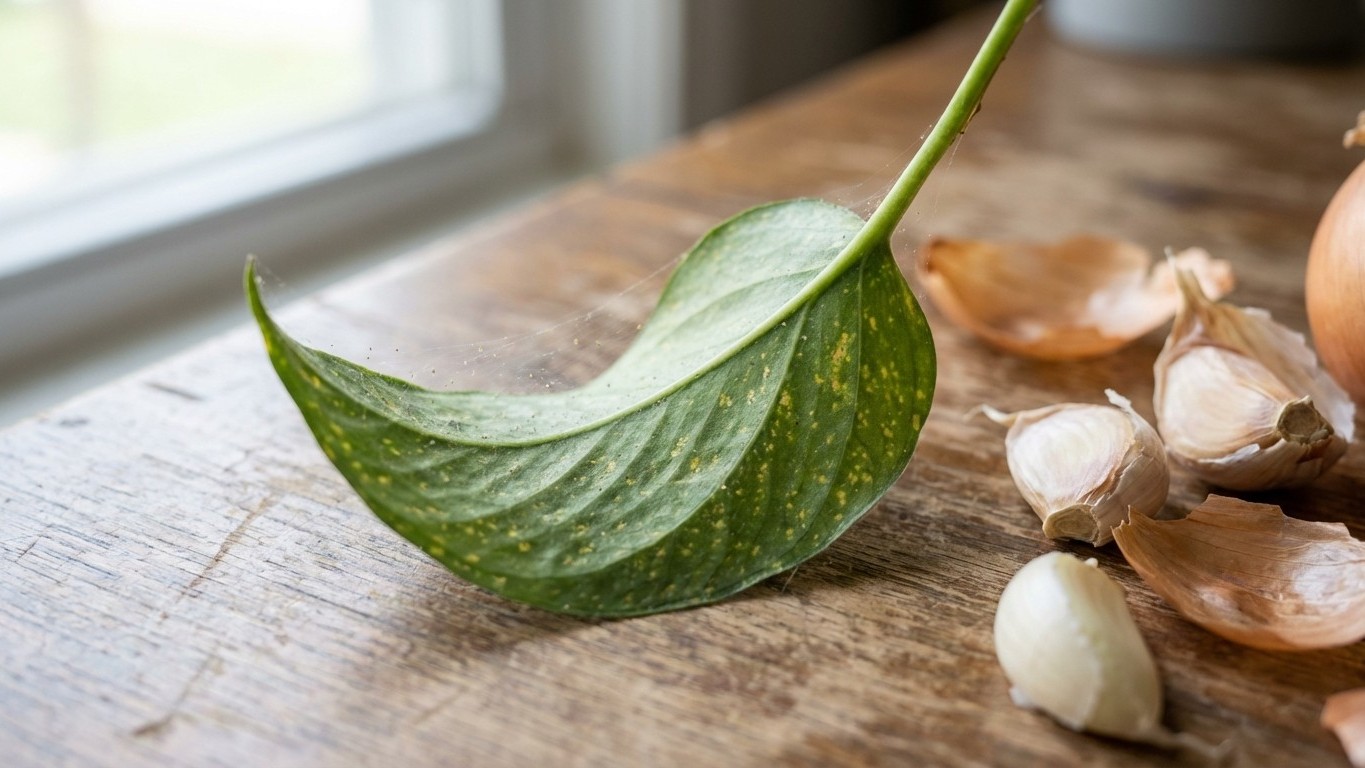
Every night, millions of American households peel a clove of garlic, slice an onion, and toss the papery skins and stubby ends straight into the trash, or maybe the compost. It turns out those scraps may be the most effective, zero-cost weapon against one of the most hated pests in the indoor plant world: spider mites. The connection is real, it’s backed by research, and the fix is embarrassingly simple.
Key takeaways
- Spider mites can multiply from manageable to catastrophic in just three days under the right conditions
- Kitchen scraps contain a compound that achieves 95.6% repellency against spider mites within 24 hours
- A simple homemade spray using items you’re already throwing away can replace expensive chemical pesticides
The Enemy You Probably Can’t See
Spider mites are reddish brown or pale, oval-shaped, and very small, about 1/50 of an inch long, roughly the size of the period at the end of this sentence. That’s why most people notice the damage long before they ever spot the mites themselves. Leaves mottled with small dots and very fine webbing are the visible signs, and the mites themselves are barely visible unless the infestation is already large. By then, you’re already behind.
They feed on plant sap, causing speckling, yellowing, and weakening of leaves, as well as stunting growth, and sometimes killing the plant. They reproduce rapidly, and infestations can be difficult to control if not managed early. The speed is what shocks people. Under ideal conditions, dry air and temperatures around 77–80°F, spider mites can complete their full life cycle from egg to adult and back to eggs in just three days. Three days. A colony that seems manageable on a Monday can be a crisis by Thursday.
Drought conditions are favorable for two-spotted spider mite outbreaks. Dry weather, low humidity, and temperatures exceeding 85°F are associated with spider mite population growth. This is exactly the profile of most American living rooms in winter: the heating system runs full blast, humidity tanks, and houseplants quietly become ground zero for a mite explosion.
Why Garlic and Onion Scraps Are the Answer
Here’s where the kitchen trash can becomes relevant. Both garlic and onions belong to the allium family, and that family produces compounds that spider mites genuinely cannot tolerate. Garlic serves as a natural pest repellent due to its strong smell and sulfur-containing compounds, making it an effective insecticide and fungicide. It has been found to repel various pests including aphids, beetles, mites, and mosquitoes. Its unique chemical composition, particularly the compound allicin, released when garlic is chopped or crushed, enhances its efficacy against these nuisances.
The science here is solid, not just folklore. Laboratory tests on garlic-straw extracts showed contact toxicity and repellent effects against female adult spider mites, with the highest concentration causing 76.5% mortality in Tetranychus urticae within 48 hours of treatment. Even more strikingly, repellency of T. urticae reached 95.6% after just 24 hours at a concentration of 10 g/L of garlic extract. That’s nearly 96% of mites simply abandoning the plant. Research also shows that garlic can reduce the population of two-spotted spider mites on strawberry plants by up to 52 percent.
Onions work through the same mechanism. The most effective spider mite repellents are members of the allium genus, including chives, garlic, leek, onion, scallion, and shallot. So those onion tops and garlic paper you automatically discard? Stop throwing them away, or at least, not before making a spray.
How to Actually Use Your Kitchen Scraps
The method is low-effort, and there are two solid approaches depending on what you have. For a quick garlic spray, blend 4–6 garlic cloves with 1 quart of water, steep for 12–24 hours, strain, add 1 teaspoon of liquid soap, and use immediately. That’s it. The soap helps the solution stick to the leaves, without it, the spray beads up and runs off. For an onion brew, peel the onions, cut them into slices, pour water over them, boil the mixture for 30–40 minutes, and once the brew cools down, use it directly on plants without diluting.
Want to amp up the power? Adding garlic and onions together makes the pepper solution stronger and delivers better results. Combine both alliums with a pinch of cayenne pepper and a few drops of dish soap and you have a multi-front deterrent that targets mites from several angles at once. Apply the spray early morning (before 10 AM) or late evening (after 4 PM) to prevent evaporation and spray every 5–7 days during active pest season for consistent protection.
One important caveat: eggs are not affected by contact sprays, so repeated applications are required. Spider mite eggs sit waiting, protected by webbing. The goal of repeated spraying is to break the reproductive cycle, killing adults before the next generation hatches and matures. Plan on at least three weeks of consistent treatment.
The Bigger Picture: Prevention Over Cure
As much as spider mites love hot, dry conditions, they absolutely detest moisture. This means your defensive strategy has to go beyond spraying. Raise the humidity around your plants. Group them together, run a humidifier nearby, or mist the leaves regularly. Spider mite eggs are most vulnerable during the first 3 to 5 days, and humidity levels above 60% can prevent successful hatching. That’s free pest control, no scrubbing, no sprays, just a humidifier doing its job in the corner.
When plants are stressed, they’re more prone to invasion by spider mites and other opportunistic feeders. So keep them watered per their needs and ensure excess water drains well. A healthy, hydrated plant resists mite colonization far more effectively than a neglected one. Strong, healthy plants are less susceptible to pest damage and bounce back faster from attacks.
There’s also the companion planting angle, which works beautifully for outdoor gardens. Mixing crops spider mites love, tomatoes, eggplant, peppers, cucumbers, with crops they avoid, like onions, leeks, garlic, broccoli, mustard, basil, rosemary, and thyme, is a practical way to keep spider mites far away from vulnerable plants. The same principle scales down to container gardening on a balcony or windowsill: a small pot of chives next to your most mite-prone houseplant is a remarkably effective deterrent.
One more thing worth knowing: using chemical pesticides to control spider mites can be counterproductive, mites develop resistance, and the pesticides often kill beneficial insects like ladybugs that naturally prey on spider mites. You can make the problem significantly worse by reaching for the chemical bottle. The irony of pest management.
The next time you’re at the cutting board, take a second look at those garlic skins and onion ends before they hit the trash. The answer to your spider mite problem may have been sitting in your kitchen all along, the question is whether you’ll still be tossing it away next week.
Sources : happysprout.com | researchgate.net