
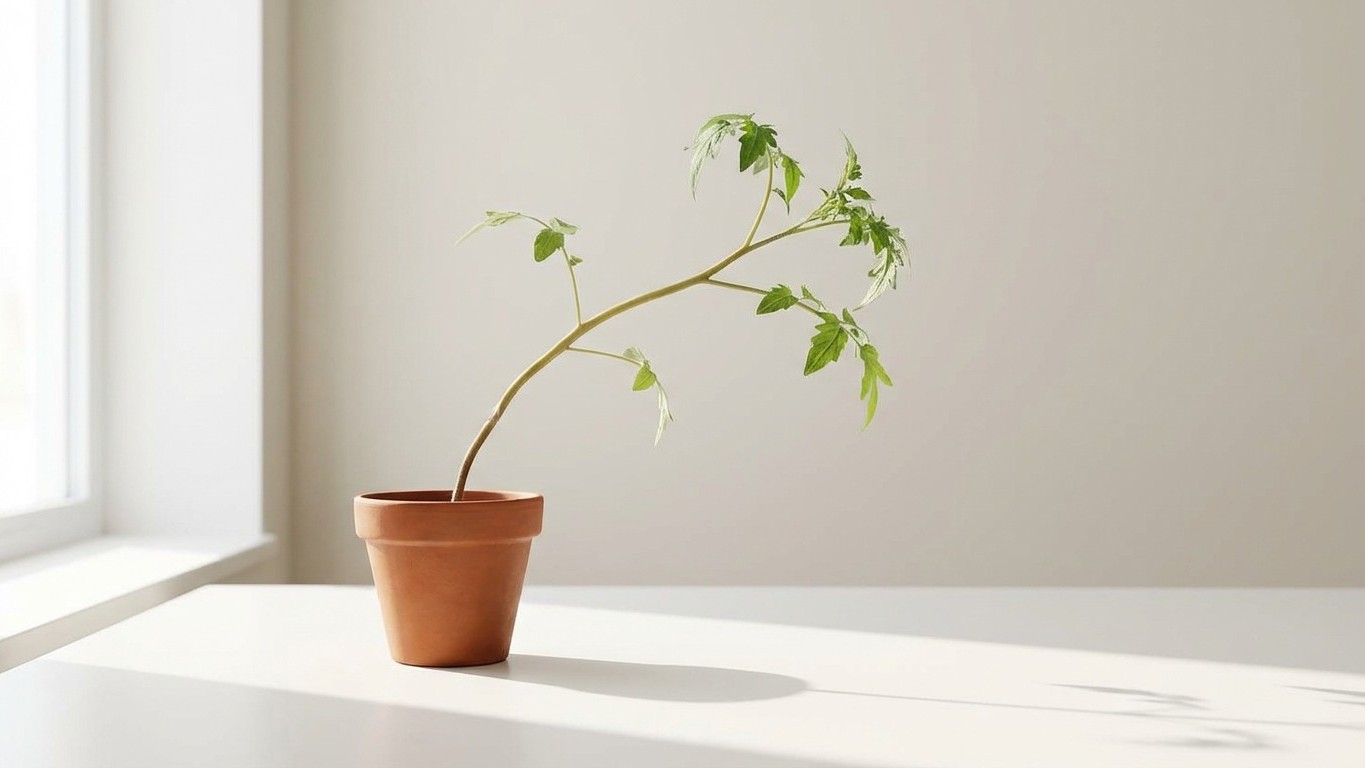
A tomato seedling starts leaning toward the window within 48 hours of germination. Not because something is wrong with it, but because you’ve made the single most common mistake in indoor vegetable growing, and it has nothing to do with watering, soil, or fertilizer. It’s about light direction. Specifically, where your light is coming from relative to your plant, and what the plant does about it.
Key takeaways
- Tomatoes lean toward light for a scientifically sound reason—but nobody tells you how to stop it
- One daily habit (taking 10 seconds) prevents the problem entirely, yet 90% of indoor gardeners skip it
- Light placement and direction matter more than you think—and commercial greenhouses prove it works
The Physics Your Plant Understands Better Than You Do
Outdoors, daylight reaches plants from all sides, so they grow straight up. Indoors, light comes from one direction, through a window, so growing plants tend to lean toward it to reach the strongest source. This is phototropism, and it’s not a problem. It’s a feature. The plant is doing exactly what millions of years of evolution designed it to do.
The mechanism is elegant, even if the result looks messy on your windowsill. Even mature plants bend toward the strongest light by elongating the cells of the stem on the side farthest from the light, a process called phototropism. The growth hormone responsible is auxin. When a plant is exposed to uneven light, auxin distributes unevenly; it gathers on the side of the plant that is farther from the light, causing those cells to elongate more and making the plant bend toward the light source. Your tomato isn’t being stubborn. It’s being rational.
The problem isn’t that the plant leans, it’s that most indoor gardeners never correct for it, and a chronically one-sided tomato is a weaker tomato. Leggy, leaning seedlings have long, spindly stems that look more like vines than proper plants, with exaggerated distance between leaves. These weak stems are prone to breaking during transplanting, and if left uncorrected, such plants typically produce far less fruit than healthier counterparts.
The Angle Most Gardeners Get Wrong
The mistake isn’t placing a tomato near a window. The mistake is leaving it there, unrotated, for weeks. Many houseplants placed near a window, if not rotated, will continue to lean toward the light, demonstrating phototropism at its most persistent. With tomatoes, which are among the most light-hungry vegetables you can grow indoors — this effect is amplified dramatically.
Tomato plants have the highest light needs of any plant, so unless you have a totally unobstructed southern-facing window and plan on growing only in summer, you’ll need a grow light. Most people don’t have that window. And even those who do face the secondary problem: a single-direction light source creates an asymmetric plant. The fix is almost insultingly simple. Rotate your seed trays 180 degrees every morning, this simple, completely free habit prevents leaning and encourages straight, even growth.
Every morning. Not every week. Every morning.
The second angular error involves grow lights. Many indoor gardeners who invest in an artificial setup place the light too far from the plant, thinking more distance means softer, safer light. Wrong. Insufficient light leads to weak, leggy growth, with stems stretching toward the light source in a desperate attempt to reach more photons — a phenomenon known as etiolation, which weakens seedlings and makes them more susceptible to diseases. Keep lights 2 to 4 inches above your seedlings and adjust height as they grow, too far away, and you’re back to leggy plants.
Light Direction vs. Light Volume: Two Different Problems
Five key aspects of light determine the ultimate plant response: intensity, photoperiod, spectrum, directionality, and energy. Most beginner guides focus on intensity, watts, lumens, hours per day. Directionality gets almost no attention, yet it’s what physically sculpts the shape of the plant. A tomato getting 16 hours of light from a single lateral window will still etiolate. A tomato getting 8 hours of overhead, centered light will stand straight.
The geometry matters as much as the quantity. Setting a timer to provide 14 to 16 hours of light per day, followed by 8 to 10 hours of darkness, will mimic natural sunlight conditions and promote healthy growth. But that timer means nothing if the fixture is positioned at an angle. Overhead placement, directly above the center of the pot, is the configuration professional greenhouses use for a reason. Visit a commercial tomato greenhouse and you’re likely to see tomato vines growing up a piece of twine suspended from above. everything in the setup is designed to keep the plant moving vertically, not diagonally.
There’s also the spectrum question, which many gardeners confuse with color temperature. Lumens measure how humans perceive light, not how plants absorb it. Color temperature (Kelvin) also only measures how light looks to the human eye, it tells us very little about the actual color spectrum distribution, which is what actually impacts plant growth. A tomato responding to blue-spectrum light will exhibit stronger phototropic bending toward that source. Overhead full-spectrum lighting distributes that stimulus evenly across the canopy — no winner side, no loser side, no lean.
Practical Corrections That Actually Work
Fixing the angle problem doesn’t require buying new equipment. For window-grown plants, the daily quarter- or half-turn is non-negotiable. To promote symmetrical growth, give your houseplants a quarter turn each week, and for tomatoes, honestly, do it more often than that. Cherry tomatoes on a south-facing windowsill can visibly redirect within two days of skipping a rotation.
For anyone using grow lights, placement is everything. For young tomato seedlings, start with grow lights about 6 to 8 inches above them. As they grow taller, gradually raise the lights 1 to 2 inches every week until they reach about 12 to 18 inches from the canopy. The light should follow the plant upward, not stay fixed while the seedling stretches toward it. If the plants are getting leggy or lean toward the light, it’s a sign that they are not getting enough light and the panel should be lowered.
Variety selection is the other correction most articles skip. While dwarf tomatoes with full-sized fruits usually need at least a 5-gallon container, many dwarf and determinate cherry and cocktail tomatoes have been specifically bred for much smaller containers, perfect for patios, windowsills, hanging baskets, and even growing indoors under grow lights. A compact, determinate variety has far less stem length to bend in the first place. Small tomato plants, often called dwarf or micro tomatoes, are bred for tight spaces and container gardening — unlike traditional vining indeterminate types that need cages and constant pruning, these stay tidy, manageable, and highly ornamental. Growing a full indeterminate tomato under a desk lamp is a battle you will lose. Growing a micro-dwarf variety under a properly centered grow light is straightforward gardening.
One last angle: if a tomato seedling has already gone leggy despite your best efforts, there’s a structural rescue that works surprisingly well. If the tomato seedling has grown too tall and spindly, you can prune it back to just above the first set of true leaves. But even more effective, tomatoes are one of the only vegetables that actively benefit from being buried deeper than they were growing. The buried portion of the stem will develop roots along its length, resulting in a more robust, upright plant with a wider anchoring base. The lean becomes, quite literally, a foundation.
Sources : gardenersbasics.com | tomatodirt.com