
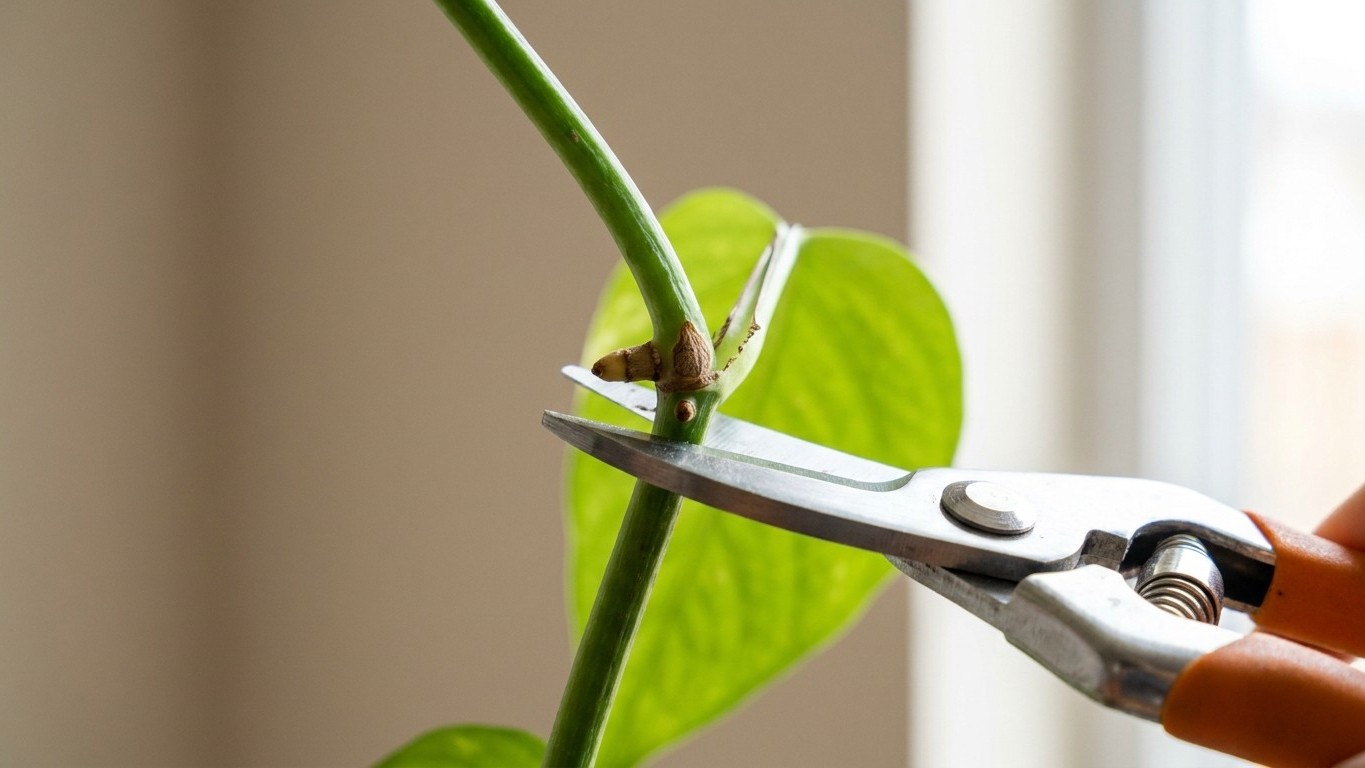
The node is everything. That small, brownish bump or joint along a pothos stem, the spot where a leaf attaches, where an aerial root might emerge — is the single point that determines whether your cut produces new growth or a dead stub. Most houseplant guides mention nodes in passing, as if the location of your scissors is obvious. A nursery grower corrected that assumption for me in about forty seconds, and it changed how my pothos grows.
Key takeaways
- Most people cut pothos between nodes, creating dead stubs that never branch—but there’s a better way
- A nursery grower’s 40-second demonstration reveals exactly where meristematic tissue concentrates and why placement matters
- Three weeks after one properly-placed cut, multiple new stems emerged from a single node on a demonstration plant
The Cutting Mistake Almost Everyone Makes
The default instinct when pruning a pothos is to cut somewhere in the middle of a leggy stem, usually between nodes, because that’s where there’s space and it feels tidy. The result looks clean for about two weeks. Then nothing happens. The cut end dries out, the stub browns, and the plant puts energy nowhere in particular. You’ve essentially created a cul-de-sac.
The problem is that meristematic tissue, the actively dividing cells that generate new shoots, is concentrated at and just below the node, not in the internode space between them. When you cut above a node, leaving a length of bare stem attached to the plant, that stub has no capacity to branch. It will eventually die back to the node anyway, but slowly, and sometimes with rot in humid conditions. You’ve just made the plant do cleanup work instead of growth work.
Cutting at the node, by contrast, means your scissors go directly at that joint, essentially flush with it, or just a few millimeters above. The node on the parent plant is now the terminal point of that stem. With no dead material ahead of it, the plant’s energy has exactly one direction to go: outward, in the form of new lateral shoots. In some pothos varieties, two or even three new stems can emerge from a single node after a clean cut. That’s the branching effect that makes a pothos go from sparse and trailing to genuinely full.
How to Actually Do It (The Nursery Grower’s Method)
The grower’s demonstration was almost comically simple. She held a stem up to the light, identified a node by the slight swelling and the leaf scar, then placed her pruning shears so the blade was right against that joint, not a half-inch above it, right against it. One clean cut. She handed me both pieces: the cutting for propagation, and the parent stem with the node now exposed at its tip.
Within three weeks on her plant (she had a demonstration specimen she’d been working on for months), two new stems had emerged from that node. Her secret wasn’t a fertilizer or a grow light. It was scissor placement, repeated consistently across the plant.
A few practical details matter here. Use sharp, clean scissors or shears, a dull blade crushes the tissue at the node rather than cutting it, which slows the healing process and delays new growth. Wiping blades with rubbing alcohol between cuts also prevents spreading any fungal issues between stems. And timing helps: pothos respond fastest to pruning during their active growing season, roughly spring through early summer, when internal growth signals are already running high.
For the cuttings themselves, each one needs at least one node to root in water or soil, ideally with one or two leaves attached. Strip the leaf closest to the cut end so it doesn’t sit submerged. A pothos cutting with a healthy node can root in water in as little as ten days, and in soil slightly longer but with a root system that adapts better to transplanting.
Why Pothos Stays Sparse Without This
Pothos (Epipremnum aureum) is a vining plant by nature. Left entirely alone, it will produce one long, increasingly leafless stem that trails toward the nearest light source. That’s efficient for the plant in a jungle canopy; it’s less satisfying on a shelf in a living room. The plant has no built-in reason to branch unless it’s prompted. Pruning at the node is that prompt.
There’s a concept in plant physiology called apical dominance: the growing tip of a stem produces hormones (primarily auxin) that suppress the development of lateral buds lower on the plant. When you remove that tip by cutting at a node, the auxin signal drops, and those dormant lateral buds are suddenly free to activate. This is exactly what happens when you cut correctly. The node you’ve exposed becomes the new “tip,” lateral buds wake up, and branching begins.
This is also why pinching the tip alone, without cutting lower on a leggy stem, only helps the very top of the plant. If your pothos is long and bare in the middle, pinching the tip does almost nothing for the lower section. You need to make cuts at nodes throughout the stem to activate dormant buds along its length.
The Longer Game: Building a Full Plant
One pruning session won’t transform a sparse pothos into a bushy one overnight. Three months is a realistic timeline for visible fullness, assuming the plant is getting adequate indirect light and consistent moisture. The grower’s approach was methodical: she identified the three or four longest, barest stems, cut each at a node, then waited before touching the plant again.
Repeated over several rounds of growth, this creates a plant with multiple branching points, each producing its own new stems. The pothos eventually stops looking like a few long ropes and starts looking like a layered, dense specimen. Some growers also pin stems back into the pot, using small hairpin-shaped wire clips, to keep new growth compact rather than immediately trailing again, which further encourages the bushy appearance.
One detail worth knowing: golden pothos and marble queen pothos respond similarly to node pruning, but neon pothos and manjula pothos tend to branch more readily with fewer cuts, partly because their growth habit is slightly more compact to begin with. If you’re working with a particularly slow-growing variety, patience is the variable, the biology is the same, the timeline just stretches.