
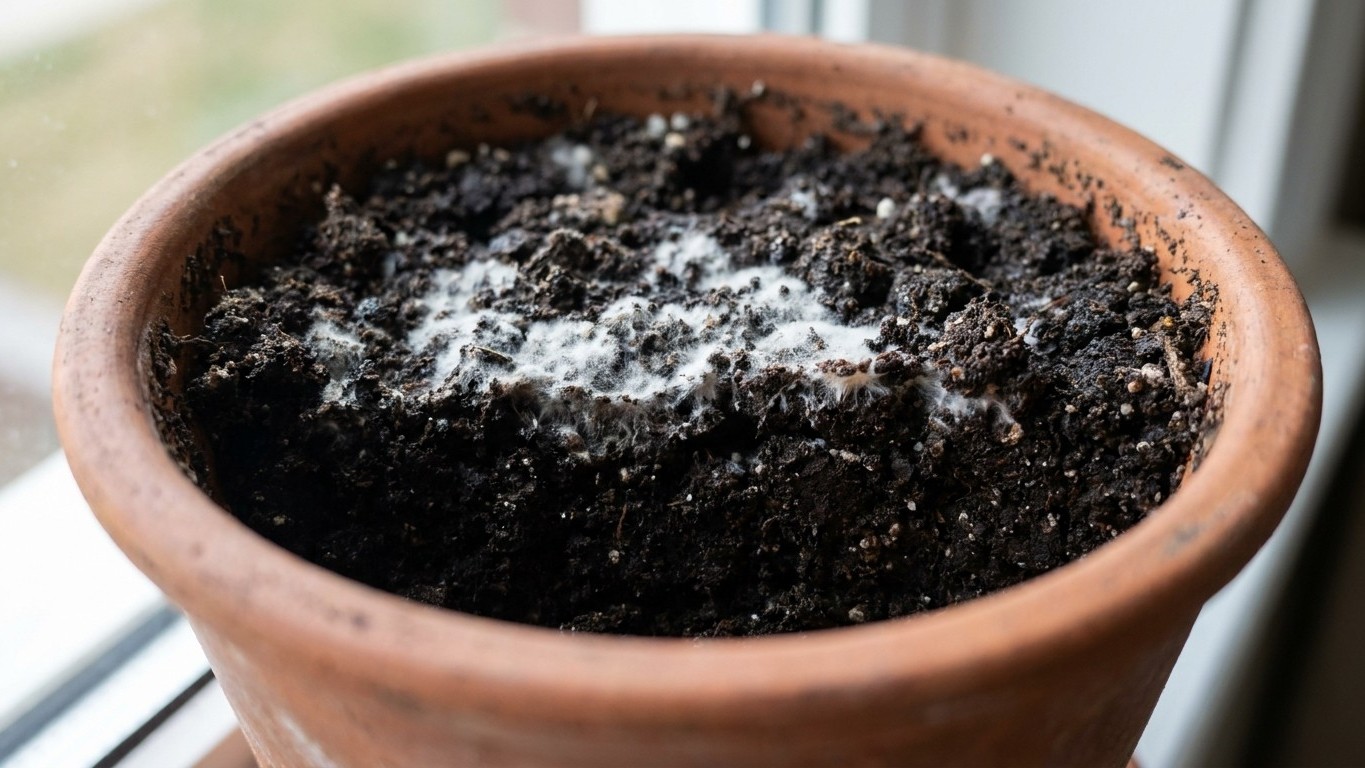
White fuzz. That’s what was staring back at me from under the soil surface when I finally dug into the pot of my fiddle-leaf fig. A thick, fuzzy layer of mold, white at first, shading toward green, had colonized the wet coffee grounds I’d been faithfully spooning in every Monday morning for months. The internet had told me it was a brilliant hack. The soil told me otherwise.
Coffee grounds as a plant amendment have become one of those viral houseplant tips that spreads faster than any fungus ever could. The premise sounds logical: coffee is organic, it contains nitrogen, and it smells earthy. Plants love organic matter and nitrogen. Therefore, add coffee grounds to your plants. It’s the kind of chain reasoning that collapses the moment you look at what’s actually happening beneath the soil.
Key takeaways
- That white fuzzy layer under your soil isn’t supposed to be there—and it’s destroying your plant from the roots up
- Coffee grounds are nearly neutral pH after brewing, not acidic—and the viral myth could be ruining your plants
- One simple drying step most people skip could have prevented months of damage to otherwise healthy houseplants
The Mold Problem Nobody Warns You About
Wet or thick layers of coffee grounds promote mold and fungal growth on the soil surface, impede air circulation, create dampness, and can lead to root rot. That white growth under your soil isn’t a fluke, it’s physics. The most common contaminants of used coffee grounds are trichoderma (forest green mold), cobweb mold, and basic pin molds, all of which appear white during their vegetative stages as mycelium, essentially the “roots” of fungus. Some of these are harmless to humans. For your plants, it’s a different story.
Mold also attracts fungus gnats, which feed on organic matter and plant roots. And once fungus gnats move in, these needle-point-sized flies become more than an annoyance, when they’re done with the moldy grounds, they turn to devouring the plant’s roots, resulting in poor growth, discolored leaves, and leaf drop. A weekly coffee ritual, can quietly unravel months of careful plant care.
The mechanics of why this happens are straightforward. Spreading grounds directly on top of soil creates a dense, water-repellent layer that traps moisture and breeds mold. It also doesn’t release nutrients quickly, since nitrogen in coffee grounds is bound in organic form and must decompose first. You’re not feeding your plant. You’re feeding the fungus.
The pH Myth and Other Misconceptions
One of the biggest reasons people reach for coffee grounds is the belief that they’ll acidify the soil, a boon for ferns, peace lilies, or that temperamental gardenia. The science says: not so fast. Contrary to popular belief, it’s a myth that coffee grounds are acidic and will lower soil pH. After brewing, the grounds are close to pH neutral, between 6.5 and 6.8. Fresh, unbrewed grounds do register acidic — fresh grounds have a pH of 5 to 5.5, while used grounds are near neutral at 6.2 to 6.8. By the time those grounds come out of your coffee maker, most of the acidity has already been extracted into your cup.
Research shows that whatever change coffee grounds bring to the soil pH is short-lived. Don’t depend on them to keep a lower soil pH. Oregon State University soil scientist Linda Brewer put it plainly: “The big message is that generally people are too enthusiastic. You really need to take the recommended dosages to heart. I’ve visited a site where a raised bed was ruined by too much coffee grounds.”
There’s another wrinkle that almost never gets mentioned. As coffee grounds break down, nitrogen is tied up by soil microorganisms using it to grow and reproduce. So during the decomposition window, your plant may actually experience a temporary nitrogen deficit, the exact opposite of what you were trying to achieve. Coffee grounds have been shown to suppress seed germination in many plants and inhibit growth in others, possibly due to toxic substances released as they decompose.
Which Plants Actually Tolerate It, and Which Don’t
Some houseplants are more vulnerable than others. Snake plants prefer dry, neutral soil. ZZ plants store water, making extra moisture a rot risk. Spider plants are sensitive to fluoride and pH shifts. For succulents and cacti, the calculation is even simpler: it’s best to keep coffee grounds and coffee-amended potting soils away from plants that prefer dry soils.
On the more forgiving end, peace lilies, philodendrons, Chinese evergreens, Boston ferns, and monsteras tolerate slightly acidic, nitrogen-rich soil, though even for these, the method of application matters enormously. And coffee grounds are too acidic for epiphytes like orchids, causing root rot; even though coffee contains nitrogen orchids need, their roots cannot absorb it, leading to further rotting.
Fresh coffee grounds, specifically, are highly acidic and rich in caffeine that can burn plant roots. If you’ve been tossing your grounds in straight from the coffee maker, still warm, still wet, that’s the highest-risk scenario.
How to Actually Use Coffee Grounds Without Wrecking Your Plants
The safest route, consistently supported by agronomists and extension services, is composting before application. One of the best uses of coffee grounds is in composting. As a “green” compost material, coffee grounds contribute nitrogen to a compost pile, which is vital for the microbial activity that breaks down organic matter into rich compost. Once fully composted, the grounds no longer pose a mold risk, and their nutrients become bioavailable in a form plants can actually use. Turn the compost weekly to prevent mold. After four to six weeks, you’ll have rich compost to mix into your potting soil.
If you want to use grounds more directly, dilution is the key. For liquid application, dilute brewed coffee significantly, one part coffee to three to four parts water, or until it resembles weak tea — and use this diluted solution sparingly, perhaps weekly. For dry grounds mixed into soil, up to 10% coffee grounds in potting mix can improve aeration and nutrient retention, for the right plants. More than that, and you’re pushing into harmful territory. In a compost pile, coffee grounds should make up no more than 20% of the total volume, as higher amounts can be toxic to plants.
Dry used grounds thoroughly before application to minimize mold risk. That detail alone, drying the grounds on a sheet pan before use, would have saved my fiddle-leaf fig from its fuzzy ordeal. It sounds almost too simple. But the gap between “coffee is good for plants” and “here’s how to actually apply it without causing damage” is exactly where most houseplant advice falls apart. What the viral posts rarely mention: coffee grounds are not a substitute for a balanced fertilizer program. They offer minor nutrient contributions and soil amendment benefits, but lack all the necessary nutrients for robust growth. Use them as an occasional supplement, not a strategy.
Sources : news.oregonstate.edu | gardeningchores.com