
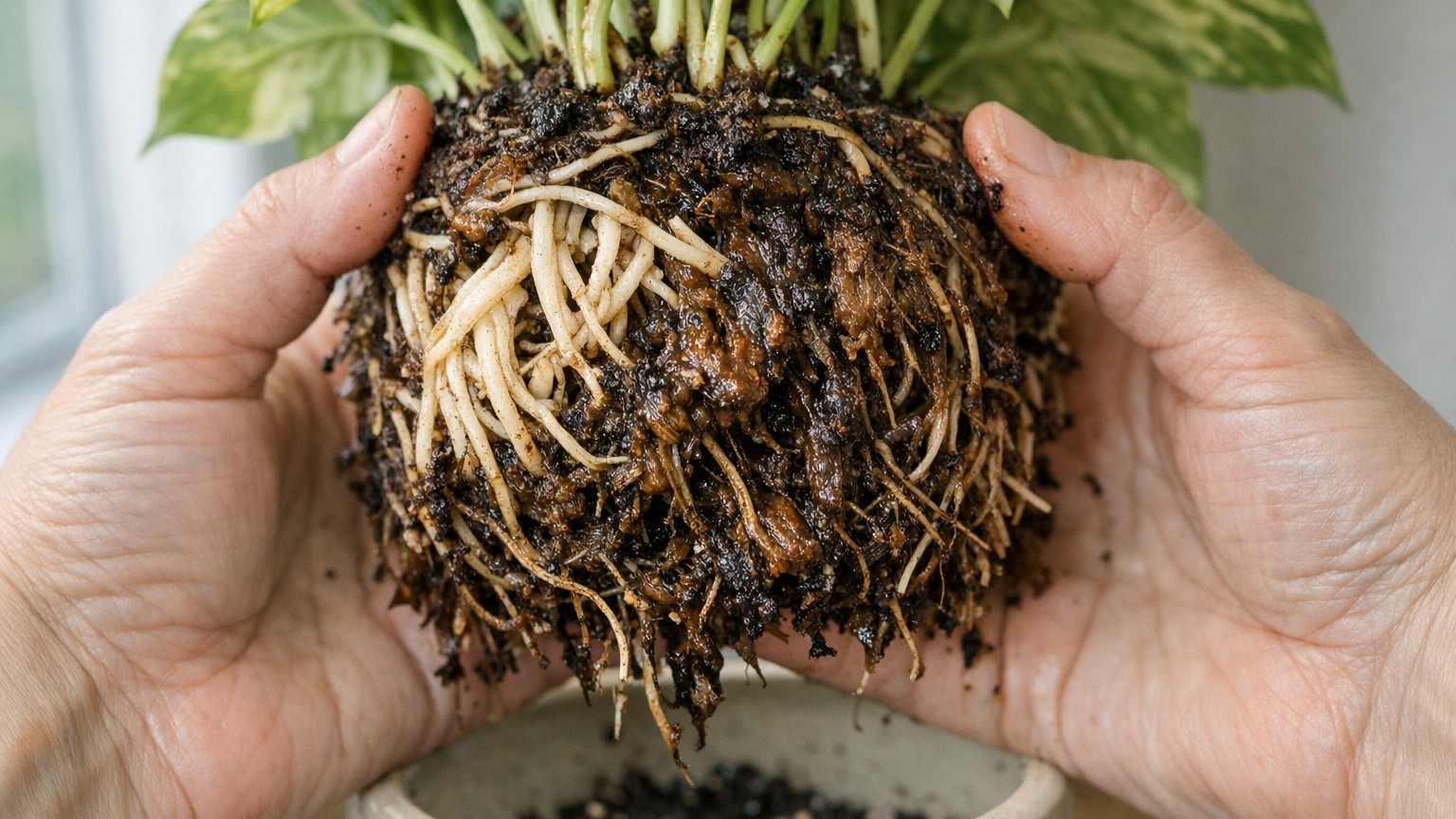
Root rot doesn’t announce itself. One day your pothos looks a little tired, the next the soil smells off, and by the time you actually pull the plant out of the pot, there’s almost nothing left to save. The scenario is heartbreakingly common: someone upgrades their pothos to a larger pot, good intentions, genuine care, and three weeks later discovers a tangle of brown mush where healthy white roots should be. The pot was bigger. The problem got worse. That’s the paradox nobody warns you about when you first start growing houseplants.
Key takeaways
- A larger pot holds more soil moisture, which can suffocate roots faster than you’d expect
- Yellow leaves are a misleading signal—most people repot at exactly the wrong time
- Root rot in pothos happens silently; by the time leaves show damage, it’s often too late to save
Why a Bigger Pot Can Actually Kill Your Pothos
Pothos, like most tropical aroids, have a complicated relationship with soil moisture. Their roots need oxygen as much as they need water, and when the growing medium stays wet for too long, the roots suffocate and begin to decompose. A larger pot holds significantly more soil volume, which means more moisture retained, for longer, with every single watering. If the root system isn’t large enough to absorb that water quickly, it just sits there. Stagnant. Waiting to cause damage.
The rule of thumb that experienced growers use is simple: only go up one pot size at a time, and only when the plant is genuinely root-bound. “Root-bound” means roots visibly circling the drainage holes, or a dense root mass that holds the entire soil ball together when you unpot the plant. A few roots peeking out the bottom? That’s not distress, that’s just growth.
Moving a pothos with a modest root system into a pot that’s two or three sizes larger creates what growers call “overporring syndrome”, though the real culprit is excess soil volume around underdeveloped roots. The plant can’t regulate moisture through its roots fast enough, and Pythium and Phytophthora, the fungal-like organisms most responsible for root rot in houseplants, thrive in exactly those warm, waterlogged anaerobic conditions.
How to Actually Read Your Pothos Before Repotting
Yellowing leaves are the signal most people respond to, and they almost always misread it. Yellow leaves on a pothos can mean a dozen different things: low light, nutrient deficiency, overwatering, underwatering, or natural leaf aging at the base of the plant. Repotting is rarely the right response to yellowing leaves alone.
The correct way to assess repotting readiness is physical. Unpot the plant gently and examine the root ball. If the soil falls away easily and you see mostly dark, loose growing medium with a sparse root network, the plant needs more time in that pot, not a larger one. Healthy pothos roots are white to pale cream, firm to the touch, and faintly waxy. Any roots that appear brown, feel mushy, or smell sour are already compromised.
Timing matters too. Spring and early summer, when daylight hours are longer and the plant’s metabolism is more active — give repotted plants the best recovery window. Repotting in late fall or winter, when growth slows dramatically, means the roots sit in fresh damp soil with very little activity to drive moisture uptake. That’s a recipe for the exact situation described above: a pot of wet soil slowly destroying a root system over three weeks, while the leaves above show almost no outward sign of trouble until it’s too late.
What to Do When Root Rot Has Already Started
The prognosis depends entirely on how much of the root system is still viable. Pull the plant out, rinse the roots under room-temperature water, and cut away every compromised root with clean scissors or pruning shears, sterilized with rubbing alcohol between cuts. What you want to keep is anything white, firm, and clearly alive. What you remove is everything brown, black, mushy, or hollow. Be aggressive. Leaving even a small section of rotted root in contact with healthy tissue gives the pathogen a foothold to continue spreading.
After trimming, let the root ball air-dry for 30 to 60 minutes before repotting. Some growers dust the cut ends with powdered cinnamon (a mild antifungal) or a diluted hydrogen peroxide solution, about 3% concentration, the kind available at any pharmacy. Neither is a guaranteed cure, but both reduce the microbial load at the wound sites. Repot into fresh, well-draining mix (a combination of standard potting soil with added perlite works well), and choose a pot that’s appropriately sized for what’s left of the root system, not what it was before trimming.
Then water sparingly. The plant has fewer roots than before and genuinely cannot absorb much. Let the top two inches of soil dry out completely between waterings, and keep the plant in bright indirect light to support recovery without additional heat stress.
The Broader Lesson About Houseplant Care
There’s a tendency to equate action with care when it comes to houseplants. More water, bigger pot, fresh soil, it feels like doing something. But pothos, which grow natively across forest floors in Asia and the Pacific Islands, are adapted to lean conditions, intermittent moisture, and frequent drying out between rains. The plant that thrives on a forgotten shelf is the same plant that quietly drowns in a well-intentioned oversized pot.
The data from the University of Florida’s extension program on container gardening supports what experienced growers already know: container size is one of the most frequently mismanaged variables in houseplant care, with larger containers cited as a contributing factor in overwatering-related root decline across multiple tropical species.
Pothos are often called “unkillable.” They’re not. They’re forgiving, which is different. And the gap between those two things is exactly where root rot lives.