
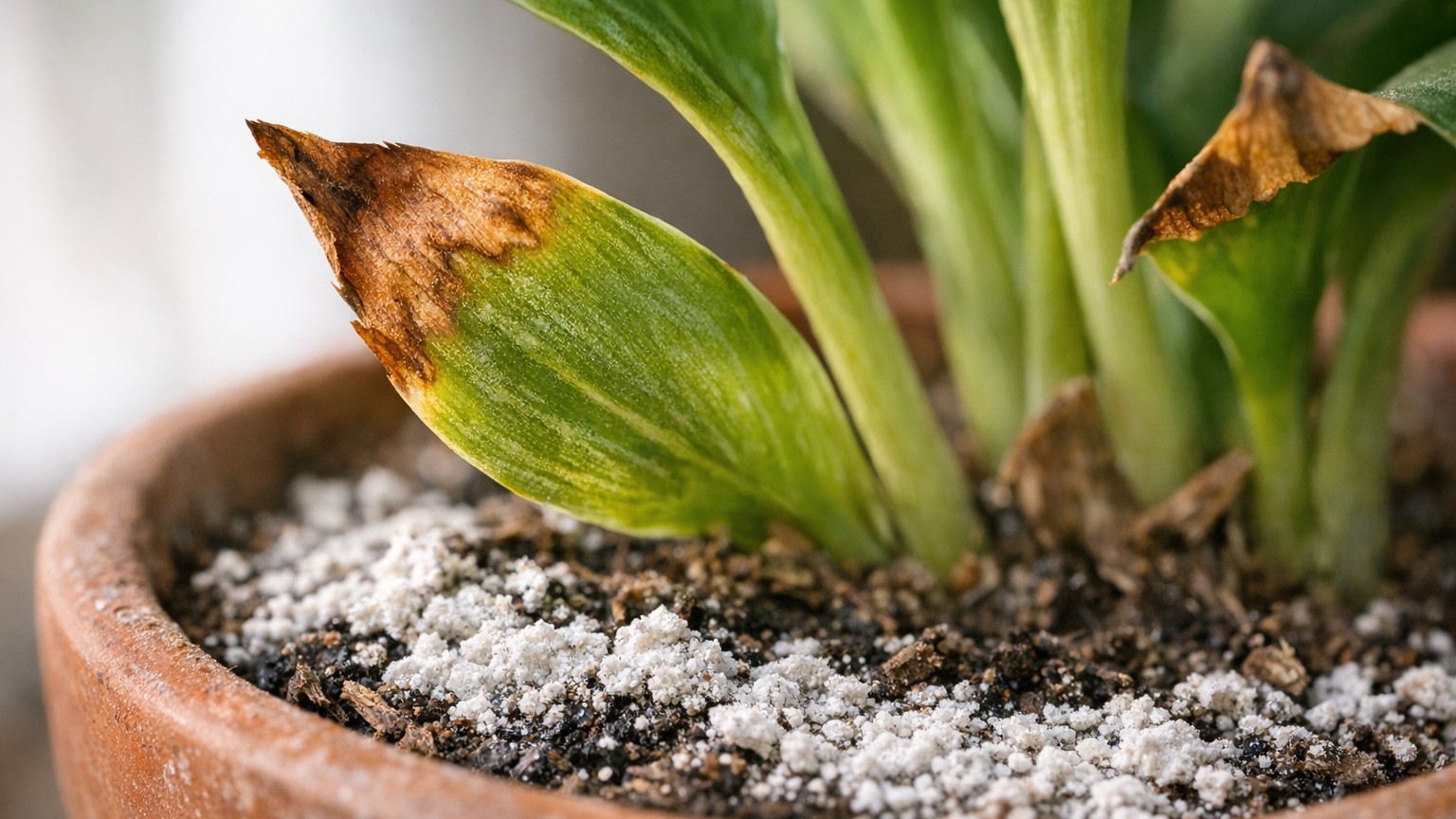
Brown leaf tips on houseplants are one of the most common complaints among indoor gardeners, and most of us spend months blaming the wrong culprit. Too much fertilizer, too little humidity, drafts from the windows, the usual suspects get cycled through while the real problem keeps flowing silently from the faucet. The white crust forming on the surface of potting soil is a direct clue, and once you understand what it’s made of, the brown tips start making perfect sense.
Key takeaways
- Municipal tap water leaves mineral deposits that accumulate in soil and starve roots of water absorption
- Leaf tips brown first because they’re the last stop on the plant’s water highway—the first sign something’s wrong underground
- Fluoride-sensitive plants like spider plants and peace lilies show toxicity symptoms specifically as brown tips, not whole-leaf damage
What That White Crust Is Actually Telling You
Municipal tap water in most American cities contains dissolved minerals, primarily calcium and magnesium carbonates, along with trace amounts of fluoride and chlorine added during treatment. When you water your plants, the water is absorbed or evaporates, but the minerals stay behind. Over weeks and months, they accumulate on the soil surface and along the inner rim of the pot, forming that chalky white or yellowish crust. In areas with hard water, which according to the U.S. Geological Survey covers roughly 85% of the country, this process happens faster than most people realize.
The visual buildup is only half the story. Beneath the surface, those same mineral salts are accumulating throughout the root zone. At high enough concentrations, they create a phenomenon called osmotic stress: the salinity around the roots becomes so elevated that the plant struggles to absorb water normally, effectively experiencing drought even when the soil is damp. The roots, unable to draw moisture efficiently, fail to hydrate the leaf tips, the furthest points from the root system, and those tips die back and turn brown.
Why Leaf Tips Specifically, and Not the Whole Leaf
Leaf tips are physiologically the last stop on the plant’s water highway. When water and nutrients travel from roots through stems and into leaves, they move toward the tips via a process called transpiration pull. The tips receive water last. Any disruption to water uptake, whether from mineral buildup, root rot, or compacted soil, shows up there first, before the rest of the leaf is affected. This is why brown tips appear uniformly across a plant even when only some roots are compromised.
Fluoride sensitivity adds another layer to the problem. Several popular houseplants, including spider plants, peace lilies, and dracaenas, are genuinely sensitive to fluoride at the concentrations found in treated municipal water (typically 0.7 milligrams per liter, the level recommended by the CDC for dental health). These plants show fluoride toxicity primarily as brown leaf tips and margins, a symptom so specific that some botanists use it as a diagnostic marker. If your dracaena or spider plant has been tipping brown despite careful watering habits, fluoride is the more likely culprit than calcium buildup.
Fixing the Problem Without Overthinking It
Switching to filtered or purified water is the most effective fix, but not the only one. Leaving Tap Water to sit uncovered overnight in a watering can allows chlorine, a volatile compound, to off-gas naturally. This reduces one variable, though it does nothing for calcium, magnesium, or fluoride, which are dissolved minerals and don’t evaporate. For fluoride-sensitive plants, collected rainwater is genuinely the gold standard: it’s naturally soft, free of treatment chemicals, and slightly acidic in a way that mirrors the native soil conditions of many tropical houseplants.
Flushing the soil periodically matters just as much as changing your water source. Every two to three months, take pots to the sink or outside and run water slowly through the soil for several minutes, allowing it to drain freely from the bottom. This leaches accumulated salts out of the root zone before concentrations reach damaging levels. Nursery professionals do this routinely as part of plant maintenance, it’s a simple practice that most home growers skip entirely because nobody ever mentions it.
For pots that have already developed the white crust, scraping off the top inch of soil and replacing it with fresh potting mix removes the heaviest mineral concentration. The crust itself isn’t dangerous to touch, but leaving it in place means every subsequent watering pushes those salts further down into the root zone. Replacing the top layer Costs Almost Nothing and immediately improves conditions for the roots.
The Plants Most and Least Bothered by Hard Water
Not all houseplants react equally. Succulents and cacti, which evolved in mineral-rich desert environments, tolerate hard tap water with little complaint, their roots are adapted to high-solute conditions. Many pothos varieties, often described as nearly indestructible, also handle average tap water without significant tip browning. On the other end of the spectrum, calatheas, peace lilies, spider plants, and most ferns are visibly sensitive to mineral accumulation and fluoride. These are the plants that will always perform better with filtered or rainwater, regardless of your humidity levels or fertilizer routine.
One detail worth knowing: distilled water, while completely mineral-free, isn’t necessarily ideal for long-term use on its own. Used exclusively over many months, it can gradually deplete certain trace minerals from the potting mix that plants do need in small quantities. The practical approach most experienced indoor gardeners use is alternating, rainwater or filtered water most of the time, with an occasional watering of diluted liquid fertilizer to replenish micronutrients. The goal isn’t sterile water; it’s water that doesn’t actively work against the plant.