
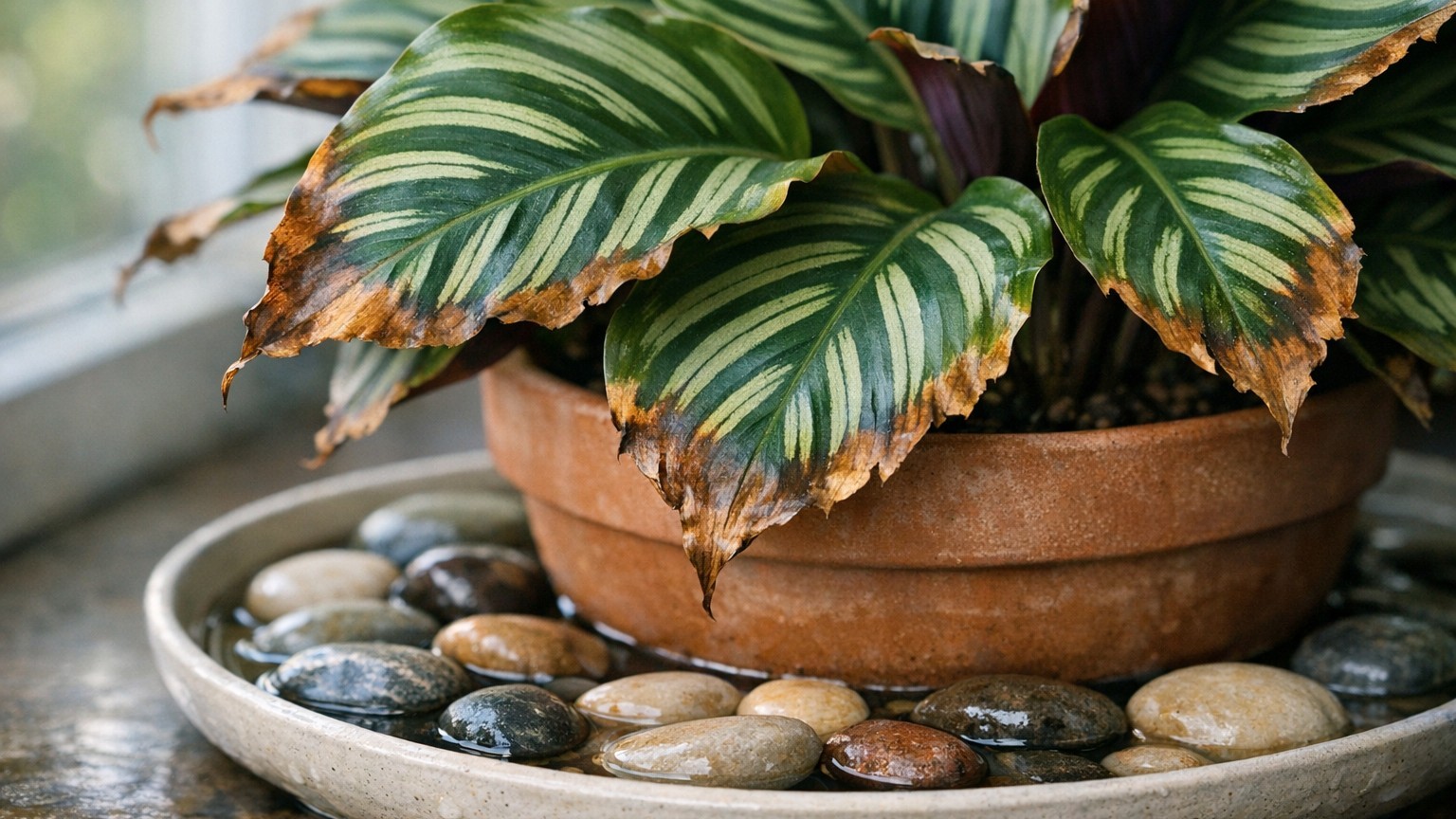
Pebble trays are one of the most widely repeated pieces of houseplant advice on the internet. Fill a shallow tray with gravel, add water just below the surface, set your pot on top, and watch your tropical plants thrive. The logic sounds solid, water evaporates, humidity rises, plant is happy. For years, that’s exactly what I did. Diligently. Almost obsessively. Then I bought a cheap hygrometer and held it about two inches above the tray. The reading: 42% relative humidity. My living room, without any tray at all, measured 40%.
Two percentage points. That’s what years of pebble tray maintenance had actually delivered.
Key takeaways
- A hygrometer test revealed an uncomfortable truth about the most popular houseplant advice online
- Physics explains why your water tray can’t compete with thousands of cubic feet of air in your living room
- Calatheas and ferns are suffering for a reason that has nothing to do with your watering technique
Why pebble trays barely move the needle
The physics here are worth understanding, because they explain a lot. Evaporation from a small, static water surface is a slow process, and humidity, unlike heat, doesn’t stay put. It disperses almost immediately into the surrounding air volume. A pebble tray might hold half a cup of exposed water surface. The average living room contains somewhere between 8,000 and 15,000 cubic feet of air. That tray is fighting an uphill battle against an enormous atmospheric sink, and it’s losing every time.
Research from plant physiology labs has consistently shown that localized evaporation sources need to be substantial and sustained to affect the humidity experienced at leaf level. A study frequently cited in horticultural education points out that the microclimate directly above a pebble tray, within an inch of the water surface, can register 5 to 8 percentage points higher than ambient air. But at the height of actual foliage, which sits several inches above that water surface (elevated by the pot itself), the effect essentially vanishes into background noise.
This matters because tropical plants like monsteras, calatheas, ferns, and anthuriums typically want 60–80% relative humidity. Most U.S. homes in winter hover between 25% and 45%. A pebble tray bridging that gap is a bit like trying to heat a swimming pool with a birthday candle.
The specific plants most likely to suffer despite your best efforts
Calatheas are the canary in the coal mine. Brown crispy leaf edges on a calathea almost always signal humidity stress before they signal watering problems, and their leaves are sensitive enough that growers sometimes use them as informal humidity indicators. If your calathea has crispy tips even though you water consistently and keep the tray full, the tray isn’t failing because you’re doing it wrong. It’s failing because the method has real physical limits.
Ferns tell a similar story. Boston ferns, maidenhair ferns, and staghorn ferns all evolved in environments where the air is permanently saturated, rainforest floors, cliff faces near waterfalls, dense canopy undergrowth. Placing them in a 40% humidity apartment with a pebble tray underneath is roughly equivalent to moving a polar bear to Miami and giving it a small ice cube to sit on. The intent is kind. The outcome is predictable.
Orchids are a slightly different case. Epiphytic orchids like Phalaenopsis actually tolerate lower humidity better than most people assume, which is why they survive in typical home conditions at all. But their roots do benefit from intermittent humidity cycles, which good air circulation and occasional misting can provide more effectively than a static tray.
What actually works, and by how much
A room humidifier is the only intervention that reliably moves humidity into a range tropical plants can use. Ultrasonic humidifiers, the kind that produce a cool mist, can raise a medium-sized room from 40% to 65% within a few hours. That’s not a marginal improvement, it’s the difference between a plant that survives and one that genuinely grows. The downside is the maintenance: ultrasonic units require distilled water to prevent white mineral dust from coating every surface nearby, and the reservoir needs cleaning every few days to prevent mold growth.
Grouping plants together does produce a measurable, if modest, effect. Plants transpire water vapor through their leaves, and a dense cluster of foliage creates a shared microclimate. Studies measuring humidity within dense indoor plant groupings have found increases of 3 to 10 percentage points compared to isolated specimens in the same room. Not transformative, but real, and it stacks with other methods.
Placing plants in bathrooms or kitchens is underrated. A bathroom that sees two showers a day routinely hits 70–80% humidity during and after use, the kind of humidity a calathea would consider mild. The catch is light: most bathrooms lack the bright indirect light tropical foliage plants need. A grow light installed near a bathroom window can resolve that conflict entirely, turning an otherwise wasted wall into a genuinely viable plant habitat.
Some growers swear by enclosed plant cabinets or IKEA greenhouse cabinets (the Milsbo unit became a cult object in houseplant communities for exactly this reason). Seal a glass cabinet around your most humidity-hungry plants, add a small ultrasonic humidifier inside, and you can maintain 70%+ humidity continuously without affecting the rest of your home. It’s a more committed solution, but for maidenhair ferns or rare aroids, it’s often the only one that actually keeps the plant alive long-term.
The pebble tray isn’t completely useless, to be fair. It does protect surfaces from drainage water, prevents the pot from sitting in standing moisture (which would rot roots), and contributes that negligible 1–2% bump. Just don’t expect it to carry the humidity load. Treat it as a drainage solution that happens to evaporate, rather than a humidity solution that happens to drain, and your expectations, and your plants, will be better for it.