
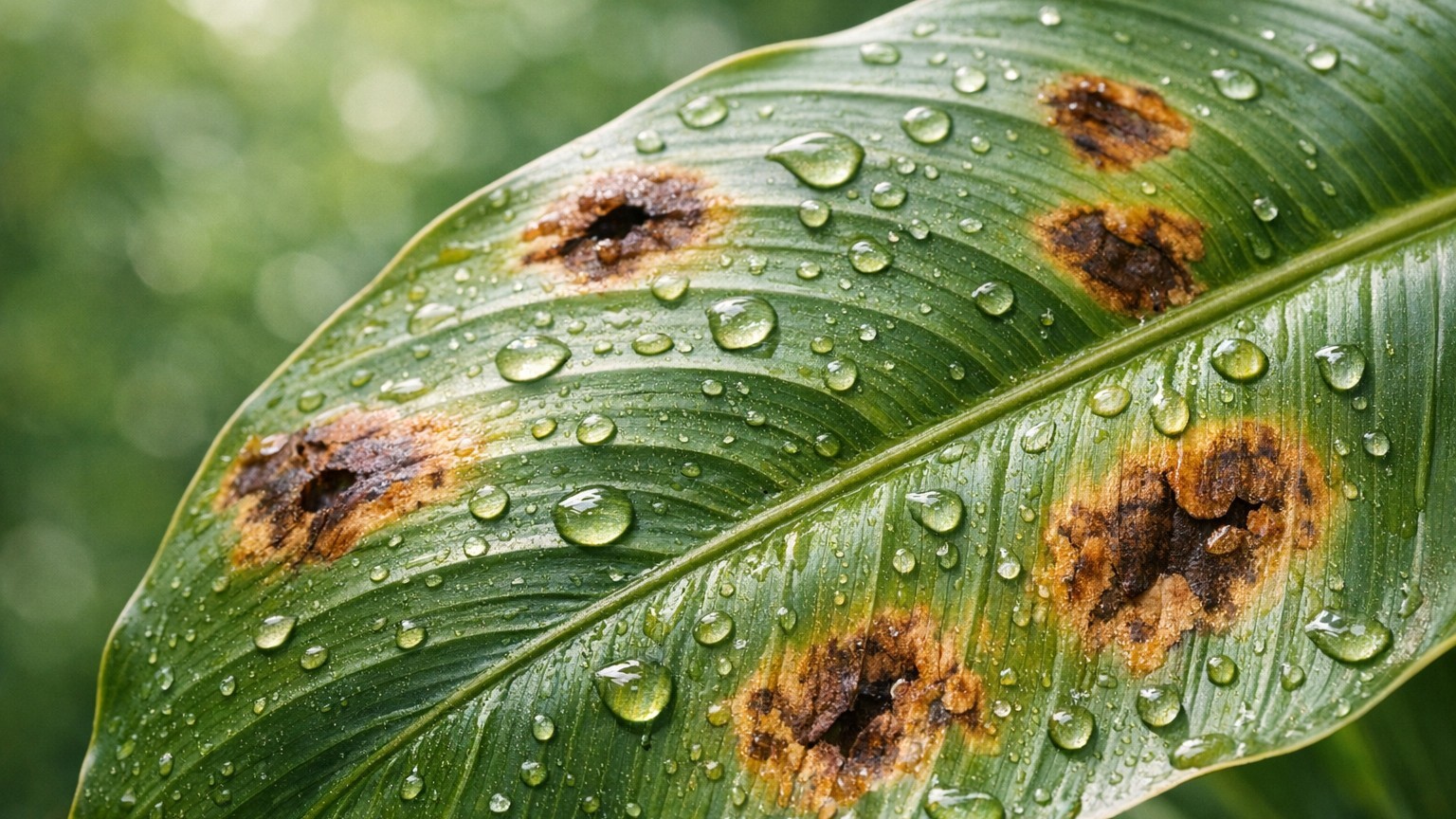
Brown spots on tropical houseplants are one of the most common complaints among indoor gardeners, and for years, the leading suspect is usually low humidity. The instinctive fix? A spray bottle. Mist the leaves every morning, recreate that misty jungle atmosphere, and watch the plant thrive. Except the spots kept coming. More brown edges, more crispy patches, more frustrated Googling. The misting wasn’t helping. It was, in many cases, making things actively worse.
Key takeaways
- Water droplets on leaves concentrate heat like tiny magnifying lenses, causing localized cell damage and brown spots
- Wet leaf surfaces are breeding grounds for fungi and pathogens that thrive in moisture—the opposite of what you intended
- True humidity control requires humidifiers, plant grouping, or pebble trays—not spray bottles
What the Droplets Actually Do to a Leaf
A botanist friend put it plainly during a visit to my apartment: “You’re not watering the humidity. You’re watering the surface.” That distinction sounds subtle, but physiologically, it changes everything. When water droplets sit on a leaf, they don’t evaporate instantly. Depending on air circulation and ambient temperature, a fine mist can linger on the leaf surface for 30 minutes to several hours. During that window, the droplet acts as a tiny magnifying lens under direct or indirect light, concentrating heat onto the tissue beneath and causing localized cell damage. The result? Exactly those pale, scorched-looking spots that had me blaming my window’s light exposure for months.
The second mechanism is biological. Standing water on a leaf is essentially a five-star resort for fungal pathogens. Botrytis, powdery mildew, and various leaf spot fungi require moisture to germinate and spread. A study published through the American Phytopathological Society has documented how leaf wetness duration is one of the primary predictors of fungal infection severity in tropical species. Each morning misting session, repeated religiously, was creating exactly the humid leaf surface conditions these organisms need to establish themselves. The brown spots weren’t a humidity deficiency. They were a fungal calling card.
There’s also a third, less discussed issue: tap water chemistry. Most municipal water contains chlorine, fluoride, and dissolved mineral salts. When droplets evaporate from a leaf, those minerals don’t vanish with the water. They stay behind, accumulating in tiny deposits that gradually damage the waxy cuticle layer plants use to regulate water loss. Over months, this shows up as white residue, then as brown, papery patches where the protective layer has broken down. Filtered water reduces this, but it doesn’t solve the core problem of misting itself.
The Humidity Myth Tropical Plants Can’t Escape
The logic behind misting was never entirely wrong. Tropical plants genuinely do prefer higher relative humidity, typically between 50% and 70% for species like monsteras, calatheas, and anthuriums. The error is in assuming that spraying the leaves delivers that. It doesn’t. A single misting session raises the ambient humidity of a room by a fraction of a percent for a matter of minutes. The surrounding air re-equilibrates almost immediately. You’d need to mist constantly, throughout the entire day, to meaningfully shift the room’s humidity baseline, which would guarantee the fungal problems described above.
What actually moves the needle on humidity is something far less dramatic. A humidifier running at consistent intervals in the same room as your tropicals will hold the air moisture at a steady level without ever wetting the leaf surface. Grouping plants together raises local humidity through their collective transpiration. Even a shallow tray filled with pebbles and water placed beneath a pot, kept below the drainage holes, generates a continuous low-level evaporation zone around the plant. None of these approaches are as satisfying as the ritual of the spray bottle, but they work on the physics of air, not the surface of a leaf.
How to Actually Read What Your Plant Is Telling You
Brown spots are not a monolith. The shape, location, and texture of a brown patch tell a genuinely different story depending on the cause, and misreading them leads to the wrong fix. Crispy brown edges that march inward uniformly across a leaf almost always signal low humidity combined with underwatering or excessive airflow from a vent. Scattered brown spots with a yellow halo are the signature of a fungal or bacterial infection. Pale, bleached patches with a slightly translucent quality tend to indicate sunburn or, as described, light concentration through water droplets. Dark, mushy brown areas at the base of a stem are rot, usually from overwatering.
Calatheas deserve a specific mention here because they’re frequently sold as “high humidity plants” that beginners immediately start misting. Their broad, decorative leaves are particularly vulnerable to fungal leaf spot, and they’re sensitive enough to water chemistry that even a few weeks of tap water misting can cause visible mineral damage. They respond better to a pebble tray and filtered water at the roots than to any amount of surface spraying. The dramatic leaf movement they do overnight, curling and unfurling in a process called nyctinasty, is often mistaken for a humidity distress signal. It isn’t. It’s just what they do.
Rethinking the Spray Bottle
The spray bottle isn’t useless. It has legitimate applications in houseplant care: rinsing dust off large-leafed plants like ficus or bird of paradise (followed by air-drying in good circulation), applying diluted neem oil or insecticidal soap to combat pest infestations, and misting the aerial roots of orchids, which actually do absorb moisture directly. What it cannot do is substitute for ambient humidity management. That requires infrastructure, not ritual.
Switching from daily misting to a small ultrasonic humidifier set to 55% in my plant corner produced visible results within six weeks. New leaves on a previously struggling monstera came out without the brown tips that had become expected. The calathea stopped developing spots. The only thing that changed was moving the moisture from the leaf surface into the air around it. One small shift in understanding, years of better results.
The spray bottle habit persists partly because it feels productive and partly because it was passed down through decades of houseplant advice that predated modern understanding of fungal pathogen dynamics. Interestingly, commercial nurseries rarely mist their foliage plants this way. They use overhead misters set on timed cycles with strong horizontal airflow to dry leaves quickly, a system specifically engineered to avoid the moisture accumulation that hobbyists recreate accidentally every morning at the kitchen sink.