
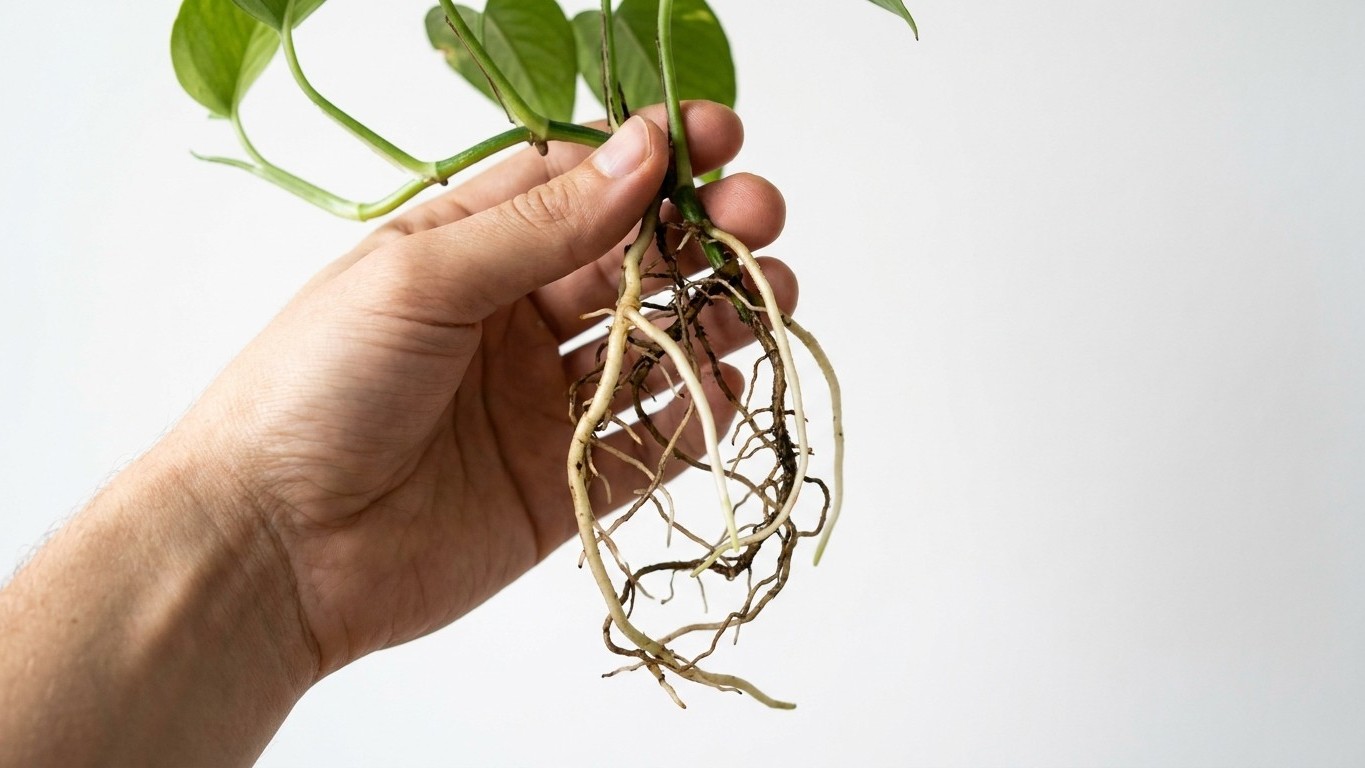
Three weeks after potting a water-rooted pothos cutting, I tipped the pot over to check on it, expecting a tangle of healthy white roots gripping the soil. What I found instead was a mix of collapsed, blackened threads at the base and a handful of stubby new growth pushing out just above them. The cutting hadn’t died. But it had clearly gone through something rougher than the label on a bag of potting mix ever suggests.
That gap between what we expect and what actually happens underground is the part nobody shows you in the glossy propagation photos. The jar of water with roots dangling like tiny chandeliers looks like the hard part is over. It isn’t.
Key takeaways
- Water roots are fragile and adapted only to dissolved oxygen, not soil moisture
- Transplanting triggers wilting and yellowing as the plant simultaneously maintains old roots while growing new ones
- The blackened, collapsed roots you find weeks later aren’t a failure—they’re evidence the plant survived the transition
Water roots and soil roots are not the same organ
The roots a pothos grows in a glass of water are built for that environment and nothing else. Water roots are thinner, paler, and adapted to dissolved oxygen, while soil roots are thicker and designed to pull from a denser medium. That’s not a cosmetic difference. It’s the reason so many water-propagated cuttings sail through the rooting stage and then stall, wilt, or rot within days of hitting soil.
A plant consultant explained the mechanism plainly on a gardening forum: roots grown in water have a different cell structure than roots grown in soil, which is why cuttings in water don’t rot even though they’re surrounded by water, but soil-grown roots will rot if the soil is constantly wet. Flip a water root into soil and you’ve essentially asked a fish to breathe air. It might adapt. It might not.
Handling makes things worse before they get better. The problem with rooting plants in water and then transplanting to soil is that water-grown roots are very fragile and easily broken, while roots formed in soil have to be tough because it’s a rough and rocky world inside a pot of soil. Simply pressing potting mix around a water-rooted stem can snap off a good portion of the root hairs you spent weeks growing. You never see it happen. You just see the aftermath three weeks later.
What’s actually happening in those first weeks in soil
The wilting that shows up a day or two after transplanting isn’t a mystery, it’s physics. The plant will look slightly wilted in the first 24 to 48 hours after transfer because it’s adjusting to soil moisture absorption after the constant supply it had in water. In a jar, roots are bathed continuously. In a pot, they have to work for every drop, pulling moisture from particles rather than floating in it.
Underneath the surface, the plant is essentially running two projects at once: trying to keep the fragile water roots functional long enough to matter, while pushing out entirely new root tissue better suited to solid ground. Water-started plants produce roots more quickly, but the resulting roots aren’t as well-adapted to living in earth, so it takes them longer to become established once transplanted, whereas plants started in soil take longer to root but establish and grow faster once they do. That’s the trade nobody mentions when they hand you a rooted cutting in a jar: speed now, or resilience later. Rarely both.
This is also why yellowing leaves after a water-to-soil move don’t always mean disaster. On the same forum thread, an expert reassured a worried grower that if the roots aren’t too badly damaged, the plant may struggle but should be fine with proper care, and it’s even possible to root cuttings directly in soil instead. The plant isn’t dying. It’s rebuilding its plumbing from scratch, and that takes visible energy away from the leaves for a while.
What I’d do differently next time
Timing turned out to be the real culprit in my case, not bad luck. Waiting too long in water lets roots grow long, tangled, and increasingly brittle, exactly the roots least likely to survive a rough transplant. Water propagation is a good starting point for watching the process, but cuttings should be transplanted before roots exceed about two inches to avoid the fragile water-root transition. Mine had gone well past that, closer to four inches, because they looked so satisfying dangling in the jar that I kept putting off the move.
The soil itself matters just as much as the timing. A loose, chunky mix gives young, damaged roots room to breathe instead of sitting in compacted, waterlogged ground while they try to regenerate. A well-draining potting mix with added perlite, damp enough to hold together when squeezed but not dripping, should be backfilled around the rooted cutting. Watering habits need to shift too. The instinct after seeing a wilted plant is to drown it in water, which is exactly backwards. Overwatering to compensate should be avoided; instead, wait until the top two to three centimeters of soil are dry before watering again.
If I’m honest, the simplest fix is the one most water-propagation tutorials skip entirely: skip the jar phase for anything beyond a few days of admiring root nubs, and either root the cutting straight in a chunky, well-aerated mix or move it to soil the moment those first roots appear rather than waiting for a jungle to develop underwater.
The upside nobody talks about
Here’s the part that actually surprised me once I stopped panicking about the blackened roots: the new growth I found wasn’t random. It had emerged from the same nodes as the dying water roots, essentially using the old root’s position as a launchpad. Pothos roots grow from nodes in the stem, the area where the leaves emerge, and a node that’s already proven it can generate roots in water will typically do it again in soil, just with a different, tougher version of the same structure.
Three weeks later, the plant I nearly declared a failure had three new, pale but firm roots gripping the mix, alongside the collapsed remains of its water roots still tangled at the base. Nobody tells you to expect a graveyard of old roots sitting right next to the new ones doing the actual work, but that’s what a successful transition often looks like from underneath. The dead tissue isn’t a verdict. It’s just the receipt for a trade the plant already made.
Sources : quora.com | bloomingexpert.com