
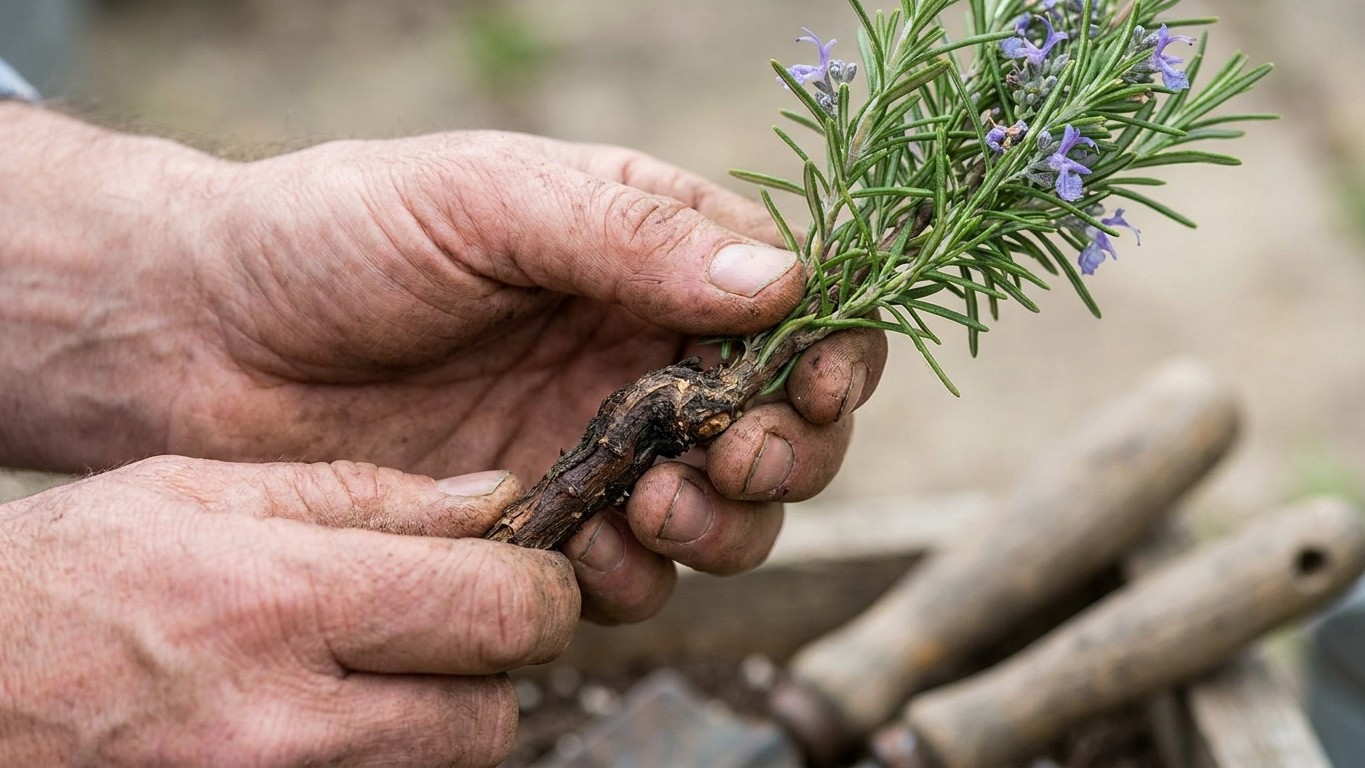
My grandmother’s rosemary hedge produced more cuttings than she ever had pots for, and every single time she reached for the pruners, she did the same odd little move: instead of snipping a clean stem, she’d pull a small side shoot away from the main branch so a thin strip of the old, woody bark came with it. I used to tease her about it, this tiny scrap of “heel” she’d sometimes trim into shape before planting. It looked fussy, unnecessary, like a superstition passed down with no real reason behind it. It wasn’t. That little heel of old wood is doing real botanical work, and once you understand why, you’ll probably start doing it too.
Key takeaways
- A grandmother’s ‘fussy’ pruning habit reveals deep botanical knowledge about plant chemistry
- That tiny heel of old wood isn’t decoration—it’s where the plant hides its rooting power
- Rosemary refuses to root like basil does, and there’s a surprising reason hidden in its woody stems
What a Heel Cutting Actually Does
The heel isn’t decoration. It’s a strip of older wood pulled away with the young shoot, and it exposes something specific: the cambium layer, the thin ring of actively dividing cells that sits just under the bark. This anatomical feature plays a significant role in cutting propagation, as it contains a higher concentration of growth hormones and cells that are more likely to develop into roots. my grandmother wasn’t being fussy. She was giving the cutting a running start.
Gardeners typically reach for this trick with plants that are notoriously reluctant to root from a plain, straight-cut stem. When taking cuttings of difficult to propagate plants, especially in the semi-ripe and hardwood stages, it is often necessary to take a special step to encourage root formation, and there are two choices: wounding and heel cutting. Both techniques help roots form by exposing the cambium layer of the stem, where undifferentiated cells will grow into roots, and removing the bark also helps prevent it from becoming a physical barrier to root growth. Rosemary, with its woody, almost shrub-like stems, falls squarely into that “difficult” category once the growth matures past the soft, green stage.
Why Rosemary Fights You on This
Here’s the part that took me years to appreciate: rosemary isn’t basil. It doesn’t throw roots into a glass of water within a week just because you wished hard enough. Herbs that grow more stiffly, like rosemary and thyme, will have stems that have already turned brown and hardened, and these older parts of the stem contain less rooting hormone than the softwood part of the stem. That’s the whole problem in a nutshell. The tissue you’d normally cut, the part that’s stiff enough to snap rather than bend, is exactly the part running lowest on the natural auxin that triggers root formation.
This is why rosemary and thyme are unlikely to root in water alone, but with rooting hormone and a dry rooting medium, they can do very well. A heel cutting sidesteps part of that deficit by tapping into the cambium’s naturally richer hormone concentration instead of relying solely on a powder from a jar. It’s not a replacement for rooting hormone. It’s a complement to it, and my grandmother, who never owned a bottle of IBA powder in her life, was essentially engineering the same biochemical advantage with her fingers.
There’s also a timing piece she got right without ever reading a horticulture textbook. The best time to take rosemary cuttings is in early summer when new spring growth starts to become semi-woody but is still supple enough to root easily, when the stems have new growth but are firm enough to snap. Grab a stem about six inches from the tip, and if you can bend it at a 90-degree angle and it snaps and breaks off, it is ready. That snap point is the sweet spot where a heel cutting makes the most sense, young enough to root, old enough to carry a useful strip of cambium-rich wood.
Taking a Heel Cutting the Right Way
The method itself is almost embarrassingly simple once you’ve seen it done. Pull off a young side shoot in such a way that a strip of the previous year’s growth stays attached, then trim off the ragged tail of the heel, dip it in rooting hormone powder, tap off the excess, and insert it into gritty compost. The trimming step matters more than it looks: a jagged, torn edge invites rot, while a clean trim leaves a manageable wound for callus tissue to form over.
From there, the rules for any semi-hardwood cutting apply. Strip the lower leaves so several inches of bare stem sit below the soil line, since roots will form from the exposed nodes, or bumps, along the stem. Rooting hormone concentrations should scale with the wood’s maturity: 1,000 ppm is used most often for herbaceous and softwood cuttings, while 3,000 ppm and 8,000 ppm are used for semi-hardwood and hardwood cuttings. A heel cutting from a mature rosemary bush usually falls into that semi-hardwood range, so don’t reach for the mildest powder in the drawer.
Patience matters just as much as technique. Rosemary cuttings rooted in a soil-based medium typically take 4-8 weeks, and you’ll know they’ve succeeded when you see new growth forming on top. Success rates drop noticeably if cuttings are taken during flowering, from a dehydrated or unhealthy plant, or from very old woody stems, so pick a healthy, non-flowering branch and skip anything that looks gray and brittle rather than green and firm.
What I never noticed as a kid, watching her hands move through that ritual a hundred times, is that she wasn’t guessing. She was reading the plant’s own chemistry, decades before anyone handed her a diagram of a cambium layer. The heel she tore off wasn’t sentiment. It was the plant’s own rooting hormone, hiding in plain sight, and she knew exactly where to find it.
Sources : groworganic.com | growagoodlife.com