
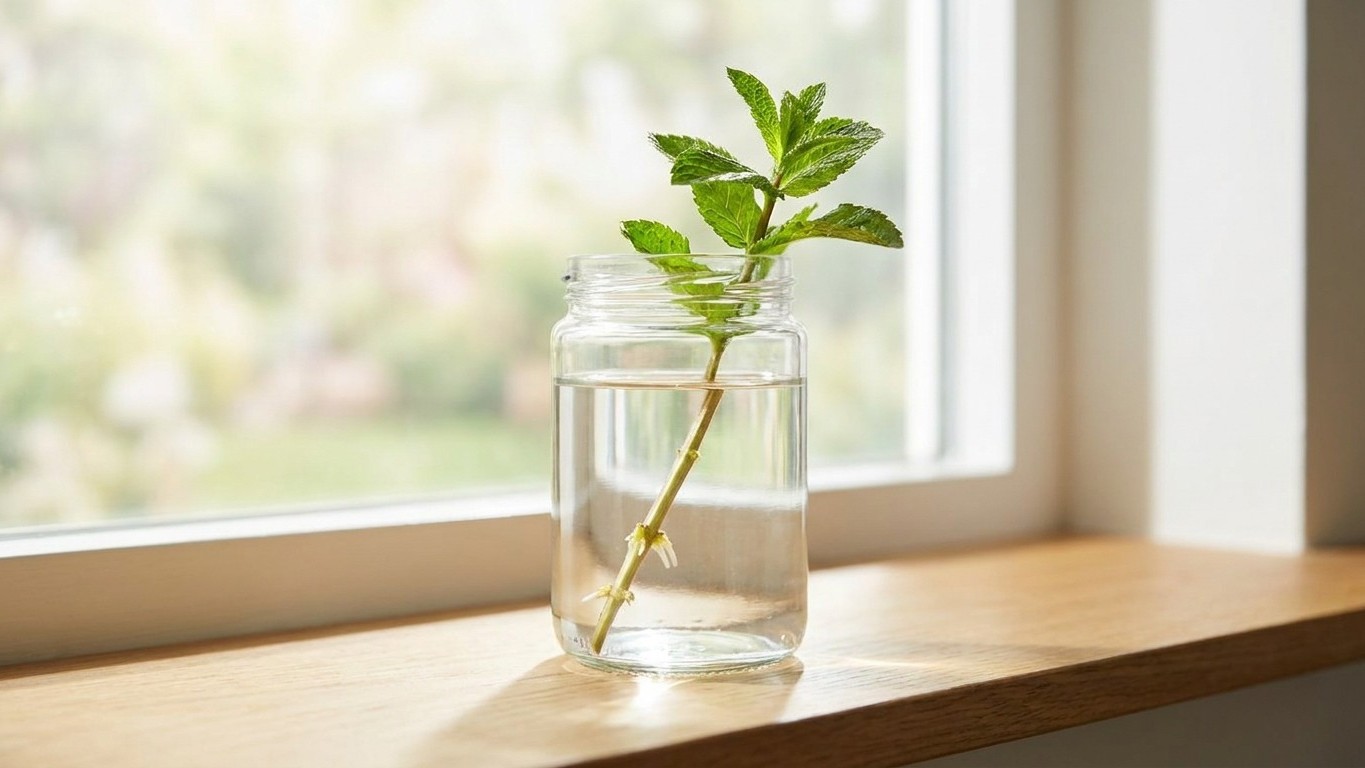
Drop a mint sprig into a glass of water and something almost magical happens within a week: pale, thread-like roots start pushing out from the stem nodes. It feels like proof that propagation is easy, that you’ve cracked the code. But a plant cutting in a glass of water is always a good start, but most of the time, those water roots need to be converted into soil roots to allow your herb to grow further. The roots growing in that jar aren’t the same as the roots your mint plant will eventually need underground, and that gap explains why so many kitchen-windowsill mint projects wilt and die within days of hitting the dirt.
Key takeaways
- Water and soil demand completely different root structures—but most guides ignore this entirely
- The missing piece nobody mentions: root hairs that only develop in soil, not in water
- Transplant shock hits hard because water-adapted roots can’t handle the switch—but there’s a timing trick that changes everything
Water Roots and Soil Roots Are Built for Different Jobs
Roots aren’t a one-size-fits-all structure. They’re shaped by whatever medium they’re growing in, and water and soil ask completely different things of a plant. Water gives cuttings constant moisture, but it does not behave like soil. Soil and airy potting mixes hold moisture while also creating tiny air pockets around roots. Still water contains much less oxygen, and oxygen levels drop further when water sits unchanged. That single fact, the oxygen deficit, is the starting point for everything that goes wrong later.
Faced with a low-oxygen environment, plants don’t just cope, they restructure themselves. Botanists call the tissue that forms in response aerenchyma, a network of air pockets inside the root that acts like an internal snorkel. Aerenchyma provides an internal path for low-resistance gas-phase diffusion of oxygen into and along roots. Rice paddies are the textbook example: rice roots are practically built for standing water, forming this spongy internal architecture as a default survival strategy. Mint cuttings do something similar on a smaller scale when they sit in a glass, prioritizing oxygen transport over the features that matter once soil enters the picture.
The Missing Piece: Root Hairs
Here’s the detail that gets glossed over in most propagation guides. Water roots are different: roots formed in water are often smoother, more fragile, and less covered in fine root hairs than roots formed in potting mix. Root hairs are microscopic, almost invisible to the naked eye, but they’re doing the heavy lifting in soil. They’re the structures that wedge themselves between soil particles, pull in water films clinging to grains of dirt, and scavenge dissolved minerals. In water, none of that matters. The root is already bathed in the exact liquid it needs, so there’s no evolutionary pressure to grow the hairs that would let it forage through solid ground.
That’s the trade nobody warns you about. A water-rooted mint cutting is optimized for absorbing dissolved oxygen and moisture directly through a smooth surface, not for gripping and feeding off particulate soil. Move it into a pot, and it’s like handing someone a snorkel and asking them to run a marathon. The equipment simply wasn’t built for the new task.
Why This Turns Into Transplant Shock
Symptoms show up fast, usually within 48 hours of potting. Leaves droop, edges yellow, and sometimes the whole cutting just gives up. The stem rooted. The hard part seemed over. Then it flopped two days after potting up. That’s not bad luck. It’s a root system without the hair density needed to keep pace with a plant that’s suddenly transpiring into drier air and pulling water from soil instead of a jar.
Timing makes the difference. Wait too long in water, and the problem compounds. If you’ve waited too long and the roots on your cutting are more than 3-4 inches long, you can still try to transition the cutting to soil, but just be prepared for the cutting to be stressed, and know that sometimes cuttings that have been in water too long die when you attempt to move them to soil. Those long, glassy roots are the most water-adapted, the most fragile, and the least equipped for the abrasive reality of potting mix. Longer roots also snap more easily during the move, and a root hair-poor structure has almost no fine anchoring system to fall back on when a chunk breaks off.
There’s an easy fix hiding in plain sight, and it’s the one most water-propagation guides mention only in passing. The easiest way is to transfer the cuttings from water to soil as soon as you see the first sign of tiny roots poking out of the lenticels, rather than waiting until the water roots have been established extensively, because this is the least stressful for the plants as it reduces the shock of switching the growing medium. Don’t wait for pretty roots. Move the cutting the moment it shows the faintest white nub, while the stem tissue is still primarily land-adapted and hasn’t fully committed to the aquatic architecture.
The Soil-First Alternative
If transplant casualties bother you, skip water altogether. Rooting mint directly in a small pot of moist potting mix takes longer to show visible progress, no satisfying glass jar to admire, but the payoff is a root system that never has to switch gears. When you propagate your mint cuttings in soil, the roots and the plants will be much stronger, and there’s a lower risk of them dying from transplant shock. Even one of mint’s other Propagation tricks proves the point: leave a runner lying on moist soil and it roots itself without any help at all, because those runner roots develop with root hairs from the very first cell division, no jar, no conversion, no shock.
None of this makes water propagation useless. It’s still the fastest way to confirm a cutting is alive, and mint tolerates the method better than fussier herbs like rosemary or cilantro. But if the goal is a thriving plant on the patio rather than a science-fair display on the windowsill, the smarter move is treating that glass of water as a two-week audition, not a permanent home, and getting the roots into dirt before they get too comfortable being wet.
Sources : bloomingexpert.com | scienceinsights.org