
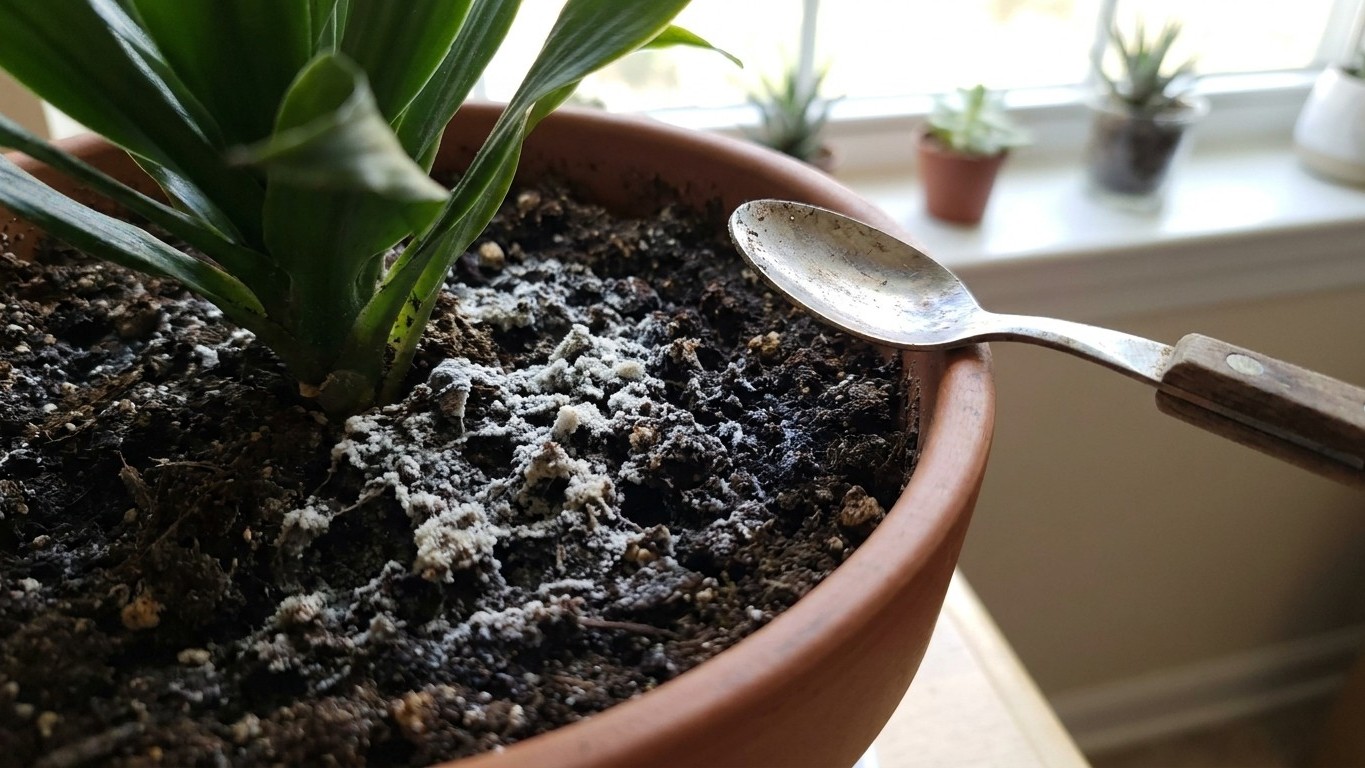
That white crust wasn’t dirt, mold, or dust. It was fertilizer salt, and it was slowly strangling the roots underneath every time weekly feeding got poured onto already-stressed summer soil.
The instinct made sense on paper. Heat stresses plants, stressed plants look hungry, so more fertilizer seemed like the obvious fix. But salt buildup from minerals in fertilizer and hard or softened water can damage plants, preventing them from absorbing the water they need, stunting growth, and burning root tips until rot sets in. Feeding weekly through a heat wave didn’t nourish those pots. It buried the roots in a mineral traffic jam they couldn’t drive through.
Key takeaways
- A mysterious white crust appeared on soil after aggressive summer fertilizing—but it wasn’t what anyone expected
- The more you fed them, the worse the roots suffered, but the symptoms screamed ‘feed me more’
- One unexpected household item works better than fertilizer to save dying potted plants
What That Crust Actually Is
Every time water evaporates from soil, whatever was dissolved in it stays behind. This crust is made of soluble salts that come from two main sources: the minerals in tap water and the fertilizers used. As water evaporates, the salts are left behind, and over time they accumulate on the surface or inside the pot. Weekly feeding during summer just accelerated a process that normally takes months.
The mechanism is almost mathematical in its cruelty. Tap water and liquid fertilizer mixed with water soak into the soil carrying dissolved minerals and salts, but not Everything/”>Everything in the water is useful to the plant, so excess minerals stay in the soil, and as the top layer dries out, water molecules leave while the minerals, too heavy to evaporate, get left behind. That happens after literally every single watering, so a summer of weekly feeding means dozens of tiny deposits stacking on top of each other. Feeding a plant more than it needs means there are always excess fertilizer salts in the soil, similar to eating more salt than the body uses. The excess has to go somewhere, and in a pot, it goes to the top of the soil.
Anyone with hard water at home has an even shorter countdown. Areas with hard water, meaning water with high mineral content, will see salt buildup appear faster than someone with soft water. Combine hard tap water with a weekly fertilizer habit and that white ring around the pot rim can show up in weeks rather than the usual half-year cycle.
Why the Roots Gave Up Instead of Perking Up
This is the part that feels backward until it’s explained: salt doesn’t burn plants the way sunlight does. It works by osmosis, essentially reversing the direction water normally moves. If too many salts build up, the plant will draw moisture from its own root tips and die. Instead of roots pulling water in from the soil, the concentrated salt outside the root actually pulls moisture out of the plant tissue. Under intense summer heat, when a plant is already fighting to hold onto every drop of moisture, that reversal is devastating.
The visible symptoms mimic drought stress almost perfectly, which is exactly why the instinct to feed more felt logical. Signs include brown leaf tips, lower leaves dropping, very little new growth appearing, and a yellow or white crust on the soil surface or rings around the inside of a plant’s pot. Browning tips look like thirst. Dropped leaves look like heat exhaustion. Both read as “needs food and water,” when the actual problem is chemical gridlock at the root zone.
University extension research backs up just how far this can go before anyone notices the crust. Mineral and fertilizer salt deposits usually appear as white crystallized residue on leaves or potting medium, and by the time it’s visible on top, there’s typically far more hidden below. Do not confuse a clean-looking surface with a healthy root zone. A container can look normal from above and still be carrying a lot of mineral residue below the top inch.
The Fix Takes Five Minutes, Not a Trip to the Garden Center
Scraping off that crust is step one, and it’s genuinely simple. Using a spoon, small trowel, or fingers, remove the top half-inch of soil where the white crust has formed, taking the crusty, salt-heavy layer with it, and discard it rather than composting it. That alone removes the most concentrated layer, but it’s not the whole fix, since salts have already migrated deeper with every watering.
The real reset is a process called leaching, and it’s less complicated than it sounds. Repeatedly and thoroughly watering, called leaching, washes any remaining salts out of the soil. Water the plant until excess water drains out the bottom, using twice as much water as the container will hold. For example, a 6-inch pot holds 10 cups of water, so use 20 cups. Let it drain completely each time, since pouring the water gradually through the soil and letting it drain fully matters, because plants left sitting in water will simply draw the salt-laden water back up, defeating the purpose.
One detail changes Everything for anyone tempted to feed again next week: dilution and timing matter more than frequency. Fertilize only when plants are actively growing, and use a dilute solution, about one fourth to one half the recommended rate, when fertilizing. Extension specialists recommend leaching as routine maintenance, not emergency response. To reduce mineral buildup, water with clear water to leach houseplants every 4 to 6 months, applying at least 3 times the volume of the pot in fresh water and letting it drain completely.
There’s one more wrinkle worth knowing before reaching for the watering can again. Straight tap water can undercut the whole effort if the local supply runs hard. Some tap water contains salts that can make fertilizer burn worse, so it’s best to use distilled or rainwater to flush potting mixes. A single rainstorm’s worth of collected water, or a jug left to sit uncovered for a day, does more for a stressed summer pot than another dose of plant food ever could.
Sources : extension.umd.edu | gardenlyhome.com