
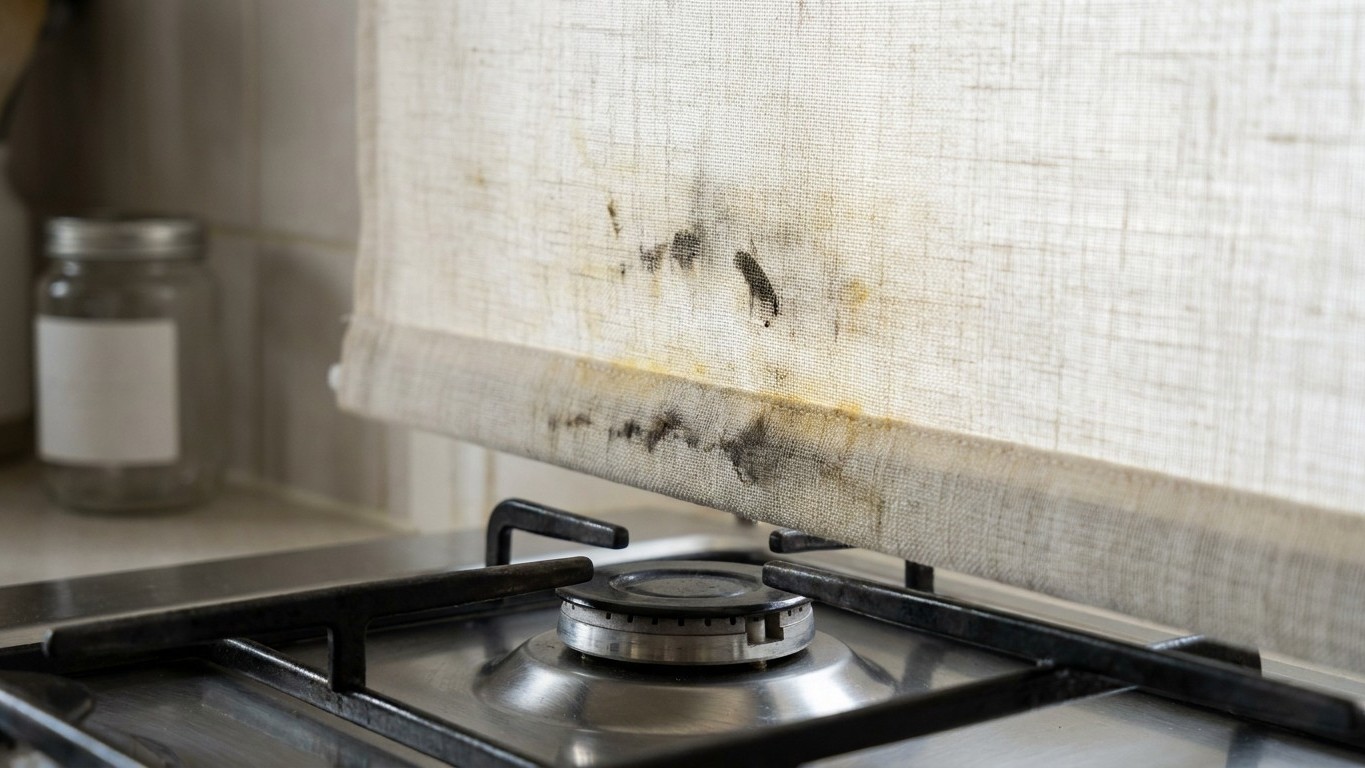
Grease doesn’t just sit on a stovetop. It floats, settles, and clings to whatever soft surface happens to be nearby, and in my kitchen, that surface was a linen-look roller blind I’d installed six months earlier purely to take the edge off a bare window above the hob. The blind looked good. It softened the light, matched the cabinets, gave the room a finished feel it had been missing. Then one evening, a burner flared while I was searing something in too much oil, and the flame reached higher than usual. That’s when I noticed the smell: not just smoke, but something greasier, thicker, coming off the fabric itself.
Key takeaways
- A decorative blind hanging above the hob absorbed six months of cooking grease without anyone noticing
- When a burner flared during dinner prep, the heat and smell revealed the textile had become a potential fire accelerant
- Cooking fires are the leading cause of home fires—and fabric window treatments directly above stovetops dramatically increase that risk
What a Flare-Up Reveals About Six Months of Cooking
A stovetop flare-up lasts maybe two or three seconds. Long enough to singe a hair, short enough that most people wave it off and keep cooking. But that brief burst of heat rising toward a textile hanging just above the hob does something a normal simmering pot never does: it pushes hot air and airborne grease particles directly into the weave of the fabric, and it does it repeatedly, meal after meal, without anyone noticing.
Fabric window treatments near a stove absorb more than steam. There is heat from cooking, moisture from the sink, airborne grease, and constant movement from kids or pets in most kitchens, and a blind positioned directly over the burners sits in the path of all of it. Every stir-fry, every pan of bacon, every reduction sauce sends a fine mist of oil into the air, and some of that oil doesn’t evaporate. It lands, and it stays.
That’s the part I hadn’t considered when I bought the blind. I’d thought about light filtering, about privacy, about matching the color scheme. I hadn’t thought about the fact that the fabric was functioning as a passive grease trap every single time I turned on a burner.
Why Cooking Fires Are Already the Number One Culprit
Kitchen fires aren’t a rare fluke. Cooking fires are the number one cause of home fires and home injuries, and the leading cause of fires in the kitchen is unattended cooking. Nationally, the scale is hard to overstate: cooking fires are the top cause of home fires, accounting for approximately 49% of all residential fire incidents, with unattended cooking the leading factor, responsible for over 40% of cooking fire-related emergencies.
Timing matters too, and it lines up almost exactly with the moment my flare-up happened. Nearly 70% of cooking fires occur during the evening hours between 5 p.m. and 8 p.m. That’s dinner rush, the hour when most households are juggling multiple burners, distracted by kids or phones, and least likely to notice a small flame climbing higher than it should.
Grease itself is a recurring theme in fire investigations, not an occasional footnote. These incidents often result from unattended cooking, grease buildup, and malfunctioning appliances, leading to significant property damage, injuries, and even fatalities. A blind hanging above the stove doesn’t cause the grease buildup. It just gives that grease somewhere new to accumulate, somewhere far less obvious than a stovetop hood filter that gets cleaned on a schedule.
The Textile-Over-the-Stove Problem Fire Safety Groups Already Flagged
I’m not the first person to learn this the hard way, and fire safety organizations have been fairly blunt about it for years. Curtains hung directly over a stove are deemed unsafe, and the Home Safety Council recommends that flammable materials, including fabric curtains, should be at least three feet from the stove surface. Three feet is a lot more clearance than most kitchen windows actually allow, which is exactly why so many of us end up hanging something decorative right where it shouldn’t go.
The mechanics of how it catches are straightforward. Curtains can blow onto a hot electric burner or the open flame of a gas stove, and they can also catch fire if a spark, flame or burning food touches the fabric. Even a blind that stays perfectly still isn’t immune, because the risk isn’t only contact. It’s proximity to rising heat and, as I found out, to months of absorbed grease that lowers the fabric’s resistance to ignition in the first place.
Design professionals who work on kitchen renovations tend to steer clients away from soft fabric entirely in that specific spot. In many kitchens, the stove is located directly below or very close to a window, and any fabric that hangs low or moves easily can become a fire hazard. The advice isn’t about banning window treatments near the cooktop altogether. It’s about choosing materials built to handle heat and grease instead of quietly stockpiling both.
What I’d Put There Instead
Once I pulled the linen-look blind down, I went looking for something that could survive actual cooking rather than just look nice in photos. Vinyl-coated roller shades turned out to be the obvious fix for exactly this spot. They roll completely up, keeping the window area clear while cooking, and many are made from vinyl-coated or treated fabrics that resist grease and wipe clean easily. No fibers to soak up oil mist, no weave for grease to hide in, and a surface you can actually wipe down after a splattery pan of anything.
If you want to keep some texture without the risk, the safer route is genuinely flame-resistant material rather than a decorative cotton blend. Flame-resistant curtains or drapes are treated to slow down or prevent spreading, and are particularly useful in areas near fireplaces, kitchens, or in homes with a lot of electrical equipment. It’s worth checking labels specifically for that kind of treatment rather than assuming any thicker fabric will do.
My blind never actually caught fire that evening, and for that I’m grateful. But I didn’t wait around to see how close it came a second time. It’s back down, replaced with something wipeable, and the window looks a little less soft now. I’ll take boring over singed any day of the week.
Sources : sewingbasicshub.com | fabricmaterialguide.com