
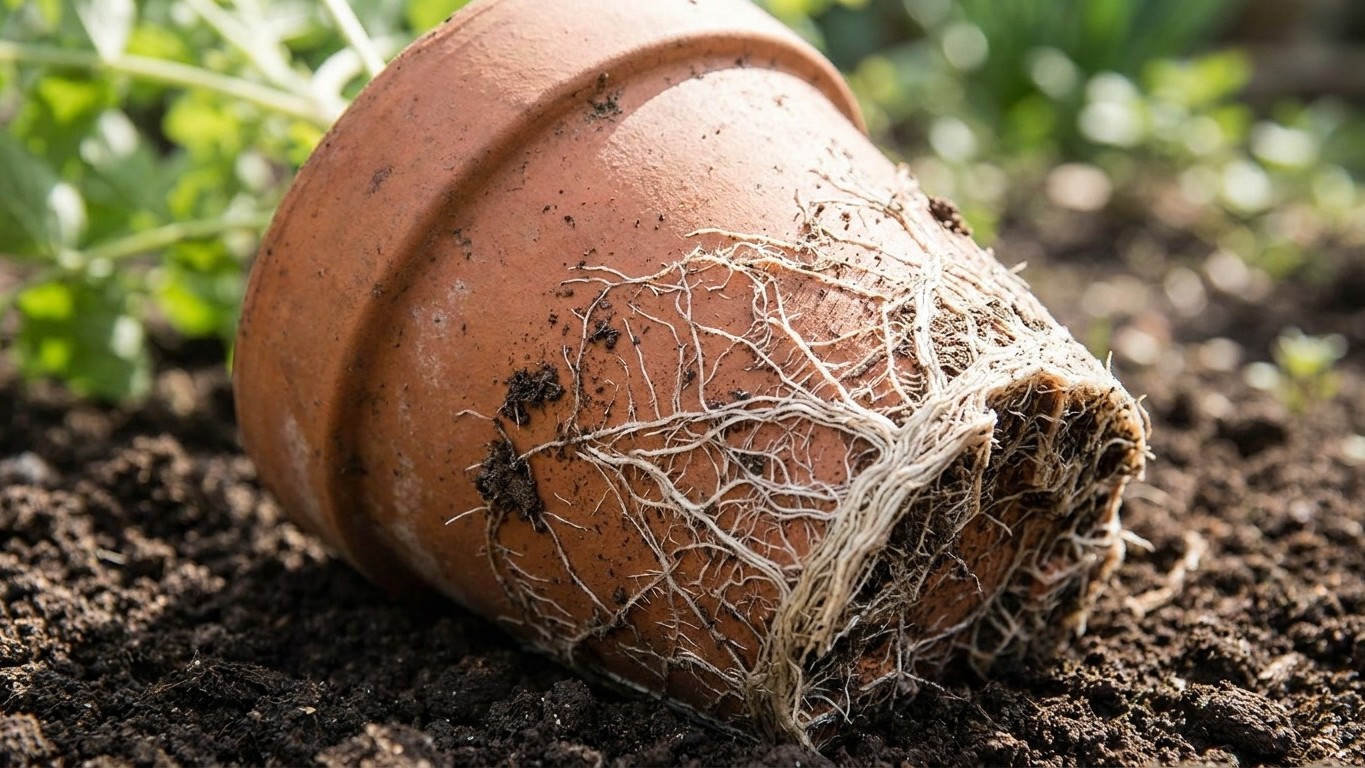
The tomatoes looked fine from the outside. Dense foliage, no obvious distress, no yellowing. But something was off, fruit that split after rain, a few blackened bottoms hinting at blossom end rot, and that constant nagging feeling of watering too much or not enough. Then came the experiment: a plain unglazed terracotta pot, buried upright next to a tomato plant, filled with water, and capped with a saucer. One month later, when it came time to dig it up, the discovery was almost unsettling. The pot was wrapped in a dense mat of roots — thin white threads clinging to every inch of the clay surface, feeding directly from the vessel.
That buried pot has a name. Ollas are unglazed clay pots you bury in the garden to water your plants. Ollas (pronounced ohh-yahh) are clay pots that were first used for irrigation over 4,000 years ago in North Africa and China. The Chinese agronomist Fan Shengzhi described the technique in writing roughly 2,000 years ago as a key method for cultivating crops in arid conditions. The technology never really disappeared, farmers continue to use buried clay pots to irrigate their crops in North Africa, China, India, Pakistan, Iran, Mexico, Brazil, and Ethiopia. America is just catching up.
Key takeaways
- What happens inside the soil when you bury an unglazed clay pot next to your tomatoes
- Why blossom end rot and inconsistent growth suddenly disappear with this one simple change
- The root system transformation that happens in just 30 days—and what it reveals about plant behavior
The Physics Behind the Miracle
Clay is porous, so the water inside the olla pot will seep through the walls of the pot until equilibrium with the surrounding soil is achieved. That’s osmosis doing the work, not you. The truly clever part is what happens when the soil is already wet: the seeping simply slows down or stops. Water seeps through the porous clay walls when surrounding soil is dry, and stops seeping when soil is wet. The system is completely self-regulating, requiring no pumps, timers, or electricity.
This self-regulation is what sets the olla apart from every modern irrigation gadget on the market. The water seeps out through the clay wall of the buried clay pot at a rate that is influenced by the plant’s water use, leading to very high efficiency, even better than drip irrigation, and as much as 10 times better than conventional surface irrigation. Research by environmental scientist David Bainbridge at the University of California, Riverside, quantified what farmers in arid regions had practiced for centuries: water efficiency is 50–70% better than traditional surface watering, with zero evaporation loss since water is released below the surface.
The numbers from the field back this up strikingly. In India, the yield of buried clay pot irrigated melon reached 25 tons per hectare using only 2 centimeters of water, compared to yields of 33 tons per hectare using 26 centimeters of water with flood irrigation. More produce with less than a tenth of the water. In Pakistan, tree seedlings irrigated with buried clay pots achieved a survival rate of 96.5%, compared to 62% with hand watering, and the seedlings were 20% taller.
Why Tomatoes Thrive, and Stop Rotting
Tomatoes are particularly intolerant of erratic watering. Every home gardener has faced blossom end rot: that black, leathery patch spreading across the bottom of a fruit that looked perfect just days before. The standard assumption is calcium deficiency. The real culprit is almost always the irrigation schedule. The conditions that cause blossom end rot are closely linked to inconsistent soil moisture throughout the growing season, since calcium is only moved into the plant with an ample moisture supply, when drought occurs the fruit continues to develop but will be affected by a calcium deficiency.
Huge fluctuations in soil moisture are problematic for crops like tomatoes and beets, the shift from extreme wetness to extreme dryness causes a lot of plant stress. An olla eliminates that cycle entirely. One major benefit reported by gardeners: no more blossom end rot in tomatoes. This frustrating issue is often blamed on calcium deficiency, but it’s usually caused by inconsistent watering. Ollas maintain even moisture levels, allowing plants to take up nutrients steadily.
Then there’s root behavior, and this is where digging up that buried pot after a month becomes genuinely revelatory. Plants naturally grow roots around the olla to access the moisture. When you pull up an olla in the fall, it’s often surrounded by a thick net of roots. If you dig up a buried jar after a growing season, you will find a dense mat of roots wrapping around the clay surface. The plants are not passively receiving irrigation — they are actively drawing it out through root pressure. The tomato is not just being watered. It is reaching for the source, building a deeper and more resilient root system in the process.
How to Make One for Under $5
No special equipment required. One of the simplest DIY ollas is to plug the hole at the bottom of a terracotta flower pot, bury it in the soil leaving the top opening a quarter inch or so from the top of the soil, then cover the top of the pot with a drip saucer once filled. The key word throughout is unglazed — glazed clay won’t allow any seepage. Do not use glazed or plastic pots for this system. The water will not be able to seep through and will not escape.
For tomatoes, which have large, spreading root systems, a double-pot setup gives better coverage. Gluing two terracotta pots together, rim to rim, sealing one of the pot’s holes completely shut while leaving the second hole open, the sealed end goes into the ground first, while the open end remains above the ground’s surface. This is where you add water throughout the season. Food-grade silicone sealant from any hardware store handles the bond. Bury the olla leaving 1–2 inches above the soil surface to keep dirt and mulch from getting inside, and gently pack the soil around it to prevent air pockets.
Depending on the shape, the size of the jar, the temperature, and the requirements of the plants, it will only be necessary to fill the jar once or twice a week, with a range of about 30 centimeters in diameter. Spacing matters too: space ollas every 2–3 feet in your garden for best irrigation. One practical note worth keeping in mind: while ollas are great for large plants like tomatoes, squash, cucumbers, and kale, they don’t always meet the water needs of newly established seedlings, the pot releases water deep in the soil, but seeds are sown close to the surface. Start seedlings with conventional surface watering, then transition once the roots can reach the clay.
There’s one bonus effect that rarely gets mentioned in watering discussions: ollas reduce surface irrigation, which promotes weeds, so you’ll see a boost in the production of your tomatoes and leafy greens, and a reduction of weeds too. Dry soil at the surface is inhospitable to germinating weed seeds. The water goes exactly where plants need it, nowhere else. After 4,000 years, that remains a difficult engineering problem to solve more elegantly.
Sources : lovelygreens.com | hgtv.com