
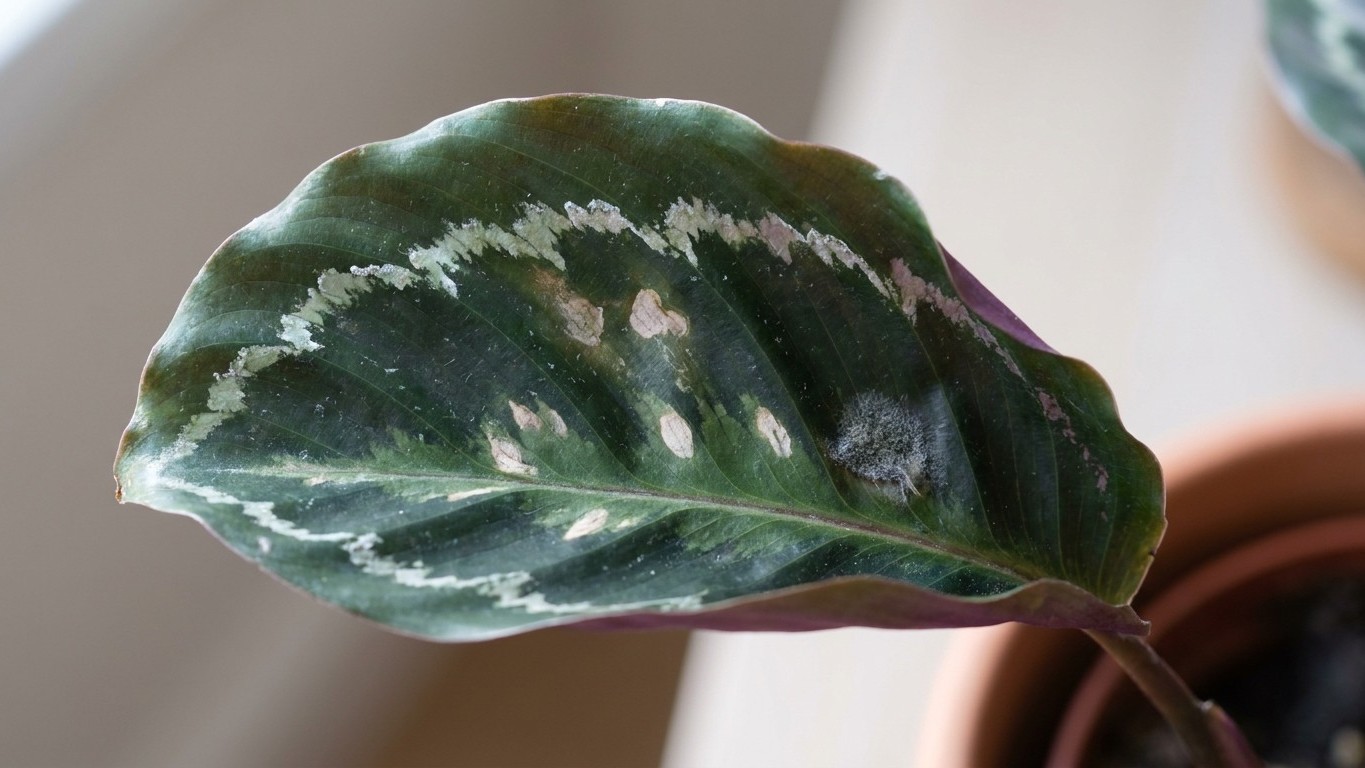
Misting houseplants feels instinctively right. You see a tropical fern or a fiddle-leaf fig, you think “humidity,” and you reach for the spray bottle. For months, that was the morning ritual, a gentle spritz on every leaf before the day started. Then came the day of actually looking at the leaves, not just at the plants. White crusty rings on the philodendron. Dark speckles on the calathea. A faint gray fuzz creeping along the base of a peace lily leaf. The spray bottle had been doing damage the whole time.
Key takeaways
- Water droplets on leaves act as magnifying glasses, causing bleached spots and burnt patches under light
- Wet foliage creates perfect conditions for gray mold and powdery mildew to thrive in home environments
- Mineral deposits from tap water gradually clog the microscopic pores plants use to breathe
What misting actually does to a leaf
The logic behind misting seems solid: tropical houseplants evolved in humid environments, so adding moisture to the air around them should help. The problem is that a spray bottle doesn’t add moisture to the air in any meaningful way. A few seconds after misting, the water droplets sitting on the leaf surface either evaporate, raising ambient humidity by a negligible fraction, or they stay put long enough to cause problems.
Water droplets on leaves act as tiny lenses under direct or bright indirect light. They concentrate light onto a single point on the leaf surface, which can cause the faint bleached spots or scorched patches that are easy to mistake for pest damage or a nutrient deficiency. That alone should give pause. But the more serious issue is fungal disease. Wet leaves in a home environment, where air circulation is limited, create the exact conditions that pathogens like Botrytis (gray mold) and powdery mildew thrive in. Calatheas and begonias are especially vulnerable, their wide, textured leaves hold moisture in their grooves and take longer to dry than smooth-leafed plants.
The white crusty rings? Those come from tap water. Most municipal water in the U.S. contains calcium and magnesium, minerals that leave deposits when the water evaporates. Mist a plant with tap water every morning for three months and you’ll accumulate a visible mineral crust on the leaves. Beyond being unsightly, those deposits can partially block the stomata, the microscopic pores through which plants breathe and regulate water loss.
The plants that genuinely need humidity, and what actually works
Some plants do struggle in the dry air of a typical American home, especially during winter when heating systems drop indoor humidity well below 30%. Orchids, ferns, calatheas, anthuriums, and air plants are legitimate humidity lovers. The distinction is between needing ambient humidity and needing wet leaves, and that distinction matters a lot.
A pebble tray is the low-effort solution most often overlooked. Fill a shallow tray with pebbles, add water to just below the top of the pebbles, and set the pot on top. As the water evaporates, it raises humidity directly around the plant without ever touching the foliage. It won’t transform a dry room into a rainforest, but it creates a localized microclimate that’s genuinely more comfortable for moisture-loving species.
Grouping plants together is another underrated strategy. Plants release water vapor through their leaves in a process called transpiration, and a cluster of five or six plants creates a measurably more humid zone than any single plant sitting alone on a shelf. Botanical gardens use this principle at scale; it works just as well in a living room corner.
For serious humidity needs, a collection of orchids, a dedicated fern shelf, a small ultrasonic Humidifier placed nearby is the most effective solution by a significant margin. A study published by researchers at the University of Vermont’s extension program found that consistent ambient humidity between 40-60% supports healthier growth in tropical houseplants compared to periodic misting, which produced no measurable improvement in plant health metrics. The humidifier approach also has the side benefit of being good for humans in winter months, dry air isn’t great for skin or respiratory health either.
When a spray bottle is actually useful
The spray bottle doesn’t belong in the trash. Its legitimate uses are just more specific than a daily misting routine. Cleaning dust off large, smooth leaves, monstera, rubber plants, snake plants, is one of them. A light mist followed by a gentle wipe with a soft cloth removes the dust layer that can reduce a plant’s ability to photosynthesize efficiently. Doing this once or twice a month, ideally in the morning so the leaf dries completely before evening, causes no harm.
Spray bottles are also useful for watering propagation trays and moss poles. When rooting cuttings in a propagation mix, keeping the medium lightly and evenly moist without waterlogging it is easier with a spray bottle than with a watering can. Moss poles used to support climbing aroids like monsteras and pothos benefit from occasional misting directly onto the moss, not the leaves, to encourage aerial root attachment.
Pest control is the other valid application. Diluted neem oil, insecticidal soap solutions, or a plain water spray to dislodge spider mites are all spray-bottle jobs. The key here is always the same: treat the leaves, let them dry fully, and don’t make it a daily habit.
Reading your plants before reaching for water
The mineral deposit problem has a simple fix for anyone who doesn’t want to abandon the spray bottle entirely: use distilled water or collected rainwater. Both lack the dissolved minerals that create those white rings. Rainwater has the added benefit of a slightly lower pH than most tap water, which some acid-preferring tropicals respond to well.
Humidity stress in plants shows up in specific ways, brown, crispy leaf edges (not brown soft spots, which usually indicate overwatering or fungal issues) and leaves that curl inward along their length. A hygrometer, which costs around $10 at most hardware stores, takes the guesswork out of whether your plants actually need more humidity or whether you’ve been solving a problem that didn’t exist. Most common houseplants, pothos, snake plants, ZZ plants, monsteras, do perfectly fine at 40% humidity, which is within the normal range of an average American home even in winter.
The spray bottle habit persists partly because it feels like care. The act of misting is visible, immediate, satisfying in a way that running a humidifier in the corner is not. But plants respond to conditions, not gestures.