
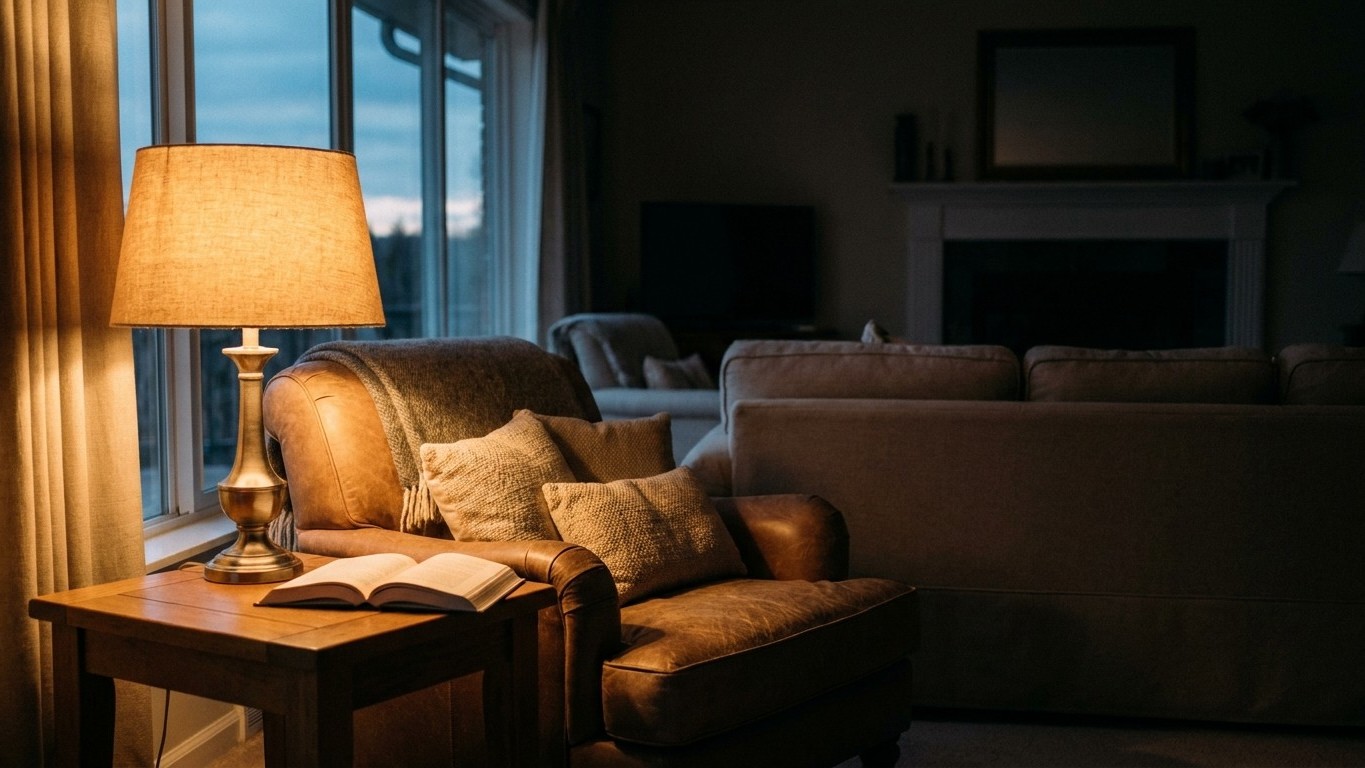
Flip a switch, flood the ceiling, done. That’s the reflex in most American living rooms once the sun drops, and it’s also the fastest way to make a cozy space feel like a waiting room. A single overhead fixture blasting the whole room from above doesn’t create warmth. It creates uniformity, and uniformity is the enemy of atmosphere.
The fix isn’t a brighter bulb or a fancier chandelier. It’s three lamps sitting roughly at eye level, or a bit below, doing the quiet work that a ceiling light structurally cannot do.
Key takeaways
- Why your brain interprets a single overhead light as perpetual noon, suppressing the cozy feelings you actually want
- The physics problem that flat, uniform light creates and how shadows actually help your eyes read a room
- A specific three-lamp strategy that works without rewiring, plus the exact color temperature number that changes everything after dark
Why the ceiling light alone falls flat
Interior designers have a pointed complaint about relying solely on overhead fixtures. As one designer put it bluntly: “To be honest, I don’t prefer overhead lighting”, arguing that it’s not natural to your circadian rhythm, since it makes you feel like the sun is always above you, so it’s always noon in your brain. That’s not a minor aesthetic quibble. Your nervous system reads a single high, bright source as midday, no matter what the clock says.
There’s also a physics problem. Uniform light erases the shadow information the brain uses to read depth, and the room becomes a flat photograph. Corners flatten out, textures on rugs and upholstery disappear, and Everything in the room reads the same distance from the eye, even when it isn’t. Lighting designers describe the failure mode the same way from a different angle: when lighting sits entirely at the same height, the space lacks the depth that comes from varied illumination levels. A ceiling fixture, by definition, is one height. It can’t fix that on its own.
The three lamps doing the real work
Here’s where eye-level lighting earns its keep. The recommendation from lighting professionals is consistent: light from multiple places, at multiple heights, floor level, table level, eye level, above eye level. Skip that layering and the ceiling fixture is left to do a job it was never built for. Skip all three in favor of a single overhead fixture, which is what most houses do, and the room feels like a waiting area.
Think of it less as decoration and more as three separate jobs splitting the workload. A table lamp beside the sofa handles the warm glow you actually sit near. A floor lamp in the reading corner throws light downward onto a book or a laptop, since inadequate task lighting shows up as eye strain during reading or laptop use, and dedicated reading lamps positioned beside seating make a noticeable difference. A third source, whether a smaller accent lamp or a sconce, fills the dead zones nobody thinks about, because neglected corners can make a room feel smaller and incomplete.
The payoff isn’t just visual. Designers frame it as: even without overhead lighting, these thoughtful layers can transform a room into a cozy and intentionally designed space. Some go further and skip the ceiling fixture entirely, treating floor and table lamps as the primary source and letting an uplight bounce off the ceiling instead, since uplighting fixtures cast light upward, allowing it to reflect off the ceiling and disperse back into the room in a broad, diffused wash, so the space feels brighter and more open without the harsh glare of direct light.
Get the color temperature right, not just the height
Placement matters, but so does the actual color coming out of the bulb. The Kelvin scale, which measures color temperature, runs roughly from candlelight to overcast daylight, and it affects mood, sleep quality, circadian rhythm, productivity, and how accurately colors appear under the light. For the lamps doing your evening work, that number matters more than most people realize.
The consensus across lighting guides is narrow and specific: for comfort and relaxation, 2700K to 3000K is the ideal range for living rooms and bedrooms, since this soft white range creates a calm, welcoming atmosphere and works beautifully with layered lighting like table lamps and floor lamps. Go higher on the Kelvin scale after sundown and you’re fighting your own body. Because cooler light suppresses melatonin, keeping bedroom lighting at 2700K or below in the evening can contribute to better sleep quality.
Mixing temperatures across a room without thinking causes its own kind of visual noise. Lighting designers warn that a 2700K table lamp next to a 5000K overhead fixture creates visual tension, and temperatures should stay within a 500K range per zone for a harmonious result. That’s an easy mistake to make when a household mixes old daylight bulbs in the ceiling can with warm bulbs in the lamps below. The room ends up looking like two different rooms stitched together.
None of this requires rewiring anything. A dimmer switch on the overhead fixture and a couple of three-way bulbs in the lamps solve most of the flexibility problem, since without dimmers you’re locked into one brightness level regardless of time of day or activity, while installing dimmers on overhead fixtures and using three-way bulbs in lamps adds instant versatility. Bathroom lighting follows a similar layered logic, useful in a room most people still light with a single bar of bulbs over the mirror: start with overhead lights to deliver a sense of overall brightness when required, then layer at eye level with wall lights or vanity lighting to reduce shadows.
Next time dusk hits, resist the ceiling switch first. Turn on the lamp beside the couch, the one by the reading chair, maybe a small accent glowing in the corner nobody else lights. Only flip the overhead fixture on if the room still feels dark after that, and even then, keep it dimmed. The ceiling light should be backup, not the main event.
Sources : redfin.com | edwardmartin.com