
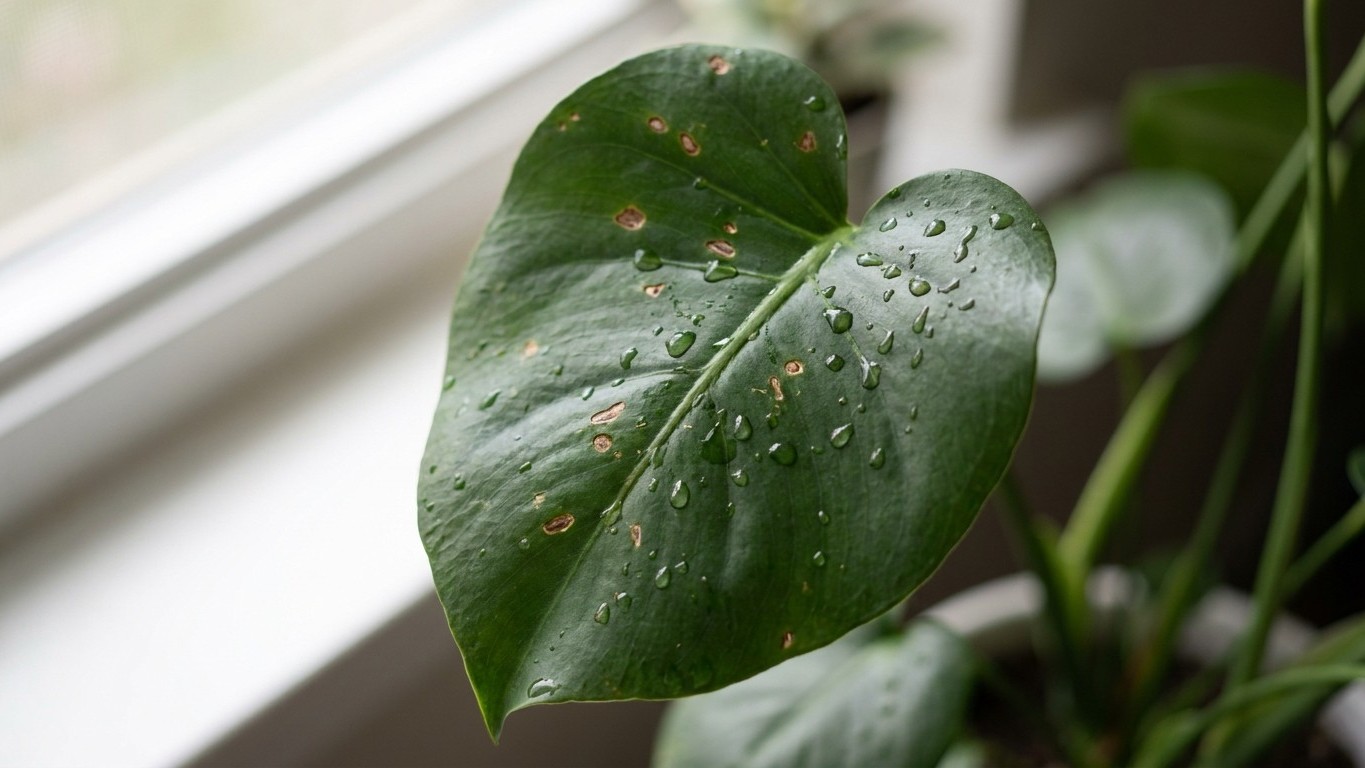
Brown spots on leaves are one of the most common complaints among houseplant owners, and for years, the go-to advice has been the same: mist your plants to boost humidity. The ritual feels logical, even caring. A quick spritz each morning, droplets glistening on the foliage, the sense that you’re recreating a tropical environment right in your living room. The problem is that the science behind it tells a different story, and a plant nursery owner laid it out in about three minutes flat.
Key takeaways
- Water droplets linger on leaves for hours, creating ideal conditions for fungal pathogens like grey mold
- Misting raises humidity for only 30 seconds, while mineral deposits from tap water clog leaf pores and stress the plant
- Humidity-loving plants thrive with humidifiers, plant grouping, and pebble trays—not foliar spray
What the mist is actually doing to your leaves
Water sitting on leaf surfaces doesn’t evaporate as quickly as most people assume. In a home environment, where air circulation is limited and humidity is already moderate, those droplets can linger for hours. That persistent moisture creates exactly the conditions that fungal pathogens love. Botrytis cinerea, the grey mold fungus, and various leaf-spot fungi thrive in the micro-climate created by wet foliage, especially when temperatures are mild and light is indirect, which describes most indoor settings pretty accurately.
The brown spots spreading across your monstera or prayer plant aren’t from underwatering or nutrient deficiency. They’re often fungal lesions, and the morning misting routine is feeding the cycle. The nursery owner I spoke with put it bluntly: misting is the horticultural equivalent of leaving wet towels on the bathroom floor and wondering why there’s mildew. The moisture is there, the warmth is there, the low airflow is there. You’ve built the perfect petri dish.
There’s also a secondary issue most guides skip entirely. When tap water dries on leaves, it leaves behind mineral deposits, calcium, magnesium, and chlorine residues. Over time, these deposits block stomata, the microscopic pores through which plants exchange gases and regulate temperature. A plant with clogged stomata isn’t just aesthetically marked; it’s physiologically stressed, less able to photosynthesize efficiently, and more vulnerable to disease in the first place.
The humidity myth, and what actually works
Here’s the core misconception: misting does raise humidity, but only for about 30 seconds. A 2020 study cited by the Royal Horticultural Society confirmed that foliar misting creates no measurable lasting increase in ambient relative humidity in a typical indoor space. The air simply absorbs the tiny water particles almost immediately. So the ritual isn’t just potentially harmful, it’s also not accomplishing the thing you were trying to accomplish.
Tropical houseplants like calatheas, ferns, and orchids genuinely do prefer higher humidity, typically between 50% and 70% relative humidity. Your average American home sits at around 30% to 50%, dropping further in winter when heating systems dry the air considerably. That gap is real. The solution, though, isn’t to spray leaves, it’s to raise the humidity of the air itself.
A cool-mist humidifier placed near your plant collection is the most effective fix. Running one in a cluster of humidity-loving plants can raise local relative humidity by 15 to 20 percentage points without ever wetting the foliage. Grouping plants together also helps, plants transpire moisture through their leaves, and a cluster creates a shared humid microclimate around the group. A shallow tray filled with pebbles and water, positioned beneath pots (with the pots sitting above the water line, not in it), adds slow ambient evaporation throughout the day.
The nursery owner also pointed out something that I hadn’t considered: acclimatization matters more than we think. Many houseplants sold at garden centers have spent weeks in commercial greenhouse conditions at high humidity. Bringing them home and immediately placing them in dry air is a shock to the system. The plant isn’t broken, it’s adjusting. Giving it two to four weeks in a bathroom, which naturally has higher humidity from showers, can help it transition before moving it to its permanent spot.
Diagnosing the real cause of brown spots
Not every brown spot is fungal, and lumping all leaf damage together leads to wrong fixes. The pattern matters. Brown tips that creep inward uniformly along the leaf edge are almost always a humidity or salt-buildup issue, the latter often caused by mineral accumulation from tap water or excess fertilizer. Crispy brown edges on otherwise green leaves typically point to low humidity combined with heat stress, common when plants sit too close to a heating vent.
Scattered brown spots with yellow halos, on the other hand, are a classic sign of fungal or bacterial leaf spot. If those spots have darker borders or a water-soaked appearance, you’re looking at a pathogen that has already established itself. In that case, removing affected leaves, improving air circulation around the plant, and stopping any foliar moisture are the first steps, antifungal treatments are available but rarely necessary if caught early.
Root rot produces brown spots too, often confused with leaf disease. When the roots can’t deliver water properly because they’re sitting in soggy soil, leaves show stress through discoloration. Checking the soil moisture two inches down before watering, rather than following a fixed schedule, eliminates most root rot cases entirely.
Rethinking the morning ritual
Misting isn’t universally harmful. There are specific cases where it genuinely helps: dusting off large, waxy leaves like those of a fiddle-leaf fig or rubber plant, where a gentle wipe with a damp cloth cleans the surface and improves light absorption. Cuttings without established root systems also benefit from light misting because they absorb water through their leaves before roots develop. Air plants (tillandsia) are the one category that actually requires regular misting, though even they need to dry fully within four hours to avoid rot.
The broader takeaway from that conversation at the nursery wasn’t just about misting. It was about understanding that plant care habits borrowed from social media often compress complex horticulture into photogenic gestures. A spray bottle looks like care. A hygrometer showing 60% humidity doesn’t photograph as well, but it’s what the plant actually needs.