
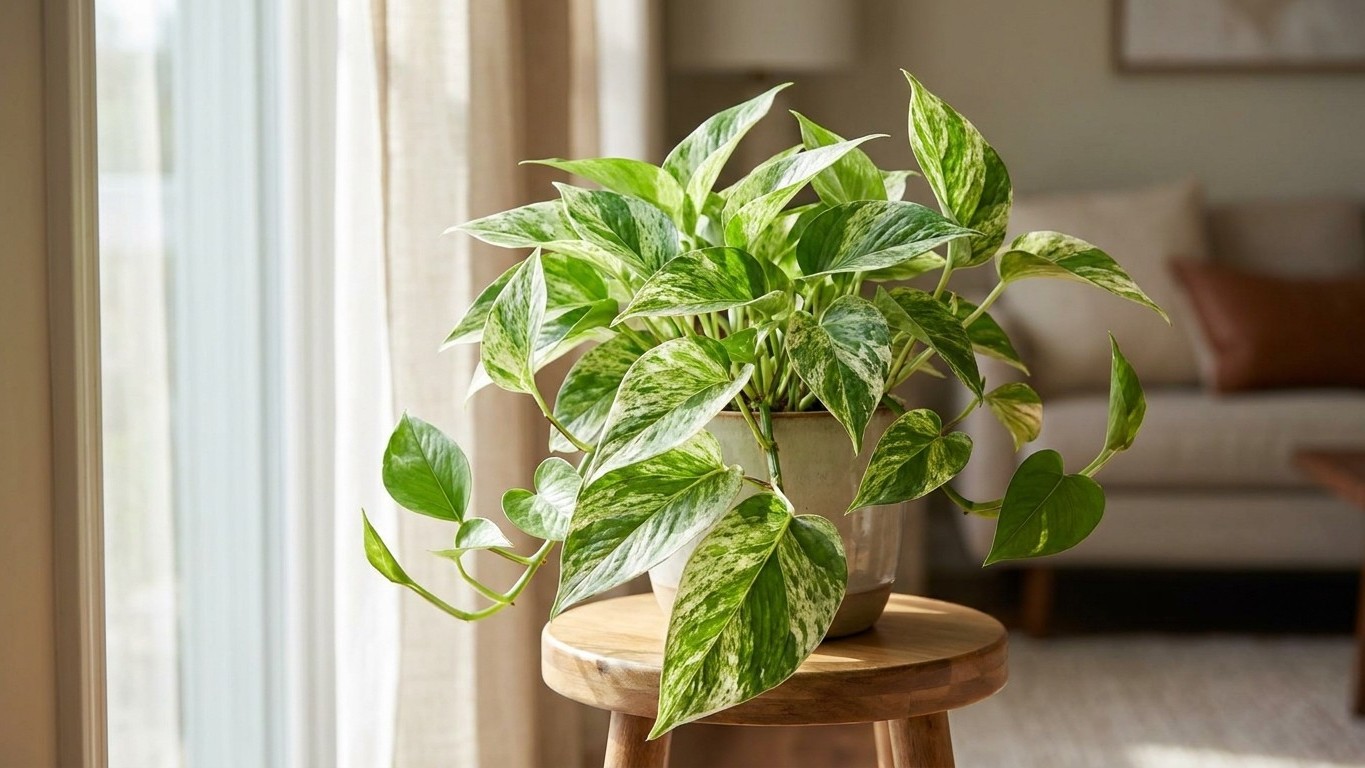
The white patches disappeared overnight. Not gradually, not leaf by leaf over weeks, one morning the newest growth on my variegated pothos came in completely solid green, and the older leaves with their cream-white marbling had started to look dull, almost apologetic. The plant wasn’t sick. It was making a decision, and once I understood the logic behind it, I couldn’t unsee it.
Key takeaways
- Variegated pothos leaves are energetically inefficient—white patches contain no chlorophyll and run at reduced capacity
- In dim corners, plants deliberately revert to solid green leaves as a survival mechanism, not a failure
- The solution isn’t complicated: your plant needs 200-400 foot-candles of light to maintain its distinctive patterning
What variegation actually is (and why it’s a liability)
Variegation in pothos, whether it’s the bright white of a Manjula, the silvery splash of a Marble Queen, or the soft cream of a Golden — comes from cells that lack chlorophyll. Those white and pale yellow patches are literally chloroplast-free zones. They look beautiful to us. To the plant, they are dead weight in the most metabolic sense of the term.
Chlorophyll is the machinery that converts light into sugar. A leaf that’s 40% white is running at 60% capacity, at best. Under good light conditions, that’s a trade-off the plant can afford. The green portions produce enough energy to sustain the whole leaf, and the variegation remains stable. Move that same plant into a dark corner, and the math changes completely.
This is where most plant owners get blindsided. They buy a gorgeous, heavily variegated pothos, place it in a dim spot because “pothos are low-light plants,” and then watch in confusion as the plant slowly erases its own patterning. The plant isn’t malfunctioning. It’s adapting with a precision that took millions of years to develop.
The reversion mechanism: survival over aesthetics
When light levels drop below what the plant needs to sustain its variegated leaves, it does something that plant biologists call reversion, though that word slightly undersells the elegance of what’s happening. The plant begins producing new leaves with higher concentrations of chlorophyll-bearing cells. More green, less white. Sometimes, in extreme low-light conditions, entirely green leaves with no variegation at all.
This isn’t random genetic drift. The stimulus is photosynthetic stress. The plant detects that its energy production is insufficient and responds by allocating more resources to chloroplast development in new growth. Older variegated leaves don’t change, the cells in a mature leaf are fixed. But every new leaf the plant pushes out becomes progressively greener, until the overall canopy shifts toward something that can actually function in the available light.
A fully green pothos leaf can photosynthesize at roughly twice the rate of a heavily variegated one under the same light conditions. That’s not a marginal gain. In a dark corner, that difference is the gap between surviving and slowly declining.
There’s also a secondary effect worth knowing about: low light slows growth dramatically, which means each leaf the plant produces represents a significant investment of stored energy. The plant cannot afford to make that investment in a leaf that will underperform. Every new leaf in dim conditions is essentially a calculated bet, and the plant consistently bets on green.
What my dark corner actually measured out to
I put a light meter in the corner where my pothos had been sitting for four months. The reading was around 50 foot-candles on a bright afternoon, roughly the light level you’d find in a well-lit hallway, nowhere near a window. Variegated pothos generally want somewhere between 200 and 400 foot-candles to maintain their patterning without stress. My plant had been operating at about a quarter of that minimum.
The reversion had started within six weeks of placement, based on when I noticed the first fully green leaf. I’d missed it because the older variegated foliage was still intact and distracting me from what the new growth was telling me. By the time the white patches “vanished,” the plant had already been making this adaptation for months : I just hadn’t been paying attention to the right leaves.
Moving the plant to a spot two feet from an east-facing window brought it to around 250 foot-candles in the morning hours. Within three growth cycles (about ten weeks), the new leaves started showing variegation again. Faint at first, then more pronounced. The reversion is not permanent, the genetic instructions for variegation are still there, waiting for the conditions that make them viable again.
How to keep variegated pothos from losing their pattern
The threshold is simpler than most care guides admit. Bright indirect light is the standard advice, but that phrase is nearly useless without a reference point. A spot within three to six feet of a window that receives several hours of indirect daylight will usually keep a variegated pothos stable. Direct afternoon sun will scorch the white patches, since those cells have no protective pigment, morning light or filtered light is the practical sweet spot.
If natural light is genuinely limited, grow lights work well and pothos respond to them reliably. A full-spectrum LED positioned 12 to 18 inches above the plant for 12 to 14 hours daily can fully substitute for window light. Some collectors use this specifically to push more aggressive variegation, since consistent, calibrated light allows the plant to sustain higher ratios of unpigmented cells without metabolic penalty.
One thing worth tracking that most guides skip: the direction of the newest leaves matters more than the overall appearance of the plant. If the newest two or three leaves are greener than the ones below them, your light is already too low, even if the rest of the plant still looks variegated. The older leaves are history. The new leaves are the current report card.
Highly variegated cultivars like Manjula or Marble Queen are more sensitive to this than standard Golden Pothos, simply because they carry a higher proportion of non-photosynthetic tissue to begin with. They have less margin for error when light drops, which is probably why they fetch higher prices and, in dim apartments, tend to disappoint people who assumed the “easy” reputation applied equally to all varieties.