
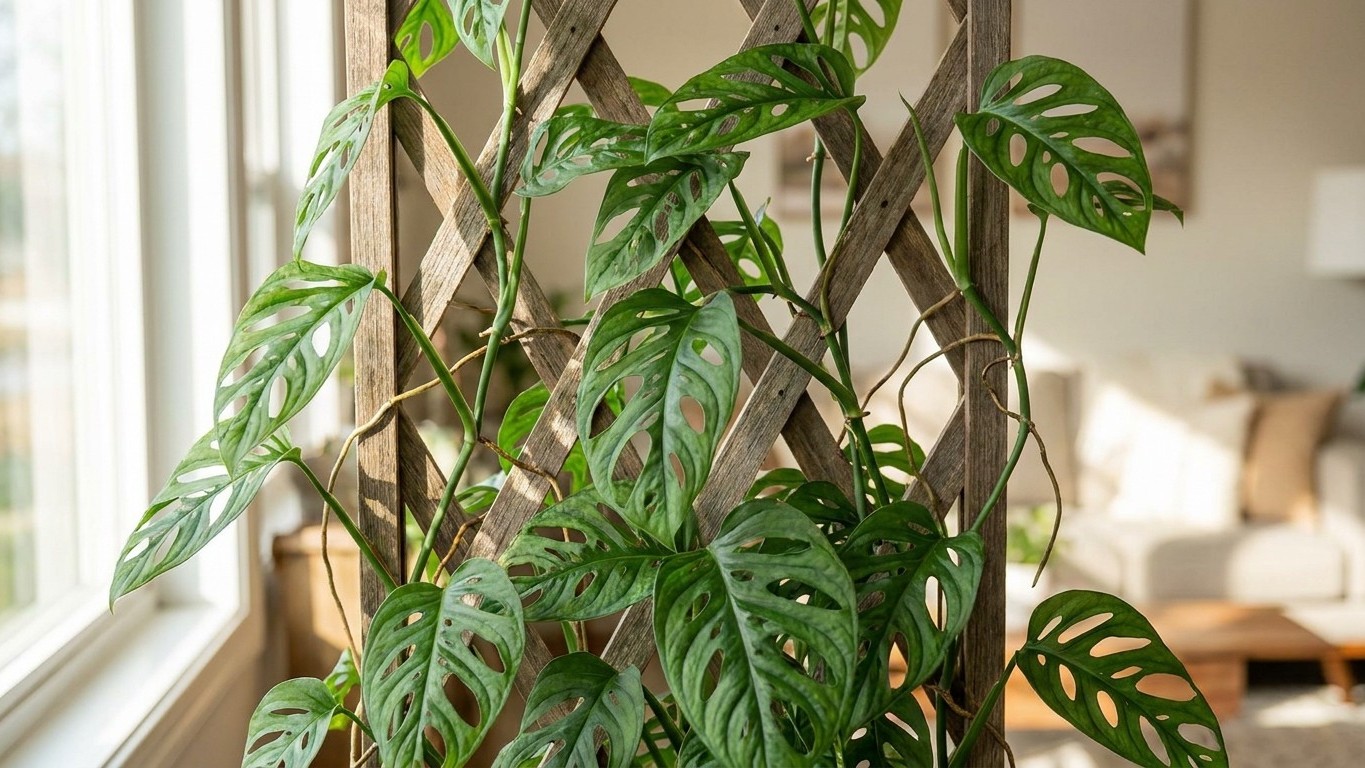
For years, the pothos occupied a throne that nobody thought to question. Walk into any nursery, browse any plant influencer’s grid, ask any garden center employee about an indoor trellis climber, and the answer was practically automatic: get a pothos. Dependable, near-indestructible, happy in dim corners. The plant equivalent of a reliable family car. But the conversation has shifted, quietly, without fanfare, and the plant that’s increasingly replacing it on indoor trellises grows faster, looks more dramatic, and rewards the grower with something pothos simply cannot deliver.
That plant is Monstera adansonii, the Swiss Cheese Vine. And the speed difference is the first thing worth understanding.
Key takeaways
- A plant that outgrows its trellis faster than you can blink—even experienced growers are surprised by the speed
- Aerial roots that actively seek climbing surfaces instead of hanging downward—the plant does the work for you
- Leaves that expand as the plant ascends, creating dramatically larger visual coverage than pothos can match
The Growth Gap Nobody Talks About
Pothos has always carried a reputation as a fast grower, and that reputation is not entirely undeserved. Pothos is the faster grower of the two when compared directly to heartleaf philodendron: in bright indirect light with consistent watering during the growing season, a pothos vine can add 12 to 18 inches of new growth per month. That sounds impressive. The problem is what happens on a trellis specifically.
Pothos naturally vines horizontally or hangs downward from their pot unless there is more sunlight to reach up for. That default trailing instinct means that on a vertical trellis, you are constantly working against the plant’s grain. You’re guiding, clipping, redirecting. The plant wants to cascade; you want it to climb. Training them is as simple as guiding the vines where you’d like them to go and securing them with hooks or twine if needed, but that “if needed” is doing a lot of work. In practice, it means ongoing intervention every few weeks.
Monstera adansonii, by contrast, is a committed climber by nature. Monstera adansonii is a natural climber because it has climbing genes written into its DNA. Its aerial roots actively seek vertical surfaces. Put a trellis in its pot, and it starts working toward the structure on its own terms. One grower notes that their Swiss Cheese Vine grows fast indoors, repotted a few years ago, four months later it already needed a taller trellis. That kind of momentum is difficult to replicate with pothos.
What “Twice as Fast” Actually Means on a Trellis
The claim isn’t just about raw vine length. Coverage speed on a trellis depends on two things working together: how quickly the plant produces new nodes, and how instinctively it grips its support. According to Justin Hancock, Horticulturalist and Director at Costa Farms, “Little Swiss Monstera (Monstera adansonii) is great for its fenestrated leaves and super-quick growth habit,” adding that “it climbs more as it gets older.” That compounding behavior, more climbing as it matures, is the key advantage over pothos, which tends to plateau in vertical coverage unless you continue to train it manually.
There is also the leaf size factor. Monstera adansonii is a vining plant that in the wild uses its aerial roots to find a tree to climb, and as the vine climbs it begins to receive more light and grows larger and larger leaves in response. Bigger leaves mean more visual coverage per node. A pothos leaf stays relatively consistent in size indoors; a Monstera adansonii leaf expands as the plant ascends. As a trailing vine, Swiss Cheese plants can develop trails of 13 feet and may need to be pruned regularly, while when allowed to climb, these plants can easily reach heights of 10 feet indoors, allowing for quite an impressive display.
The fenestrations, those distinctive holes in the leaf, are not just decorative. The characteristic holes, or windows, on Monstera adansonii leaves serve the purpose of allowing wind to pass through the plant in the wild without tearing it off the tree it has chosen to climb. Structurally, those openings make the plant more stable as a climber, reducing the drag that can cause vines to detach from their support.
The Pothos Problem on a Flat Trellis
Pothos does have a genuine limitation that most nursery staff, understandably, don’t lead with. It does work, to some extent, to grow a pothos on a trellis. However, the primary benefit of a moss pole is that it gives climbing plants something to dig their roots into. A flat wooden or metal trellis offers no moisture, no texture, and no grip anchor for pothos aerial roots, which are thick, singular nubs, one per node. Growing pothos on a trellis works to some extent, but the primary benefit of a moss pole is that it gives climbing plants something to dig their roots into — a moss pole is similar to the bark and moss the plant would encounter in nature. With moss poles, you can mist your plants regularly to maintain moisture levels similar to their natural habitat. A trellis simply dries off shortly after being misted.
Monstera adansonii handles a flat trellis considerably better. A trellis resembling a ladder or lattice made of wood, bamboo, or metal can be used, and it can be relatively easy to encourage Monstera adansonii to grow on a trellis since there are so many different sections of the structure on which the plant can take hold. The plant’s multiple aerial roots per node spread across the structure rather than hunting for a single anchor point, distributing grip across the entire support.
How to Set It Up, and What to Expect
The setup is straightforward. When training your Monstera adansonii, one of the most important things is finding the right support for your plant. A stake or trellis can provide the perfect structure for it to climb, and training it on a support will encourage it to grow vertically rather than spreading out horizontally. Insert the trellis into the soil before repotting if possible, disturbing established roots later is never ideal, then use soft garden ties to guide the first few vines upward. After that, the plant largely takes over.
Light is the single biggest variable in coverage speed. According to Justin Hancock, “The most important thing is to provide good light levels. While a fast-growing vine like Pothos will tolerate low light levels, it means it’s the minimum amount of light it needs to survive. However, the more light it gets indoors, the more it will thrive. Any plant, even those labeled as low light, will appreciate a brighter spot in your home.” For Monstera adansonii specifically, bright indirect light near a window will produce noticeably denser, faster coverage than a dim corner, they’ll tolerate low light, but you’ll see little growth, and the plant becomes very spindly.
Watering needs one note of caution. The plant “climbs more as it gets older, and prefers medium to bright indirect light” but “is sensitive to overwatering, so let the top couple of inches of soil dry out between waterings.” This is where the comparison tilts back slightly in pothos’ favor: pothos stores water in its thick, waxy leaves and can go 2 to 3 weeks between waterings without significant damage. Monstera adansonii is more forgiving than its reputation suggests, but it does want attentive watering, not the benign neglect that pothos famously survives.
One detail worth knowing before you commit: one grower found that their Monstera adansonii quickly outgrew its trellis and, after finding the wall behind it, attached to the surface and began to climb up it, which looked amazing and natural, however the vines will cause damage to paint and drywall if left unchecked. Position your trellis accordingly, and plan for it to need a taller replacement sooner than you’d expect. That, in its way, is the plant making its case for itself.
Sources : livingetc.com | idealhome.co.uk