
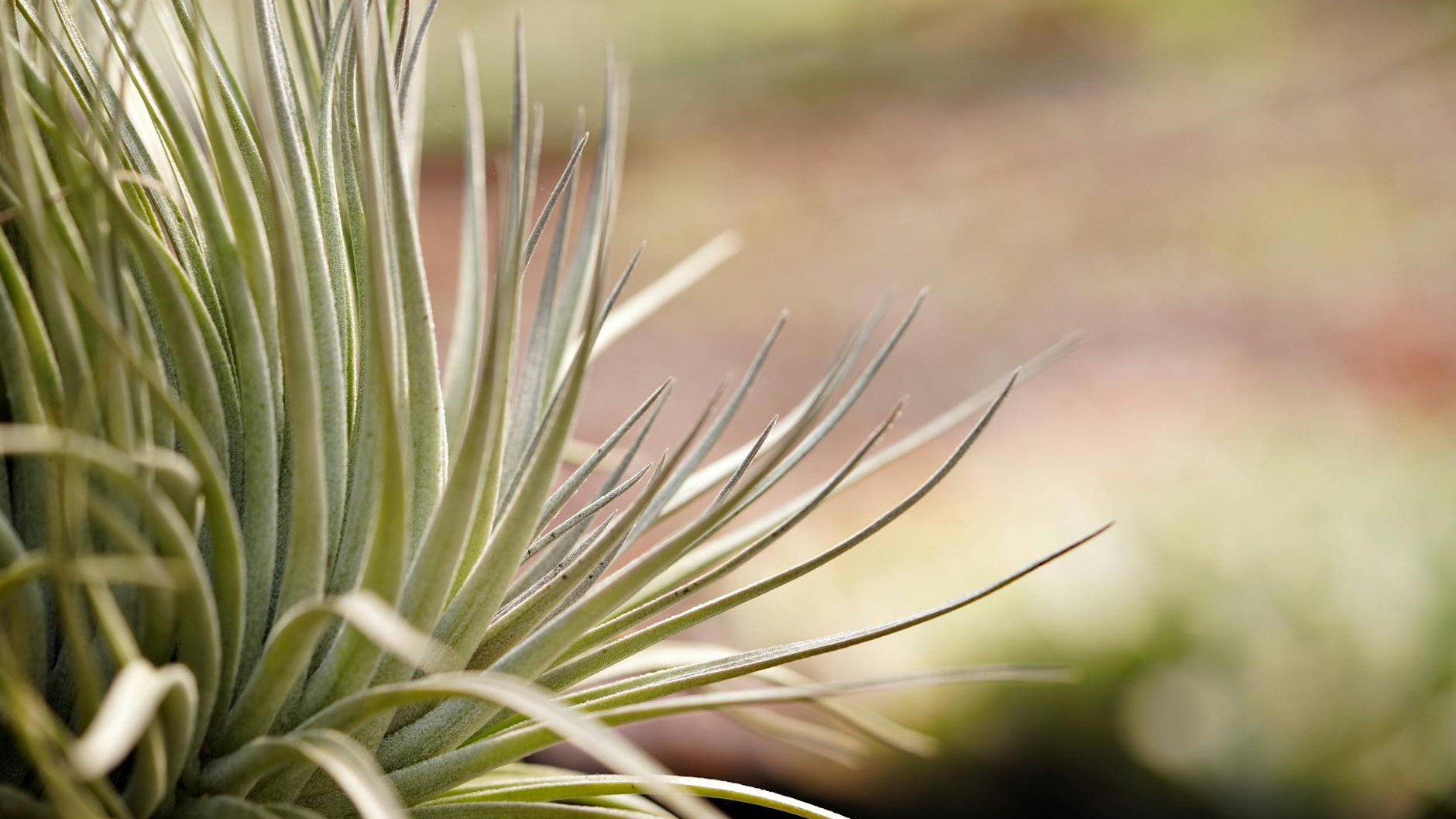
Air plants — Tillandsia, technically, are marketed as the ultimate low-maintenance houseplant. No soil, no fuss, just mist them once in a while and watch them thrive. The reality is more complicated, and the evidence hides in plain sight: those tiny white or silver hairs covering every leaf, called trichomes, are doing something far more sophisticated than most plant owners realize. When they start looking dull, matted, or weirdly flat despite regular watering, tap water is almost certainly the culprit.
Key takeaways
- Air plants don’t absorb water through roots—those tiny white hairs called trichomes are doing all the work, and tap water is silently destroying them
- Mineral deposits from hard water physically clog trichomes and damage their valve mechanism, making your plant less efficient at surviving between waterings
- The damage is invisible until it’s severe—but you can spot it by running your finger along the leaf or holding it to light
Trichomes: the organ you’ve been ignoring
Unlike almost every other plant on Earth, air plants have no functional roots for water absorption. Their roots exist purely for anchoring, to a rock, a branch, a piece of driftwood. The real work happens through trichomes, those hair-like scales that give Tillandsia leaves their characteristic fuzzy or silvery sheen. Each trichome is a specialized dead cell structure with a living base that opens and closes like a tiny valve, pulling moisture and dissolved nutrients directly from the air.
Under a magnifying glass, healthy trichomes look almost architectural, layered, slightly raised, with a pale silvery-white color that reflects light. This reflectivity isn’t decorative. In their native habitats (Central America, the American Southwest, coastal regions of South America), it bounces back intense sunlight to prevent scorching. A plant with vibrant, raised trichomes is genuinely thriving. A plant with flattened, translucent, or slightly brownish trichomes is struggling — even if the leaves themselves haven’t curled yet.
What tap water actually deposits on those hairs
Here’s where it gets interesting. Tap water in most U.S. cities contains chlorine, chloramines, fluoride, and dissolved minerals, primarily calcium and magnesium carbonates, which are responsible for what’s commonly called “hard water.” When you mist or soak your air plant with tap water and the water evaporates, those minerals don’t evaporate with it. They stay behind, deposited directly onto and inside the trichome structure.
Over time, this mineral buildup does two damaging things. First, it physically clogs the trichome openings, reducing the plant’s ability to absorb moisture from the surrounding air between waterings. The plant can look perfectly plump and green for weeks while slowly becoming less and less efficient at doing the one thing it needs to survive. Second, the calcium deposits change the surface tension around each trichome, which affects how the plant regulates its own hydration. A clogged trichome can’t close properly, meaning the plant loses moisture faster than it should.
The chlorine issue is separate but compounding. While chlorine dissipates from still water within about 24 hours, chloramines, used by many municipalities as a more stable disinfectant, do not. Chloramines can irritate trichome cells at the base, gradually damaging the living tissue that controls the valve mechanism. The plant doesn’t die dramatically; it just declines slowly, becoming increasingly brittle and less responsive to watering. By the time the leaves show visible stress, the trichome damage has been accumulating for months.
The simple test and the simple fix
Run your fingertip very gently along a leaf. Healthy trichomes feel slightly rough or fuzzy, like fine velvet or the surface of a moth’s wing. If the leaf feels almost smooth or slightly sticky, that’s mineral residue filling in the texture. Hold the plant up to a window. Healthy trichomes catch and scatter light in small flashes across the surface. A plant with clogged trichomes looks uniformly matte, almost chalky.
The fix isn’t complicated, but it does require switching water sources. Rainwater is the gold standard, collected rainwater has virtually no dissolved minerals and no chemical additives, and research on bromeliad care (air plants belong to the bromeliad family) consistently points to it as the optimal choice. Distilled water works just as well for mineral content, though it lacks the trace nutrients that rainwater picks up from the atmosphere. Filtered water through a reverse osmosis system is a solid third option. What doesn’t help much: running tap water through a standard Brita-style carbon filter. Those filters remove chlorine taste and some heavy metals, but they don’t soften hard water or remove fluoride.
If you’re committed to reversing existing trichome damage, a 24-hour soak in distilled water once a month can help flush out some of the accumulated mineral deposits. Don’t expect miracles, heavily clogged trichomes don’t fully recover, but newer growth will develop cleanly if you maintain the better water source going forward.
Why this matters more than any watering schedule
Most air plant advice focuses on frequency: soak once a week, mist every few days, adjust for humidity. That framing misses the point. A plant soaked twice a week in hard tap water is worse off than a plant soaked once every ten days in rainwater. The trichomes need to function between waterings, pulling whatever ambient humidity exists in your home. In a typical American house running central heating or air conditioning, indoor humidity often sits between 30% and 50%. That’s manageable for a Tillandsia with healthy trichomes; it’s genuinely stressful for one whose absorption mechanism has been compromised by mineral buildup.
There’s also a species dimension worth knowing. Varieties with more pronounced silver coloring — Tillandsia xerographica, T. tectorum, T. argentea — have denser trichome coverage precisely because they evolved in drier, higher-altitude environments where efficient moisture capture is survival-critical. These species are actually more sensitive to tap water damage than the greener varieties, despite looking more robust. The silvery appearance that makes them so visually striking is exactly what’s at risk.