
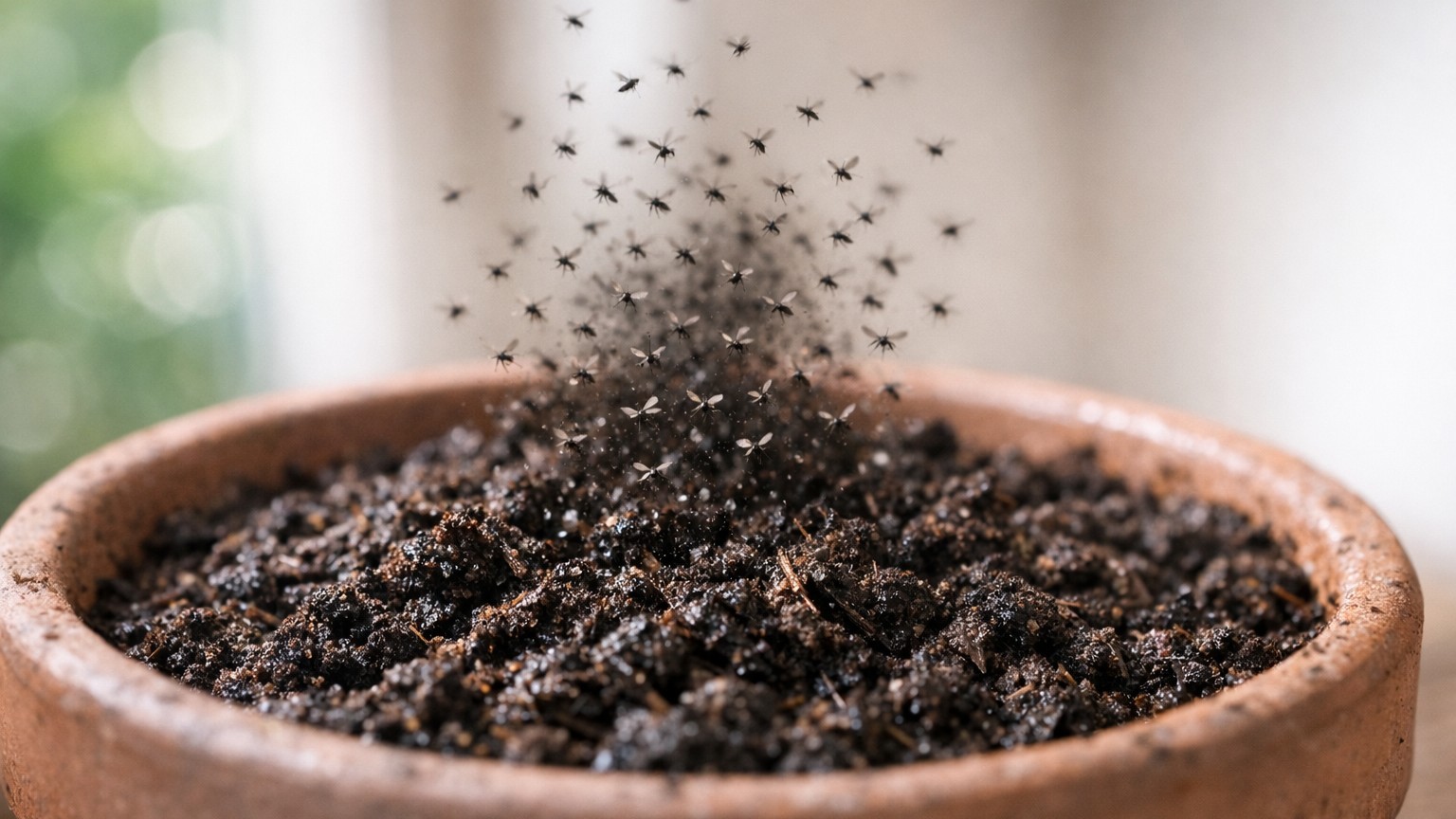
Fungus gnats don’t announce themselves politely. One morning you set your watering can down, brush the soil surface with your fingers, and a small dark cloud lifts into the air like something out of a horror film. That moment, for many indoor plant enthusiasts, is the beginning of an uncomfortable education about overwatering, and about the hidden ecosystem living just beneath the surface of every pot in your home.
Key takeaways
- That cloud of tiny flies emerging from your soil is a four-generation colony that’s been quietly expanding for weeks
- Roots need oxygen as much as water—waterlogged soil slowly suffocates plants and invites deadly pathogens you can’t see
- The weight-of-the-pot method reveals truths no watering schedule ever could, and it’s simpler than you think
The logic that made perfect sense (and was completely wrong)
Keeping potting mix consistently moist feels intuitive. Plants need water. Water is good. So more water, more consistently, should mean healthier plants. This reasoning sounds reasonable until you remember that roots don’t just drink, they breathe. Plant roots require oxygen to function, and waterlogged soil squeezes out the air pockets that make that possible. Chronic dampness doesn’t sustain a plant; it slowly suffocates it.
The fungus gnat problem is almost a side effect of that suffocation. Bradysia species, the most common household fungus gnats, lay their eggs in the top two inches of moist organic matter. A potting mix kept perpetually damp is, from their perspective, a five-star nursery. The larvae feed on fungi, decomposing material, and, crucially, fine root hairs. One adult female can lay up to 300 eggs in her short life. A “cloud” rising from a single pot can represent the third or fourth generation of a colony that has been quietly expanding for weeks.
What the soil is actually telling you
The standard advice, “water when the top inch of soil is dry”, exists for a reason, but it’s a starting point, not a universal law. Different plants, different pot sizes, and different seasons change the equation entirely. A six-inch terracotta pot filled with a succulent mix dries out in two days during a dry winter with the heat running. A large plastic nursery pot holding a tropical philodendron might still hold moisture a week after watering. Applying the same schedule to both is a recipe for trouble with at least one of them.
A more reliable method: lift the pot. A pot with wet soil is noticeably heavier than one that’s ready to be watered. It sounds almost too simple, but the weight difference is genuinely striking once you’ve done it a few times. Moisture meters exist and can be helpful, though cheaper models often give inconsistent readings in organic-rich mixes. Your hands and a sense of the pot’s weight will rarely mislead you.
There’s also the question of what “potting mix” actually means in 2026. Many commercial mixes have shifted toward peat-free formulas using coir, bark, and wood fiber. These materials behave differently from traditional peat, they can feel dry on the surface while retaining moisture deeper in the pot. That surface dryness is not necessarily a signal to water immediately.
Getting rid of the gnats (and not just the adults)
Killing the flying adults with a sticky yellow trap feels satisfying and does reduce the population, but it addresses the symptom rather than the source. The larvae are in the soil, and that’s where the intervention has to happen. Allowing the potting mix to dry out more aggressively between waterings is the single most effective step, gnat larvae cannot survive in dry conditions. In practice, this means letting the top two to three inches dry completely before watering again, which is more extreme than most plant owners are comfortable with initially.
For persistent infestations, a soil drench with a Bacillus thuringiensis var. israelensis (Bti) solution has strong scientific backing. Bti is a naturally occurring bacteria that targets the larvae of fungus gnats, mosquitoes, and blackflies without harming plants, pets, beneficial insects, or humans. Products based on this organism are widely available under various brand names, and the mechanism is well-documented in horticultural research. A few applications, combined with a drier watering routine, typically resolve even a heavy infestation within four to six weeks, roughly two gnat life cycles.
Some growers swear by a thin layer of coarse horticultural sand or fine grit spread across the soil surface. The logic holds up: adult females prefer to lay eggs in soft, moist organic matter, and a dry, gritty top layer is unattractive to them. It won’t fix an existing infestation on its own, but as a preventive measure after treatment, it adds a useful physical barrier.
Rethinking the watering habit
The hardest part of correcting a chronic overwatering habit isn’t the technical knowledge, it’s the emotional recalibration. Watering feels like care. Putting the can down and walking away from a plant that “looks like it might be thirsty” requires a small act of restraint that goes against the instinct of most dedicated plant owners.
Root rot, the companion problem to perpetual dampness, is far more damaging than mild drought stress. Most common houseplants, pothos, monsteras, ficus, dracaenas, evolved in environments with distinct wet and dry cycles. Their roots are built to handle a period of dry air between waterings. Drought stress in a well-rooted plant typically shows up as slightly limp leaves that recover within hours of watering. Root rot, by contrast, causes leaves that wilt and never fully recover, because the roots delivering water to the plant are already gone.
One detail worth knowing: overwatered soil doesn’t just attract fungus gnats. Persistently wet conditions around the root zone also create ideal environments for Pythium and Phytophthora, two water mold pathogens that account for a significant share of mysterious houseplant deaths every year. The gnats, then, are less a disaster in themselves and more a visible warning, a signal the soil has been too wet for too long, and that slower, invisible damage may already be underway.