
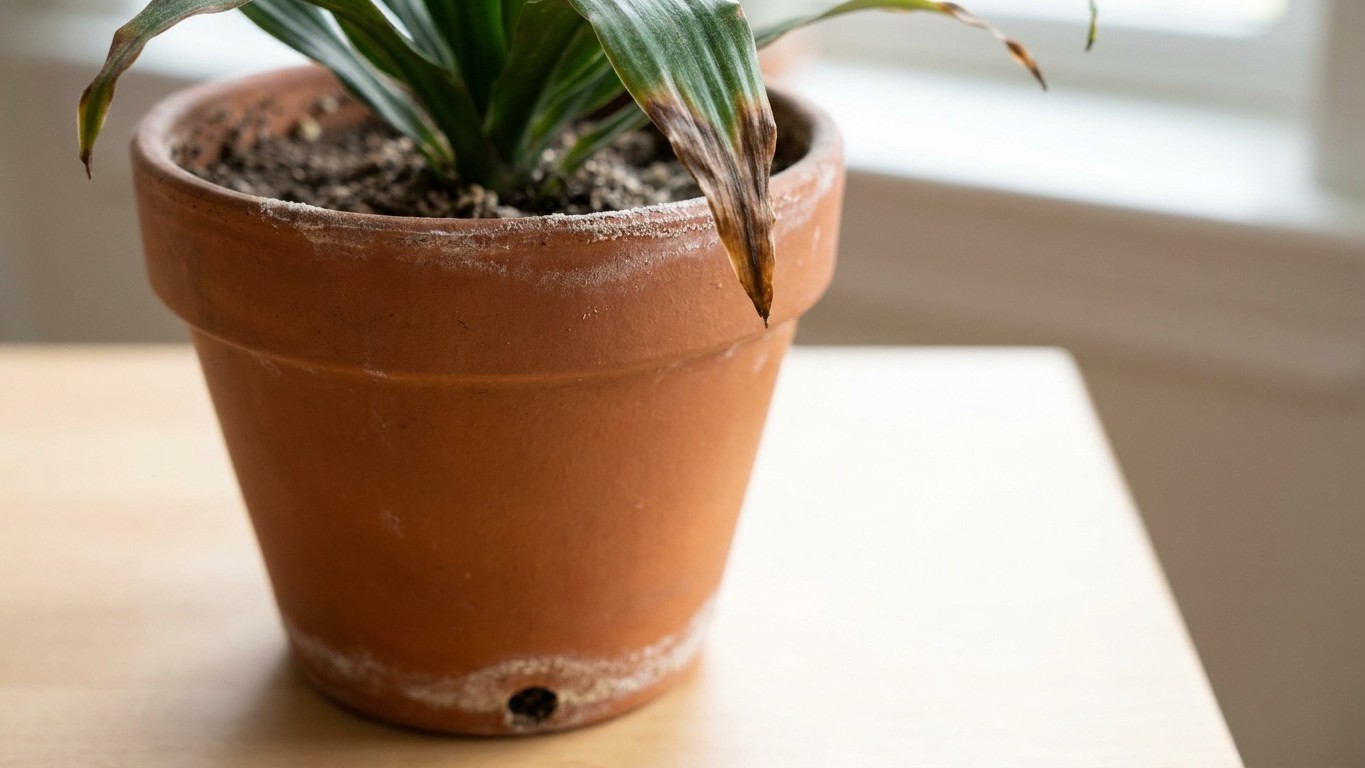
The soil looked normal from the top. Dark, slightly moist, nothing alarming. But two inches down, my finger hit something that felt more like packed clay than potting mix, dry as chalk and laced with a fine white crust along the pot’s inner wall. That’s when it clicked: I’d been running my hose through the house’s water softener for months, and my plants had been drinking salt water disguised as kindness.
The softener does exactly what it’s designed to do. It swaps calcium and magnesium ions for sodium ions through a resin bed, which is great news for your dishwasher and your shower faucet. Terrible news for anything rooted in a pot. Every gallon of softened water carries dissolved sodium into the soil, and unlike calcium or magnesium, sodium doesn’t nourish a plant. It just sits there, and it accumulates, because pots don’t get rained on and flushed the way garden beds do.
Key takeaways
- Your water softener is secretly poisoning your plants with sodium that accumulates in pots with no natural flushing
- Plants can be surrounded by moisture yet still unable to absorb water—a condition called physiological drought caused by salt stress
- One telltale sign you’ve missed: a white crusty mineral deposit around drainage holes and soil surface that appears within weeks, not months
Why the roots were thirsty in soil that felt wet
This is the part that confused me for weeks. I was watering daily. The soil surface was damp to the touch. Yet the leaves on my pothos and my peace lily kept crisping at the edges, curling inward like they were bracing for a drought that, as far as I could tell, wasn’t happening.
Sodium buildup creates what horticulturists call physiological drought. Salt in the soil pulls water toward itself through osmosis, and it pulls harder than the plant’s root hairs can. The water is technically there. The plant just can’t win the tug-of-war to get it. Roots sitting in salty soil are essentially being dehydrated from the outside in, even while surrounded by moisture. Add enough sodium and you also damage root cell membranes directly, which is why some of my plants weren’t just drying out, they were showing blackened, mushy root tips when I finally unpotted them.
According to the U.S. Geological Survey’s water hardness research, softened water can add anywhere from roughly 75 to 400 milligrams of sodium per liter depending on how hard your source water was to begin with (USGS Water Science School). Most Houseplants start showing stress at sodium concentrations well below the top of that range. Ferns, calatheas, and citrus are particularly touchy. Cacti and succulents tolerate it slightly better, though “tolerate” is doing a lot of work in that sentence.
The signs I ignored for too long
Looking back, the pot had been telling me for weeks. A crust of white or yellowish mineral deposit had formed around the drainage holes and along the soil surface near the pot rim, most visible on the darker terracotta pots where it stood out like frost. Water started sitting on top of the soil for several seconds before soaking in, instead of disappearing almost instantly the way it used to.
Leaf tips browning first, then working inward, is a classic salt-stress pattern, distinct from the more even yellowing you’d see with a nitrogen deficiency. Growth had also slowed to almost nothing on three plants I’d assumed were just “resting” for the season. They weren’t resting. They were struggling to move water at all.
Flushing the salt out and switching sources
The fix started with a hard leach. I ran plain, untreated water, roughly three to four times the volume of the pot, through each container slowly, letting it drain fully between pourings. This flushes dissolved sodium out through the drainage holes rather than letting it recirculate in a saucer, so emptying that saucer immediately matters as much as the leaching itself. I repeated the process twice over two weeks for the worst-affected pots.
For ongoing watering, I switched to water drawn from a tap before it passes through the softener, most homes have at least one hose bib or kitchen line plumbed to bypass the unit specifically for outdoor use and drinking. If that’s not an option in your house, rainwater collected in a barrel works well and costs nothing. Distilled water or water run through a reverse osmosis system also works, though it’s a pricier habit to maintain for a large collection of plants.
Repotting was necessary for two of mine. The white crust wasn’t only sitting on the surface, it had worked into the top inch of soil, and root damage was advanced enough that fresh, sodium-free potting mix gave them a better shot than leaching alone. Within three weeks of the switch, new leaf growth on the pothos came in without the tell-tale brown edge, and the peace lily, which had looked terminal, pushed out two new shoots from the base.
A quick way to check your own pots
Run a finger along the soil surface near the pot’s rim and check the drainage holes for a chalky white residue. Then dig down an inch or two with a chopstick or your finger. Soil that resists easily, feels unusually dense, or smells faintly sour rather than earthy is worth a leaching session regardless of what your watering schedule says.
One detail surprised me more than anything else in this whole process: the softener had been installed for nearly two years before I started using that line for my plants, and the damage still showed up within a single season. Sodium doesn’t need much time to concentrate in a container that holds maybe two gallons of soil total. Garden beds have the whole water table to dilute the problem. A six-inch pot has nowhere for that salt to go except deeper into the roots you’re trying to keep alive.