
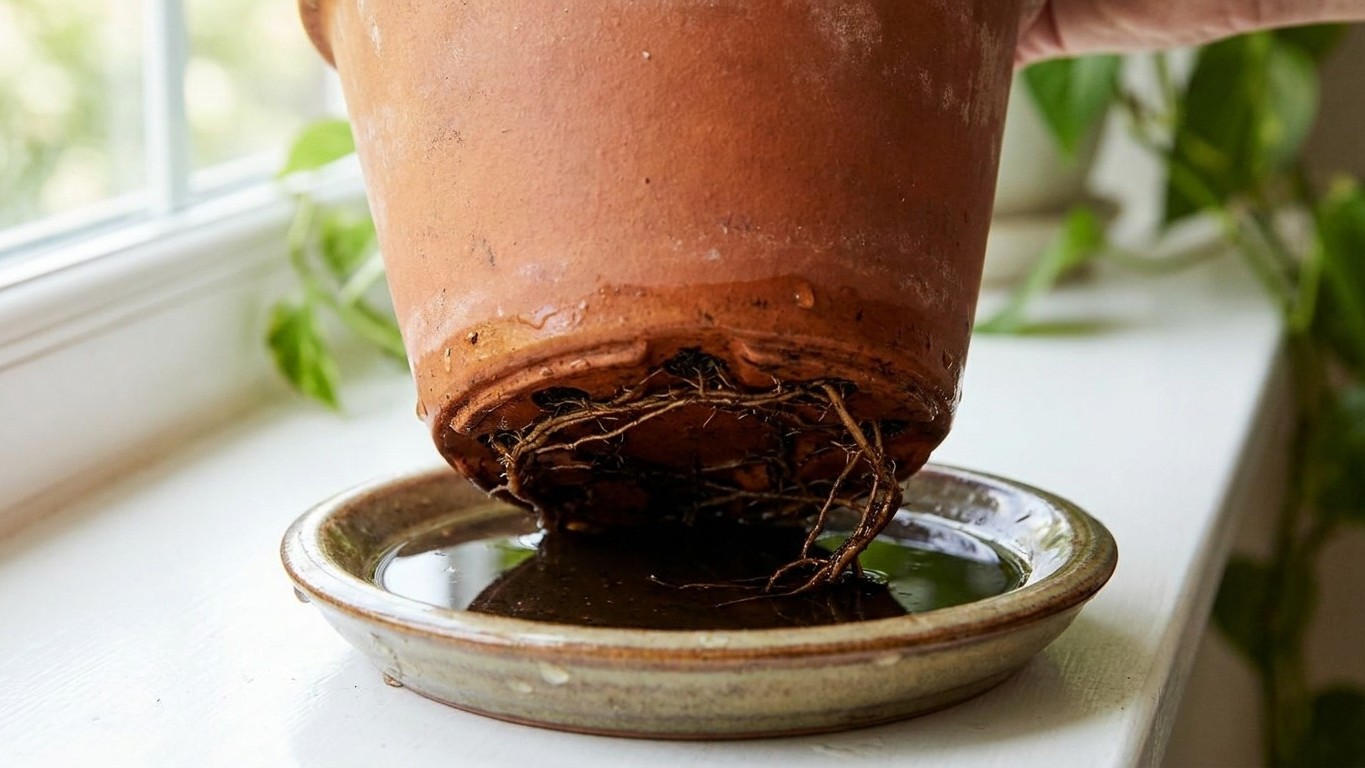
Lift any pot that has been sitting in its saucer for weeks, and you might discover a dark, swampy mystery underneath. That’s exactly what happened here, after months of daily watering, the moment the pot cleared its saucer, the culprit was obvious: a dense tangle of brown, circling roots plastered to the drainage holes, sitting in a thin film of permanently stagnant water. The plant above looked merely “tired.” Below, it was quietly suffocating.
Key takeaways
- A plant sitting in a water-filled saucer for just one night is already drowning—the safe window is only 2-3 hours
- Roots can circle the soil and literally choke the plant like a tightening zip tie, with damage hidden completely underground
- Daily watering on a schedule, not based on soil moisture, is one of the most reliable ways to kill a houseplant in slow motion
The Saucer Is Not Your Friend (Unless You Use It Correctly)
Most plant owners know saucers exist to catch overflow. Fewer realize that overflow left sitting there becomes a trap. Allowing your plants to sit in a water-filled saucer is one of the most common, and damaging, mistakes in indoor plant care. The problem is mechanical: the roots can get no oxygen because they are literally drowning in water, and the pores between the soil particles fill with water instead of oxygen, so the roots are suffocating. That’s not a slow decline, that’s an active emergency playing out in slow motion beneath your windowsill.
The counterintuitive part? The plant often appears dry because it has wilted, but if the roots are compromised, watering won’t help, because the roots cannot get water to the parched plant. So you water more. The saucer fills again. The cycle compounds itself, week after week. Daily watering, however well-intentioned, can become the most reliable way to kill a houseplant in slow motion.
A plant should not sit in a wet tray for more than 2 to 3 hours. Sitting for an extended period in a wet tray will often lead to root rot. That window is shorter than most people assume. A saucer left unattended overnight, something that happens in virtually every home, is already past the safe threshold.
What’s Actually Happening Underground
Root rot usually develops when soil stays wet for too long, giving fungi and water molds ideal conditions. The organisms responsible aren’t exotic. Most houseplant root rot problems are caused by water molds such as Phytophthora and Pythium, as well as true fungi including Rhizoctonia and Fusarium — organisms that thrive in damp conditions and can survive in the soil for many years. These aren’t pathogens you introduced. They were already there, waiting for the right conditions. Daily watering handed them exactly that.
Root circling adds a second, structural layer of damage that gets far less attention. Roots can become girdled if a plant is grown in a pot for too long, forcing roots to grow in a circular pattern around the root ball, and as the circling roots increase in diameter, they may choke the plant at the crown. Think of it as the plant equivalent of a zip tie tightening around a garden hose: water and nutrients still enter the system, but the flow gets progressively restricted. These circling roots can encircle the trunk, effectively strangling the plant by restricting the flow of water and nutrients from the roots up to the leaves — and plants that experience this often decline in health before eventually dying.
The reason this goes undetected for so long is structural. Many times, girdling roots go undetected because the damage is happening below the surface, and the symptoms are often mistaken for disorders associated with other stressors. Yellow leaves? Probably needs fertilizer. Wilting despite wet soil? Maybe needs more light. The real diagnosis requires lifting the pot and actually looking.
How to Read the Roots Before It’s Too Late
The inspection itself takes thirty seconds and tells you everything. Healthy roots are firm and light-colored. Roots affected by rot turn brown or black and become soft and mushy. Root rot often has a noticeable odor, similar to rotting vegetables. If you slide a plant out of its pot and it smells like a compost bin, the damage is significant. If the roots are still pale and firm, closer to uncooked spaghetti than soggy noodles, you caught it in time.
Lift the pot: if it seems inordinately heavy or if water is still draining from the drainage holes, your plant is waterlogged, and it’s best to start over and repot with new potting medium. Weight is an underrated diagnostic tool. A properly watered pot in well-draining soil should feel noticeably lighter a day or two after watering. If it stays heavy for days, the soil isn’t draining, it’s holding.
For the rescue itself: trim the damaged roots and repot in fresh, dry soil. Loosen the root ball slightly to allow air to circulate, and consider poking a few narrow holes through the topsoil and into the roots to allow for better drainage and air circulation. If you’re working with a large floor plant that’s too heavy to move, a turkey baster can suck the water out of a saucer without disturbing the plant. Low-tech, but it works.
The Watering Logic That Actually Holds Up
Daily watering feels like attentiveness. It’s actually a schedule masquerading as care. Many plant owners water on a schedule instead of checking the soil first, and watering when the top inch of soil is still moist leads to waterlogged roots over time. The fix is a simple shift in habit: the rule of thumb for most plants is to water only when the top inch of soil has dried. Use your finger or a moisture meter to test the soil, and only then, water the plant.
Plants in low light or cooler rooms use less water because their growth slows down, if you water them as often as your brighter, warmer plants, they can easily become overwatered. A monstera sitting two feet from a north-facing window in January needs a fraction of what it needs in July on a sunny sill. Same plant, radically different thirst. Treating them identically is where the trouble starts.
One underappreciated detail about soil mix: a balanced potting mix contains around 40% peat moss, 30% perlite, and 30% composted bark, and for succulents, coarse sand replaces peat. This structure retains enough water for roots while allowing excess to drain quickly. Dense, peat-heavy mixes sold in generic bags stay wet far longer than roots can tolerate. Mixing in perlite before potting Costs Almost Nothing and solves the problem before it starts — which is easier than rescuing a strangled root ball three months down the line.
Sources : healthyhouseplants.com | thehouseplantguru.com