
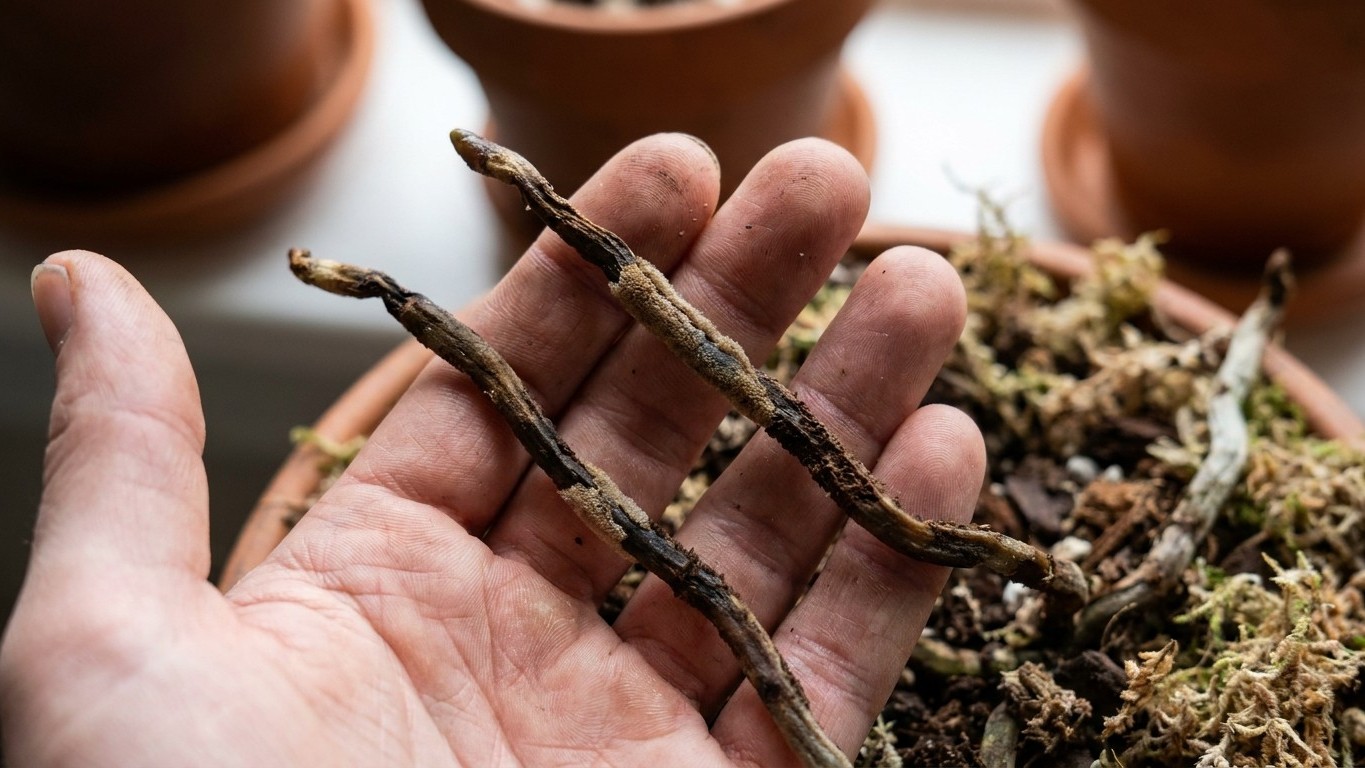
The roots were brown. Soft in places, almost translucent. Some came off in my fingers without resistance. After months of what I genuinely believed was careful, controlled watering, my orchid had been slowly rotting from the base up, and I had no idea.
The ice cube method is everywhere. Pinterest boards, Facebook gardening groups, the little care tag that came tucked into the plastic pot when I bought the plant at the grocery store. The pitch is seductive: place two or three ice cubes on the potting medium once a week, let them melt slowly, and you’ve perfectly controlled the water intake for a plant notorious for punishing overwatering. Clean. Simple. Foolproof. Except it isn’t.
Key takeaways
- A widely-recommended orchid watering trick is actually causing silent damage to roots for weeks before symptoms appear
- The scientific reason behind why this popular method backfires has everything to do with temperature and plant biology
- What one gardener found when they finally unpotted their dying orchid shocked them—and changed how they approach plant care forever
Why the ice cube method sounds logical but isn’t
The reasoning behind the technique has a surface appeal. Orchids in their natural habitat, clinging to tree bark in tropical forests, not sitting in pots on windowsills — do experience alternating wet and dry cycles. Slow, controlled water delivery mimics that restraint. The ice cube advocates aren’t entirely wrong about the principle. Where the method breaks down is the temperature.
Most popular orchids sold in the U.S. are Phalaenopsis, native to Southeast Asia and northern Australia, where temperatures rarely dip below 60°F even at night. Their roots are adapted to warm conditions. Applying ice directly to those roots, which in a transparent plastic pot you can sometimes see pressing right against the medium — exposes them to temperatures hovering near 32°F for the duration of the melt. University of Maryland Extension recommends room-temperature water for orchids specifically because cold water can damage the root tissue and shock the plant’s vascular system.
The damage doesn’t show up immediately. That’s the insidious part. The roots look fine for weeks. The leaves stay glossy. You think you’ve cracked the code. Meanwhile, repeated cold stress weakens the cell walls in the root tips, making them more susceptible to fungal rot, which thrives happily in the enclosed, bark-filled environment of a standard orchid pot.
What unpotting actually revealed
When I finally slipped the plant out of its pot (prompted by a bloom spike that had stalled for three months with no new buds), the damage was layered. Healthy orchid roots have a distinctive look: plump, silvery-green when dry, bright green when freshly watered, with white velamen, the spongy outer coating that absorbs moisture. Mine had velamen that had gone soft and mushy in patches, with dark brown discoloration spreading from the root tips inward.
Some roots had failed completely. They detached without any pulling, which is not something a healthy root does. The potting bark at the base of the pot, where the ice pooled as it melted, was staying wetter longer than the upper layers. So the coldest water was also concentrating at the crown-adjacent roots, the ones that matter most for nutrient uptake.
I cut away Everything soft with sterilized scissors, dusted the cuts with cinnamon (a mild antifungal that works reasonably well on orchid wounds), and repotted into fresh bark. The plant lost roughly 40% of its root system. That’s not a minor setback for a plant that can take 12 to 18 months to fully re-establish its root structure.
How to actually water a Phalaenopsis without killing it
The method that works, and that professional orchid growers and university extension programs consistently recommend — is the soak-and-dry approach. Take the plastic nursery pot, place it in a sink, and run lukewarm water through the bark slowly for about 30 seconds, letting it drain completely through the bottom holes. Then wait. Don’t water again until the bark feels dry when you stick a finger an inch down, and the roots visible through the pot walls have shifted from green to silver-gray. That color change is your actual watering cue, no calendar, no guessing.
In most U.S. homes during winter with heating running, that cycle works out to roughly every 7 to 10 days. In summer humidity, it might stretch to 12 days. The point is you’re reading the plant, not following a fixed schedule. Orchids are more drought-tolerant than most people assume. Missing a watering by a few days causes far less damage than watering too soon.
Fertilizing matters too, though it’s secondary. A diluted balanced fertilizer, “weakly, weekly” is the phrase orchid growers use, applied at quarter-strength with every other watering supports new root growth during recovery. Skip the fertilizer entirely on dry bark; it can burn exposed root tips.
The grocery store care tag problem
The ice cube instruction persists partly because it’s proprietary retail advice, developed as a convenience hack for consumers who might otherwise overwater and return dead plants. At least one major commercial orchid grower has printed ice cube instructions on their care tags for years. The logic was customer retention, not horticultural accuracy.
This matters because most Americans buy their first orchid at a grocery store or big-box retailer, not a specialty nursery. The care tag becomes the default authority. And when the plant dies six months later, the owner assumes orchids are just difficult, not that the advice they followed was flawed from the start.
My plant bloomed again about eight months after the repot, producing seven flowers on a single spike. The roots filling the new pot were white, firm, and visibly extending outward, which is exactly what healthy velamen looks like when a plant has finally found conditions it can trust. The recovery took longer than the damage did. That asymmetry is worth keeping in mind the next time a care shortcut sounds too clean to argue with.