
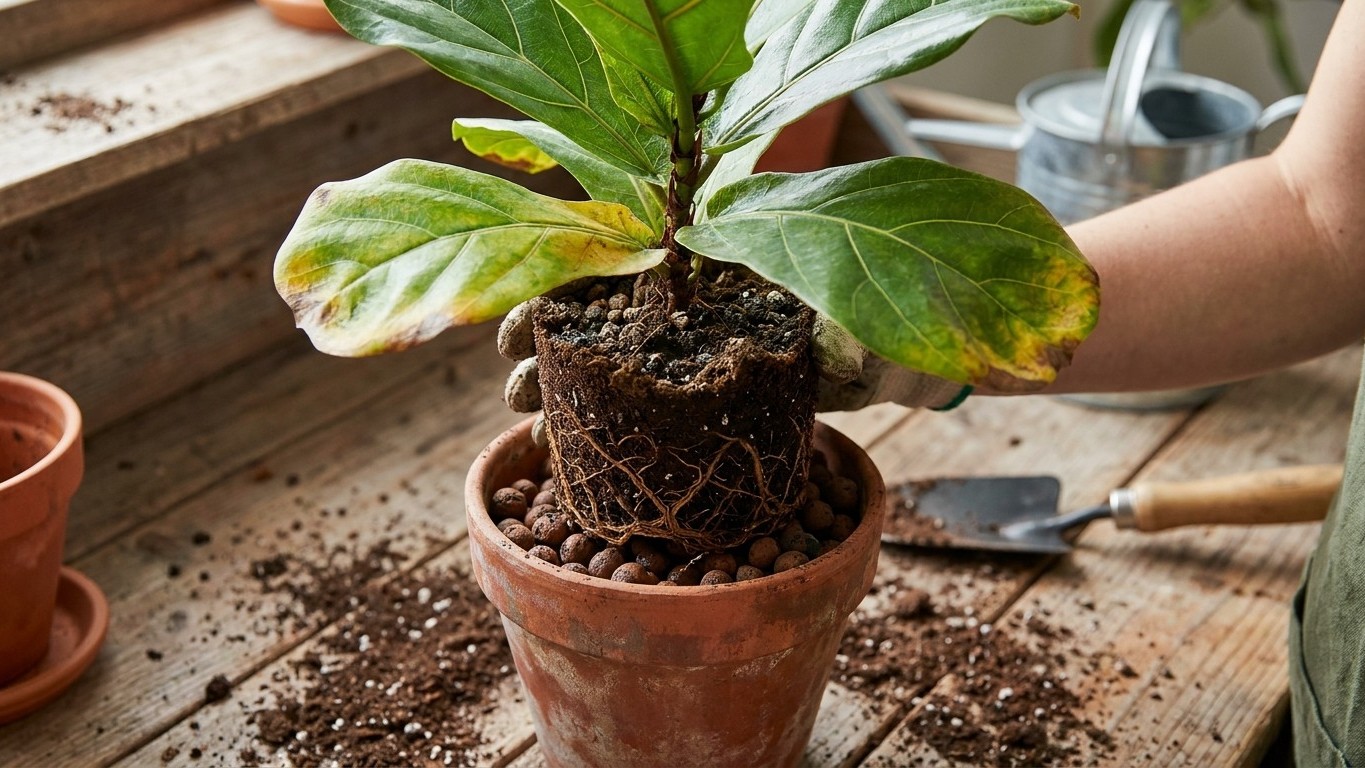
The plant was a fiddle-leaf fig, root-bound and yellowing despite a “perfect” drainage layer of clay pebbles at the bottom of its terracotta pot. When it finally came out for a repot, the bottom two inches of soil were black, waterlogged, and sour-smelling. The pebbles hadn’t drained anything. They’d created a swamp.
This is the part nobody tells you when they recommend clay pebbles (also called LECA, or lightweight expanded clay aggregate) as a drainage fix for regular potted plants: physics doesn’t work the way most gardening advice assumes it does.
Key takeaways
- A decorative layer of clay pebbles at the pot bottom doesn’t drain water—it traps it through capillary action, creating a soggy band where feeder roots live
- University extension programs have debunked this myth for years: water doesn’t move between different materials until the finer soil above is completely saturated
- The real drainage heroes are pot holes, soil mix structure, and watering frequency—not what you layer underneath
Why a Layer of Pebbles Actually Traps Water
Water doesn’t move between two different materials until the finer material above is fully saturated. Soil scientists call this a “perched water table,” and it’s been documented for decades in horticultural research, including studies from university extension programs on container drainage. Soil holds onto water through capillary action, the same force that lets a paper towel wick up a spill. Loose, chunky clay pebbles have far bigger gaps between them, so water sitting in the soil just above the pebble layer has nowhere to go until gravity finally overwhelms that capillary grip.
The result is a soggy band that sits right above the pebbles, not at the very bottom of the pot but a few inches up, exactly where a lot of feeder roots live. Instead of draining the pot faster, the pebble layer often makes it hold more water overall, because you’ve effectively shrunk the amount of usable soil space while adding a reservoir underneath it.
Cornell University’s home gardening program and multiple university extension services have pushed back on the pebble-layer myth for years, pointing out that adding gravel or pebbles to the bottom of a pot without drainage holes doesn’t add drainage at all, and in a pot that already has holes, it just shifts the flooded zone upward into the root ball.
The Drainage Hole Does the Real Work
A pot’s actual drainage capacity comes almost entirely from its holes and the soil mix itself, not from what you layer underneath. Excess water needs a continuous path down and out. Chunky pebbles interrupt that path instead of extending it.
Three factors matter far more than any bottom layer:
- The size and number of drainage holes (one small hole in a large pot is often not enough)
- The soil mix’s own structure, with perlite, pine bark, or coarse sand mixed throughout rather than layered at the bottom
- How much you water and how often, since overwatering frequency causes more root rot than pot design ever will
Pumice or perlite mixed directly into the potting soil works differently than a pebble layer because it breaks up compaction throughout the whole root zone, not just at the base. That keeps air pockets distributed everywhere roots actually grow, instead of concentrating drainage material in a spot roots rarely reach until the plant is badly root-bound.
When Clay Pebbles Actually Help
None of this means clay pebbles are useless. They’re excellent for a specific technique called semi-hydroponics, where a plant grows entirely in LECA with no soil at all, sitting in a reservoir of nutrient solution that’s periodically flushed and refilled. In that system, there’s no soil to create a perched water table problem, because the pebbles are the entire growing medium, not a layer underneath something finer. Growers of pothos, philodendrons, and other tolerant Houseplants have had real success converting to full LECA setups, precisely because the whole point is consistent moisture at the roots, monitored with a water level indicator.
Clay pebbles also work well as a decorative top dressing, covering visible soil in a cachepot for a tidier look, or as a humidity tray filler, where pebbles sit in a shallow dish of water under a pot (with the pot itself never touching the water directly). Both of those uses have nothing to do with internal pot drainage and both are genuinely useful.
The confusion seems to trace back to an old, oversimplified rule of thumb that got repeated across garden centers and hand-me-down advice for generations, long before anyone tested it against how water actually moves through layered materials. It’s the kind of tip that sounds logical (bigger particles at the bottom, obviously water falls through, right?) without accounting for capillary tension holding water in place until it’s overwhelmed.
What to Do Instead
Skip the bottom layer entirely. Choose a pot with an adequately sized drainage hole, or drill one if it doesn’t already have it. Use a potting mix suited to the specific plant, chunkier for succulents and aroids, more moisture-retentive for ferns and calatheas, and let that mix do the structural work from top to bottom.
For plants that are chronic overwaterers’ victims, terracotta pots help more than any internal layer, since the porous clay wicks moisture out through the pot walls themselves. Elevating a pot slightly on pot feet also helps water exit the drainage hole freely instead of pooling in a saucer and wicking straight back up.
Repotting that fiddle-leaf fig without a pebble layer, straight into a well-draining mix with a properly sized hole, changed the recovery timeline noticeably. New leaves stayed green from the base instead of yellowing at the edges. It’s a small adjustment, but it’s the difference between soil that breathes and soil that quietly drowns roots for weeks before anyone notices the smell.