
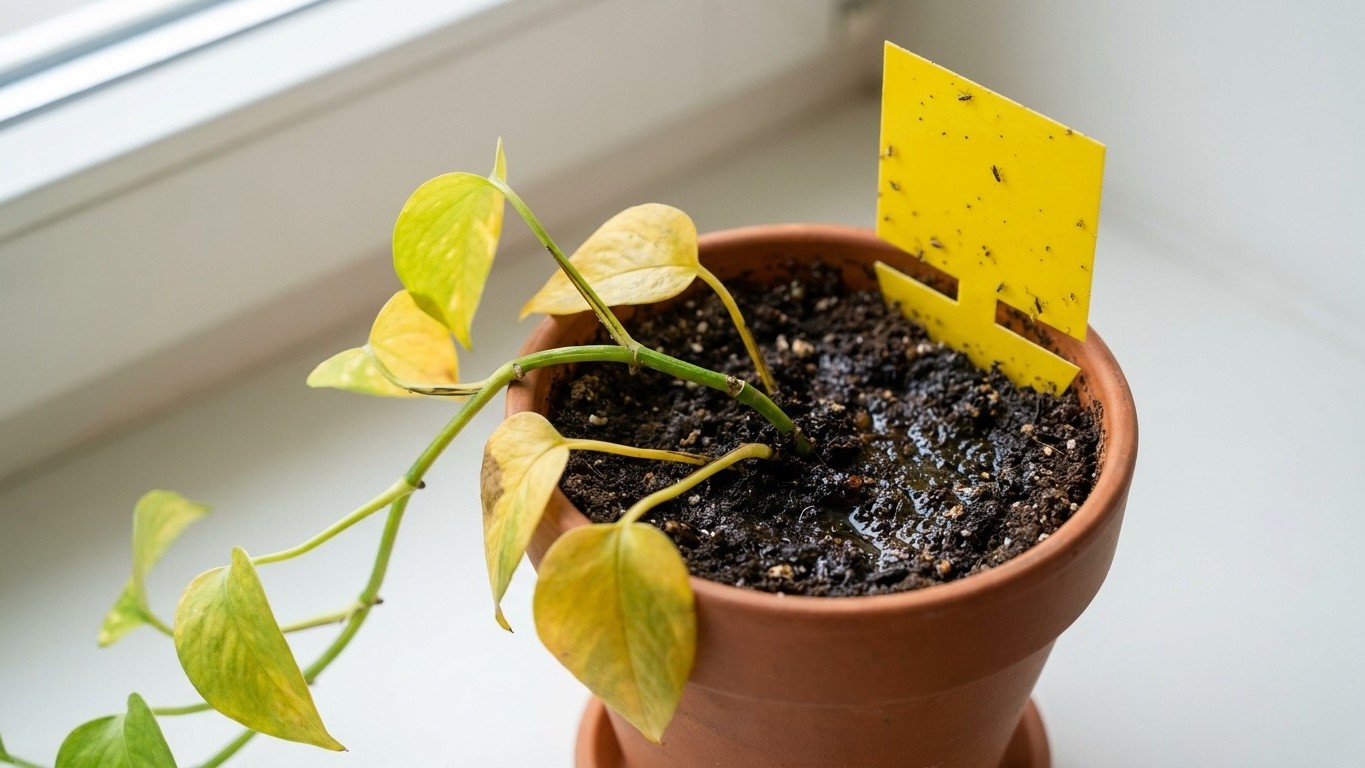
Those tiny flies weren’t just annoying. They were the visible tip of a much bigger problem happening in the dark, moist top layer of your potting soil, and by the time you noticed them hovering around your fiddle leaf fig, the damage to the roots had already started.
Fungus gnats. That’s the official name for those mosquito-looking specks that seem to multiply overnight around indoor plants. Adults are harmless nuisances, weak fliers that live maybe a week and don’t bite. The real threat lives underground, literally, in the form of larvae that hatch from eggs laid in damp soil and start feeding on organic matter, root hairs, and fungal growth within 48 hours.
A local horticulturist I spoke with pulled a small plug of soil from one of my struggling pothos plants and showed me what she called “the nursery”: a translucent, worm-like mass barely visible to the naked eye, wriggling through the top inch of substrate. Each adult female can lay up to 200 eggs in her short lifespan, and those eggs hatch within three to six days depending on temperature. Do the math on a plant that’s been infested for a month, and you’re not looking at a few dozen larvae. You’re looking at potentially thousands.
Key takeaways
- One local horticulturist’s soil inspection revealed a hidden ‘nursery’ of larvae that had already begun destroying root systems
- The real saboteurs aren’t visible to the naked eye—they’re breeding in the exact moisture zone where your plant’s most vulnerable feeder roots operate
- The solution isn’t chemical spray or sticky traps alone, but a forgotten watering habit that disrupts the entire gnat lifecycle
Why the Top Inch of Soil Matters So Much
Fungus gnat larvae don’t wander deep into the pot. They stay concentrated in the top one to two inches, the exact zone where moisture lingers longest after watering and where organic debris, dead root hairs, and fungal spores accumulate. This is also, unfortunately, where a huge percentage of a houseplant’s fine feeder roots operate, the delicate structures responsible for absorbing water and nutrients.
When larvae populations explode, they don’t just nibble on decaying matter. They start attacking living root tissue, particularly on seedlings and plants with shallow, fibrous root systems like African violets, herbs, and many tropical foliage varieties. According to extension research from Cornell University’s College of Agriculture and Life Sciences, heavy fungus gnat infestations can cause visible wilting, yellowing, and stunted growth even when watering and light conditions are otherwise correct, because the plant’s ability to take up water has been physically compromised.
That’s the piece I was missing. I kept blaming inconsistent watering or low humidity for my plants’ decline. The actual saboteurs were feeding on root hairs a few millimeters below the surface, invisible unless you went looking with a trowel and a flashlight.
The Moisture Trap Most Plant Owners Set Without Knowing It
Fungus gnats thrive almost exclusively in consistently moist soil. Adult females are drawn to damp organic material to lay eggs, and larvae can’t survive if the top layer dries out between waterings. This means the single biggest driver of an infestation isn’t a mysterious pest invasion from outside. It’s a watering habit.
Overwatering, keeping saucers filled with standing water, or using oversized pots that hold moisture far longer than the plant’s roots can absorb it, all create the exact humid, decaying environment gnats need to reproduce. Peat-heavy potting mixes make things worse because they retain water longer than mixes amended with perlite or bark. Three months. That’s roughly how long a chronically overwatered pot can sustain a breeding population before root damage becomes visible above soil level.
The horticulturist’s fix wasn’t a chemical spray. It was drying out the top layer completely between waterings, sometimes letting the surface go bone-dry for two to three days even if the deeper soil stayed slightly moist. Larvae and eggs can’t survive desiccation, and breaking that moisture cycle interrupts reproduction within a single generation, since the gnat life cycle from egg to adult runs about three to four weeks.
What Actually Works, Beyond Swatting
Yellow sticky traps placed horizontally at soil level catch adult gnats before they lay more eggs, and they double as an early warning system, letting you gauge whether an infestation is growing or shrinking. But traps alone don’t touch the larvae already established in the soil.
A thin layer of coarse sand, fine gravel, or diatomaceous earth spread over the top inch of soil creates a barrier that adult females find difficult to lay eggs in and that dries out fast, starving existing larvae of the moisture they need. Some growers repot entirely, discarding the top few inches of infested soil and replacing it with a fresh, well-draining mix, which resets the moisture profile immediately rather than waiting weeks for gradual drying.
Beneficial nematodes, specifically the species Steinernema feltiae, offer a biological option that’s gained traction among indoor plant enthusiasts. Applied as a soil drench, these microscopic organisms actively seek out and parasitize fungus gnat larvae without harming the plant, pets, or people. Research from university extension programs has shown this method reduces larval populations significantly within one to two applications, spaced about a week apart to catch newly hatched larvae the first treatment missed.
What surprised me most wasn’t the fix. It was how quickly the plants responded once the larvae die-off began. New growth on my pothos appeared within ten days of switching to a strict dry-down watering schedule, something no amount of fertilizer had accomplished while the infestation was active. The gnats disappearing was the visible sign. The real recovery was happening underground, in that same top inch of soil where the whole problem started.
Check your saucers this week. If water’s been sitting there for more than an hour after you water, that’s the habit worth breaking before you buy another bottle of fertilizer.