
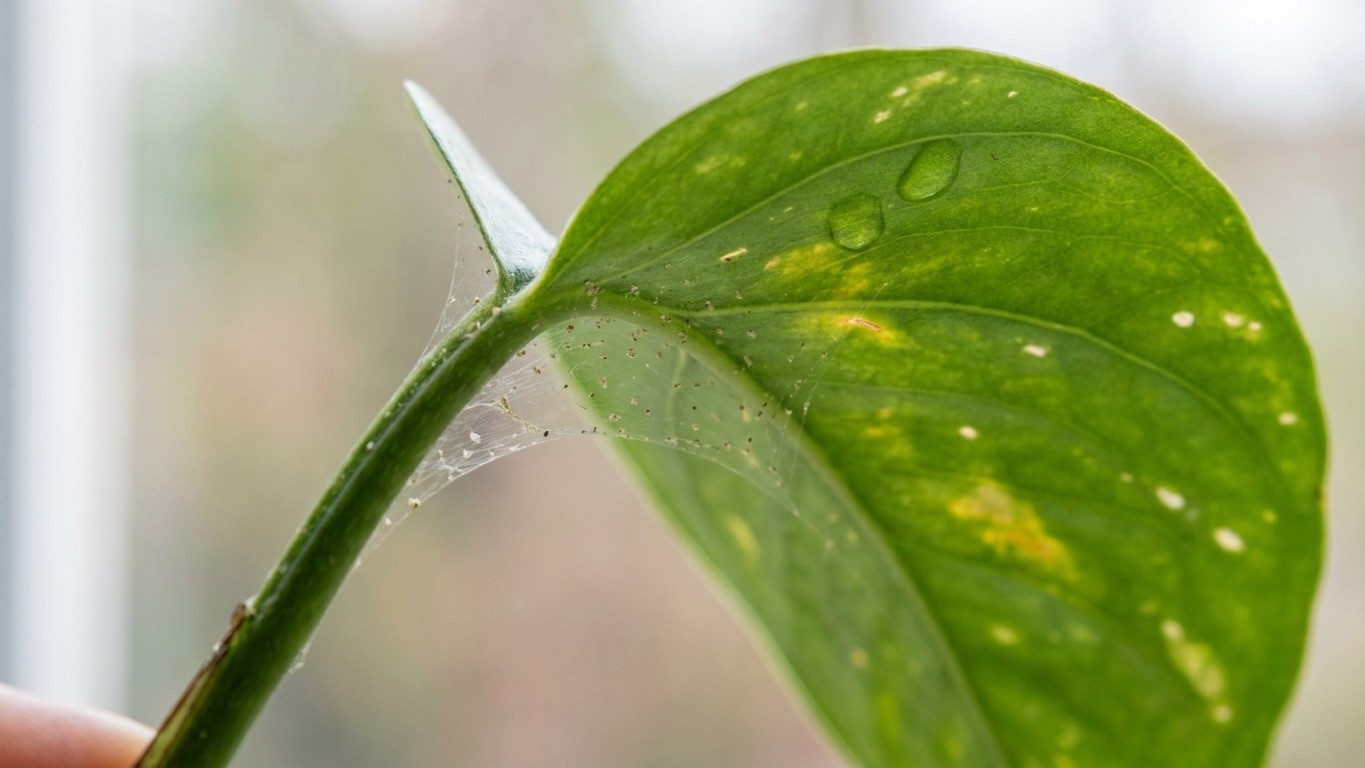
That gray film on your pothos leaves isn’t dust. It’s not mineral buildup from tap water, either. If you wiped it away and found fine threads clinging to the stem joints or the underside of leaves, you were looking at spider mite webbing, and by the time it’s visible to the naked eye, the infestation has usually been building for weeks.
July is peak season for these pests indoors. Spider mites thrive in warm, dry conditions, and central air conditioning creates exactly that environment: low humidity, stagnant air, temperatures in the 70s. A single female can lay hundreds of eggs in her short lifespan, and a population can double in as little as three days when conditions are right, according to entomology extension research from Colorado State University. That’s why a plant that looked fine two weeks ago can suddenly look like it’s dying, no matter how faithfully you water it.
Key takeaways
- A single female spider mite can lay hundreds of eggs; populations can double in three days under the right conditions
- Watering more actually makes spider mite damage worse by creating the exact environment these pests prefer
- One sheet of paper and a firm tap on the stem reveals the truth: tiny reddish-brown smears that confirm the diagnosis
Why watering doesn’t fix the problem
Spider mites don’t attack roots. They pierce individual plant cells on the leaf surface and drain the chlorophyll out, which is why the damage shows up as tiny yellow or bronze speckles before the whole leaf goes pale and crispy. Watering more won’t help because the plant isn’t thirsty in the way you think. It’s losing its ability to photosynthesize, one punctured cell at a time.
Overwatering actually makes things worse. Soggy soil weakens root function, which stresses the plant further, and a stressed plant produces softer, more vulnerable leaf tissue that mites prefer. Meanwhile, the dry air that helps mites thrive also dehydrates the growing medium faster, tricking owners into watering even more. It’s a feedback loop that ends with a plant that’s both mite-infested and root-rotted, which is a rough combination to diagnose from the outside.
How to actually confirm it’s mites
Hold a plain sheet of white paper under a suspicious leaf and tap the stem firmly. If tiny specks fall onto the paper and start moving, drag your finger through them. Spider mites leave a faint reddish-brown smear, similar to a crushed poppy seed. That streak is the confirmation most people miss because the mites themselves are barely visible, roughly the size of a period at the end of this sentence.
The webbing is the giveaway stage, and it’s actually a bad sign, not a mild one. Mites spin silk to move between leaves and protect their eggs, so visible webbing usually means the colony has already spread past a single leaf. Check the stem junctions, the newest growth at the top, and the undersides of lower leaves, since mites tend to start where airflow is weakest and humidity is lowest.
What actually gets rid of them
Isolation comes first. Move the affected plant away from others immediately, since mites migrate along touching leaves or even short-distance air currents in a still room. Then rinse the entire plant, leaves and stems, under a strong stream of lukewarm water, focusing on the undersides where colonies concentrate. This physical removal step matters more than most people realize. It won’t eliminate every mite, but it knocks the population down enough that follow-up treatment actually works.
Insecticidal soap or horticultural neem oil applied every four to seven days for two to three weeks is the standard approach recommended by university extension programs, including guidance from the University of Minnesota Extension. The repetition matters because these products kill active mites but don’t affect the eggs, which hatch on a staggered schedule. Skip a treatment cycle and you’re back where you started. One application, no matter how thorough, is basically wasted effort against a pest that reproduces this fast.
Humidity is the other lever, and it’s the one most people ignore. Running a small humidifier near vulnerable plants, or grouping them together to create a slightly moister microclimate, makes the environment less hospitable to new colonies. Spider mites struggle to reproduce once relative humidity climbs above 50 percent. Misting alone won’t do it since the effect fades in minutes, but a humidifier running for a few hours a day changes the baseline conditions in a way that actually discourages them.
The varieties most at risk this month
Not every houseplant is equally vulnerable. Mites go after thinner-leaved plants with less waxy cuticle, which is why pothos, English ivy, and calathea show damage faster than something like a snake plant or ZZ plant with tougher, more moisture-retentive leaves. Palms and ferns are also frequent targets, particularly when kept near south-facing windows where summer heat spikes hardest.
If you’ve got a mixed collection on one shelf, that’s often how an infestation spreads unnoticed. A single infected fern can seed three or four neighboring pots within a couple of weeks, especially if the plants are close enough for leaves to overlap. Spacing plants a few inches apart, even just for the summer months, cuts down on that silent transfer and makes early detection easier since you’re not searching through a dense wall of foliage.
One detail worth remembering headed into August: spider mite eggs can survive on pot rims, saucers, and even nearby windowsills for over a week without a host plant. Wiping down these surfaces with diluted rubbing alcohol after treating an infested plant prevents the kind of reinfestation that makes people think their treatment simply didn’t work.