
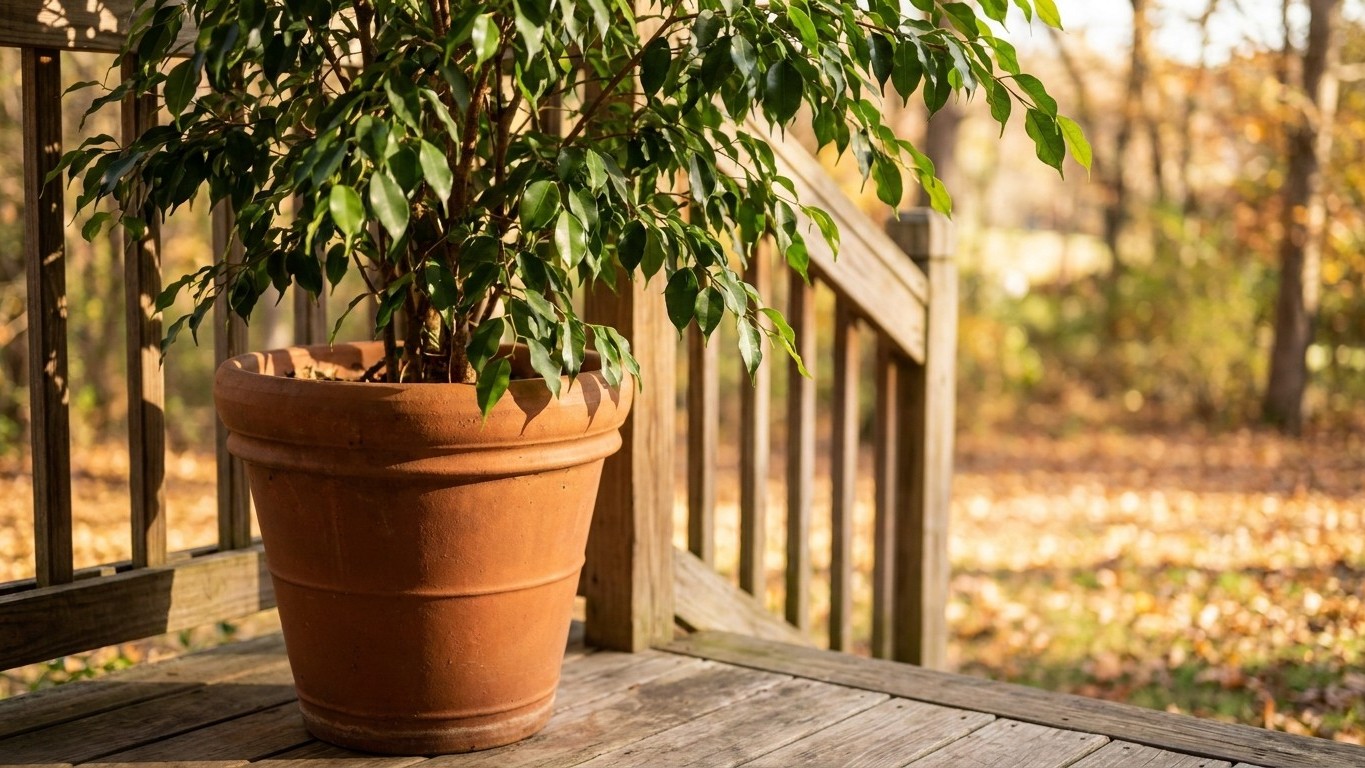
Every fall, the same scene plays out on porches and patios across the country: the first cold snap hits, and panicked plant owners rush their ficus indoors overnight. Weeks later, the tree stands nearly bare, leaves scattered across the living room floor like a bad breakup. The tree didn’t die from cold. It died from surprise.
The real damage happens long before the thermometer drops. Ficus trees hate abrupt change more than they hate mild cold, and a sudden move from bright outdoor light and humid air to a dim, dry, climate-controlled room registers as a full-blown emergency. The plant responds the only way it knows how: it sheds leaves it can no longer support, sometimes losing a fifth of its canopy or more in a matter of days.
Key takeaways
- Moving a ficus indoors suddenly triggers emergency leaf shedding—but it’s not from cold
- University research on commercial greenhouses reveals the exact timeline plants need to adjust
- A shadier patio location for 2-3 weeks before the final move changes everything
Why timing beats temperature
Gardening extension offices have been saying the same thing for years, and it rarely sinks in until after the leaves are already on the floor. Time the move to happen at least two or three weeks before the first expected frost. That window isn’t arbitrary. It’s the runway the plant needs to adjust its internal chemistry, its leaf structure, and its stomata (the pores that regulate water loss) before the environment actually changes.
The mechanism behind this has been studied for decades in commercial greenhouse production, where growers ship thousands of weeping figs into interior spaces every year. University research on the topic found that plants placed in heavily shaded greenhouses and watered sparingly for 2 months prior to placement in interior settings consistently scored higher quality grades than plants not receiving the shade treatment. Shorter windows work too, just less dramatically: containerized Ficus benjamina received higher plant grades, and dropped fewer leaves after 10 weeks in an interior setting if they were first acclimatized for at least 5 weeks under 60% to 80% shade. The pattern holds across every study: the longer the gradual shade period before the final move, the fewer leaves hit the floor afterward.
Home growers obviously don’t have a commercial greenhouse to stage this process in. But the principle scales down perfectly to a patio or a porch. Move it to a shadier location two or three weeks before you bring it indoors, giving the tree time to downshift its light needs before it loses access to open sky entirely. Think of it less as a single move and more as a slow fade, the plant equivalent of dimming the lights instead of flipping the switch.
What actually happens inside the leaf
This isn’t superstition passed down from one plant owner to another. There’s real physiology behind it. Leaves grown in bright outdoor conditions are built differently from leaves grown indoors: thicker, with a different balance of chlorophyll and a higher light compensation point, the threshold at which a leaf produces enough energy through photosynthesis to justify its own upkeep. Photosynthetic rate must equal respiration rate if the plant is to survive, and plants with lower light compensation points adapt better to low light interior environments. A leaf built for full sun simply can’t pay its own bills in a dim living room, so the tree cuts it loose and starts over with leaves better suited to the new light budget.
That’s the biological reason acclimation needs weeks, not days. A tree can’t rebuild its leaf chemistry overnight, but it can if you give it a gradual, shaded transition first. Researchers found that lowering light levels from a maximum of 12,000 ft-c during production to 2,500 ft-c for just 12 weeks lessened leaf abscission on weeping figs subsequently placed indoors. Twelve weeks is a nursery’s timeline, not a homeowner’s. But the three-week home version works on the same logic, just compressed and less dramatic.
Temperature adds a second layer of stress on top of the light shift. The optimal indoor temperature range for ficus plants is between 70-85 degrees F, and temperatures shouldn’t be allowed to drop below 60 degrees F to prevent cold stress or damage. A ficus left outside until the first hard frost warning has often already spent several nights in the 40s or 50s, quietly accumulating stress the owner never notices until the leaves start falling two weeks later, once inside.
The three-week playbook that actually works
Extension horticulturists frame this as a mirror image of the spring transition, just running in reverse. In spring, growers place the plant in a fully shaded, sheltered spot for 2–3 hours daily before gradually increasing exposure. Reversing that sequence in fall means starting the indoor transition while the plant is still outside, in shade, well before the real move happens.
A practical sequence for most home growers looks like this:
- About three weeks out, relocate the pot to the shadiest, most sheltered corner of the porch or patio, mimicking the dimmer light it’ll get indoors.
- Cut back watering slightly and stop fertilizing, since the tree’s growth should be slowing anyway as days shorten.
- Check nighttime lows daily. Once they threaten to dip near 55°F, that’s the actual cutoff for the final move, not a specific calendar date.
- Once inside, place the tree away from heating vents, radiators, and drafty windows, all of which recreate the same abrupt-change stress the pre-acclimation was designed to prevent.
Even with a textbook transition, some leaf drop is normal and not a sign of failure. It’ll take the plants four to six weeks to reacclimate to the indoor atmosphere, and gardeners will soon begin to notice a new set of lower-light leaves emerging. The tree isn’t dying. It’s swapping its wardrobe for the season, one leaf at a time, and the new growth that replaces the losses is often better suited to surviving a Midwest winter living room than anything that grew outdoors in July ever was.
Sources : lifetips.alibaba.com | cafeplanta.com