
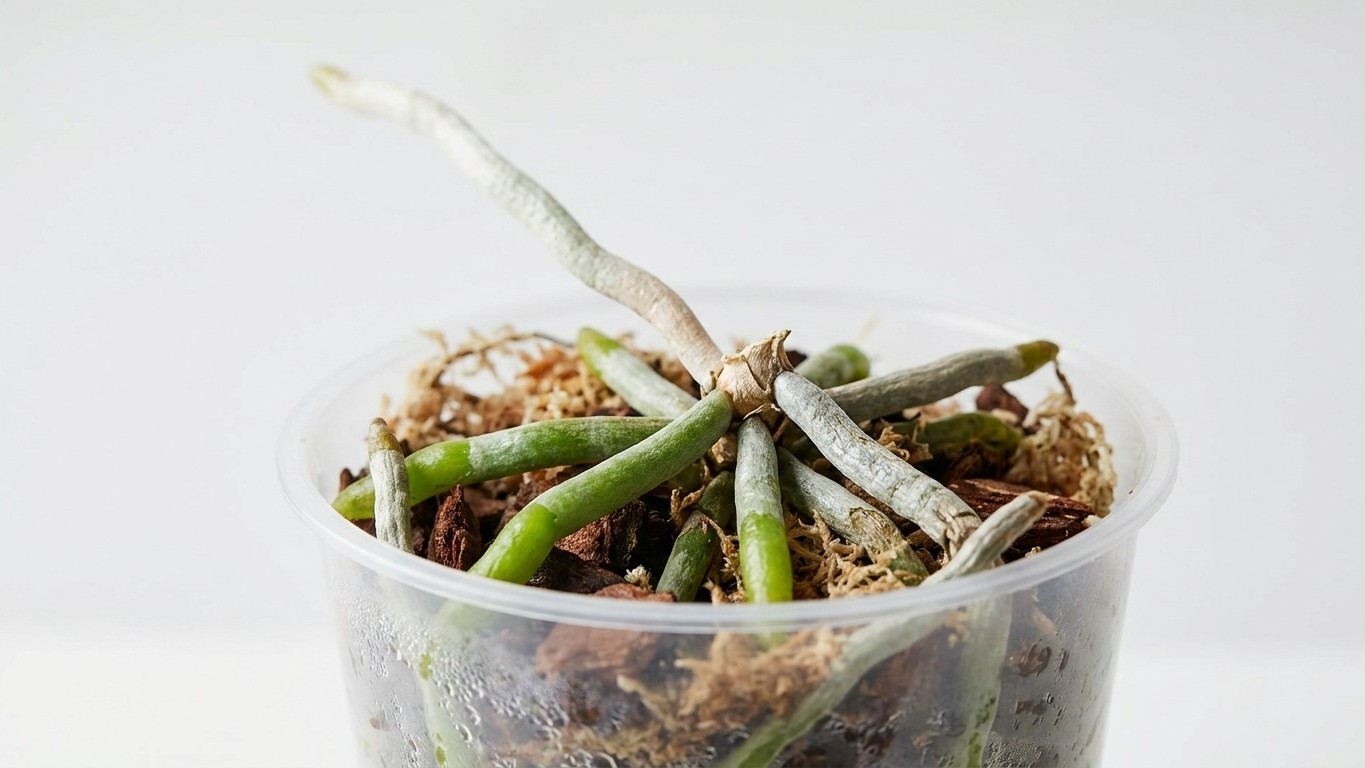
Orchid roots are honest. They’ll show you stress, rot, dehydration, and contentment long before a single leaf curls or yellows. For years, I lined the bottom of my orchid pots with a layer of decorative pebbles, the kind sold in every garden center and home décor aisle as a tray filler. The plants looked fine from above. Below the rim, something else was happening entirely.
The pebble-tray method is widely recommended as a humidity booster: fill a shallow tray with stones, add water just below the surface, set your pot on top. Simple. Logical. Except the line between “tray beneath the pot” and “pebbles inside the pot” gets blurry fast, especially with compact decorative cachepots that sit flush over a gravel bed. Over time, roots migrated downward and found the moisture. What felt like attentive care was quietly creating the conditions for rot.
Key takeaways
- Orchid roots signal problems long before leaves do—but most growers never look
- A common humidity method quietly transforms into a rot trap through capillary action
- One simple adjustment restored root health across an entire orchid collection in 18 months
What healthy orchid roots are actually trying to tell you
A Phalaenopsis orchid in good shape has roots that are silvery-gray when dry and bright green within minutes of watering. That color shift is the tell. It happens because the velamen, a spongy, multi-layered outer tissue unique to epiphytic orchids — absorbs water rapidly and reflects light differently when saturated. Growers who understand this use the color alone to gauge watering frequency, no calendar required.
When roots sit in prolonged contact with moisture, velamen breaks down. The tissue goes from firm and silvery to brown, mushy, and eventually hollow. This doesn’t show up in the leaves for weeks, sometimes months. By the time a Phalaenopsis starts dropping buds or showing wrinkled pseudobulbs (in other genera), the root system may already be 60 to 70 percent compromised. The plant is running on reserves, not on active uptake.
My pebble layer was sitting roughly two centimeters below the drainage holes of the inner grow pot. During humid summers, capillary action kept that zone perpetually damp. Some roots found it, wrapped around the stones, and stayed. A beautiful tangle of growth that looked vigorous, until I repotted and realized most of those roots snapped off dry and brittle, or came away in wet brown ribbons.
The humidity argument: real benefit, real risk
Pebble trays do raise local humidity modestly. Research from university extension programs on indoor plant care consistently notes that evaporation from a water-filled tray can add 5 to 10 percent relative humidity in the immediate microclimate around a plant. For orchids that prefer 50 to 70 percent humidity, that increment matters, particularly in centrally heated homes during winter, where indoor humidity can drop below 30 percent.
The problem isn’t the method. The problem is precision. A pebble tray works when the pot base sits clearly above the waterline, with genuine air space between drainage holes and moisture. The moment that gap closes, through capillary wicking, an overfilled tray, or roots actively seeking the water source — you’ve created a semi-hydroponic setup your orchid’s roots didn’t evolve for. Phalaenopsis orchids grow natively on tree bark in Southeast Asian rainforests. Their roots expect cycles: soaking rain, then rapid drying with airflow. Constant low-level dampness mimics neither.
One adjustment made a noticeable difference in my own collection: raising the inner grow pot on a small plastic grid above the pebbles, creating a full centimeter of air between the drainage holes and the tray surface. Roots stopped migrating. The humidity benefit remained.
Reading roots before repotting season
Most orchid growers repot every 18 to 24 months, typically after bloom when the plant enters a growth phase. But waiting for the calendar misses the point. Root condition is the actual indicator. A few things worth checking before committing to bark medium and a new pot:
- Green or silvery-white roots with firm tips: healthy, leave them alone
- Brown roots that are firm and dry: likely dead from dehydration, can be trimmed
- Brown roots that are soft or wet: rot, remove cleanly with sterilized scissors
- Flat, papery roots with green tips still growing: aerial roots adapting to low humidity, normal
Aerial roots, those white tendrils that escape the pot and reach outward into open air — confuse a lot of growers into thinking something is wrong. They’re not a distress signal. They’re the orchid behaving exactly as it would on a tree trunk, extending roots into the surrounding atmosphere. Tucking them back into the potting medium actually stresses the plant; those roots aren’t adapted for soil contact and will rot if buried.
What changed when I moved the pebbles out
Removing the gravel layer from inside the cachepots and switching to a raised grid system took about twenty minutes across my entire collection. The difference in root health at the next repotting cycle, roughly 18 months later, was stark. Root mass had increased, velamen was intact on the majority of roots, and two plants that had been stalling in growth produced new leaf sets within the same season.
Bark medium also dries more predictably without a moisture reservoir underneath. I went from watering twice a week by habit to watering when the roots told me to, which turned out to be roughly every ten days in winter, every five to six days in summer. The plants stopped being on my schedule. I got on theirs.
There’s a small irony here worth noting: the pebble aesthetic is genuinely attractive. A clear glass pot with visible roots nestled above a layer of smooth river stones looks curated and intentional. Keeping that look while protecting root health is entirely possible, the stones just need to stay decorative, not functional. One layer in the outer cachepot, water kept well below drainage level, pot elevated on a grid. The roots will show you, within a season, whether the arrangement is working.