
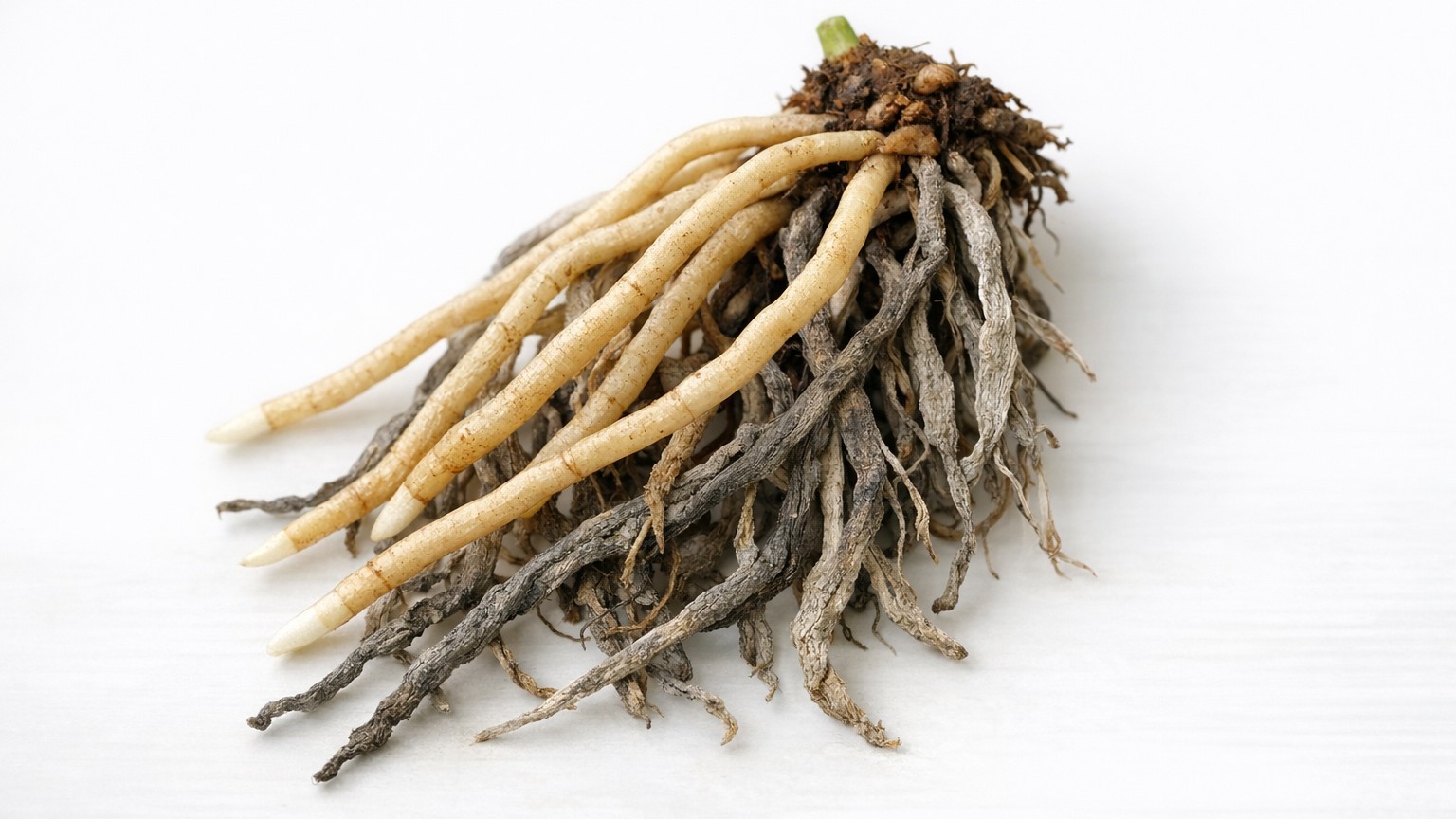
Gray roots. Shriveled, papery, clinging to the sides of a plastic nursery pot like something long abandoned. That’s what greeted me when I finally unpotted my Phalaenopsis after three years of dutifully dropping two or three ice cubes onto the bark every Sunday morning. The plant had bloomed twice in that time, barely, and I’d chalked the lackluster performance up to lighting or drafts or just the general mystery of orchids. The roots told a different story.
Key takeaways
- A viral orchid care hack has been quietly damaging plants for over a decade—but most owners never discover the damage
- Orchid roots photosynthesize and are extremely sensitive to cold, making ice cubes the opposite of gentle watering
- Plants can survive for years on this method while producing fewer, smaller flowers—the signs are hiding underground
The Ice Cube Method: Where It Came From and Why It Spread
The hack went viral around 2012 when a major orchid grower began marketing pre-potted Phalaenopsis with a simple care tag: “Water with 3 ice cubes per week.” The appeal was undeniable. Orchids have a reputation for being temperamental, and the ice cube method offered precision, no guessing, no overwatering, just a neat weekly ritual. It spread across Pinterest boards, YouTube channels, and gardening forums with the momentum of something that feels right even if the biology disagrees.
The grower’s reasoning wasn’t entirely baseless. Phalaenopsis orchids do prefer infrequent watering over constant moisture, and the slow melt of an ice cube delivers water gradually rather than flooding the pot all at once. That part, at least, mimics the logic of controlled irrigation. The problem is what ice actually is to a plant that evolved in the subtropical forests of Southeast Asia and northern Australia, where temperatures rarely dip below 60°F.
What’s Actually Happening Inside That Pot
Orchid roots are doing something most houseplant roots don’t: they photosynthesize. The outer layer, called the velamen, is a spongy tissue that absorbs moisture from the air and turns bright green when hydrated. Healthy velamen is silvery-white when dry, vivid green when wet. Gray, papery, hollow-feeling roots are dead roots, and cold is one of the fastest ways to kill them.
When ice sits directly on the velamen, it causes localized cold damage to the cells. This isn’t frost per se, but temperatures below 50°F trigger cellular stress in tropical orchids. The velamen collapses. The root can no longer absorb water or anchor the plant properly. A Phalaenopsis with 60% dead roots will still bloom, orchids are stubborn survivors, but it’s working at a fraction of its capacity, producing fewer spikes, smaller flowers, and shorter bloom cycles. That explained my two underwhelming displays in three years.
There’s also a volume problem. Three ice cubes melt to roughly 90ml of water. A standard 4-inch nursery pot with bark medium needs somewhere between 150ml and 250ml per watering to thoroughly wet the root zone and flush out accumulated fertilizer salts. The ice cube method consistently underwatered the plant while simultaneously cold-shocking its roots. A double failure dressed up as a helpful simplification.
What Orchid Roots Actually Need
The correct approach isn’t complicated, but it does require abandoning the idea that orchids need special treatment. Lukewarm water, room temperature, nothing out of the tap that’s been running cold — poured generously over the bark until it drains freely from the bottom. Then nothing, for a full week or longer, until the bark is dry and the roots have returned to their silvery-white resting color. That’s the cycle.
Bark medium matters here. Most grocery store orchids come potted in a dense, fine-grade bark that retains more moisture than the chunky mixes sold at specialty nurseries. If your bark still feels damp after five or six days, repotting into a coarser medium makes a bigger difference than any watering schedule adjustment. A transparent plastic pot (the kind most Phalaenopsis ship in) lets you watch the roots directly, the best moisture meter money can’t improve on.
Fertilizing lightly every other watering during the growing season, with a balanced or bloom-boosting orchid formula diluted to half the recommended strength, completes the picture. Salt buildup from fertilizer is a slow killer of roots, which is why the “drench and drain” watering method matters: it flushes the medium rather than just dampening it.
After the Repot: What Recovery Looks Like
When I finally repotted, I cut away every gray root with sterile scissors, roughly half the root system. The remaining healthy roots were a pale tan with firm, white tips, the growing points. I moved the plant into fresh chunky bark in a slightly smaller pot (a common mistake is oversizing the pot, which keeps bark wet too long), placed it in bright indirect light, and started watering with room-temperature water on a proper soak-and-dry cycle.
Within six weeks, two new root tips had emerged, bright green and reaching toward the pot walls. Four months later, a new flower spike appeared, the longest one the plant had ever produced, with nine buds. The bloom lasted eleven weeks.
A 2017 study published in HortScience confirmed what the root damage had already shown: Phalaenopsis orchids watered with ice cubes showed significantly reduced growth metrics compared to those watered conventionally with room-temperature water, including lower leaf area, fewer roots, and reduced overall plant mass. The researchers noted that while both methods produced plants that appeared healthy to casual observation, the internal differences were substantial. The plant looks fine. Until you pull it out of the pot.