
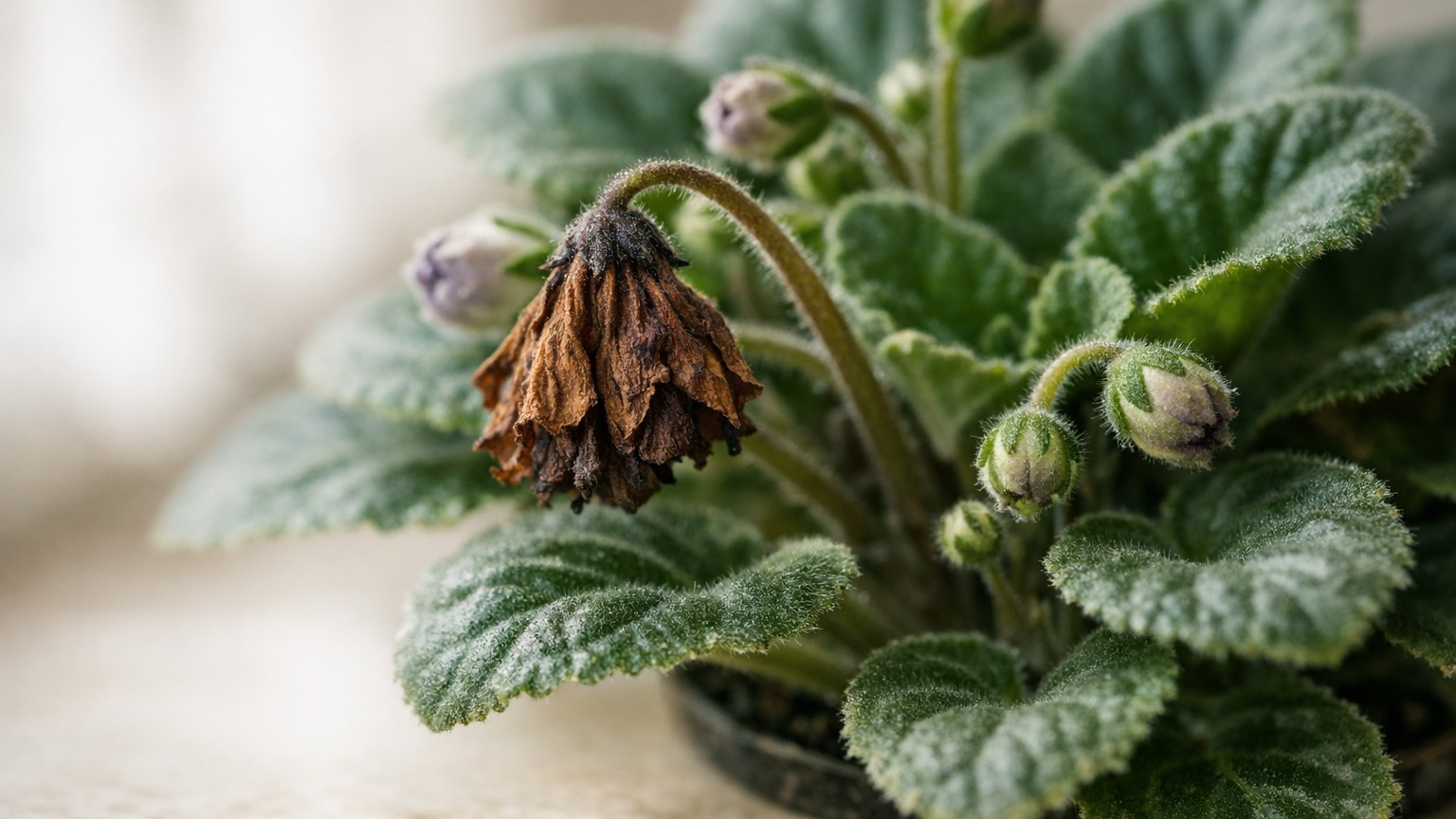
That brown, crinkled bloom you left on your peace lily “for a natural look”? It’s not decorating your plant. It’s quietly draining it. A florist friend was the one who finally pointed to the wilted flower heads on my windowsill collection and explained, with calm precision, exactly what was happening beneath the surface. The moment she finished talking, I grabbed the scissors.
Key takeaways
- Dead flowers trigger a biological signal that redirects plant energy away from new blooms toward seed production
- Rotting petals create the perfect breeding ground for fungal diseases like gray mold that spread rapidly indoors
- One simple habit—deadheading—can triple flowering in plants like African violets within weeks
The Hidden Tax of a Dead Flower
Every flower on a plant exists for one biological reason: reproduction. The bloom attracts pollinators, gets fertilized, and then the plant’s whole energy system pivots toward making seeds. Once a flower has died, many plants start putting their energy into producing seeds rather than into the roots, foliage, or next round of blooms. That beautiful African violet on your kitchen shelf is running a quiet calculation, and a rotting flower head is telling it: mission accomplished, stop producing.
When flowers are past their prime, they turn their attention to producing fruits and seeds. Producing fruits and developing seeds wastes energy that might otherwise be used to make more flowers, foliage, or roots. Think of it like a financial leak. Every dollar the plant sends toward seed development is a dollar not spent on the next bud. You’d never let a bill auto-renew for a service you don’t use. Yet most of us do exactly that with dead blooms.
The fix has a name: deadheading. Deadheading is the process of removing spent flowers from plants to encourage more blooms and prevent seed production. This helps to redirect the plant’s energy into producing more flowers rather than producing seeds. It sounds surgical. The practice is anything but. For most indoor plants, a pinch between two fingers is all it takes.
But the Energy Drain Is Only Half the Problem
There’s a second issue the florist raised that I hadn’t considered at all: rot and disease. A spent flower sitting against a warm, slightly humid leaf is essentially a welcome mat for fungal problems. Old leaves and spent flowers may develop gray mold, while younger leaves that aren’t getting enough air circulation can develop a powdery mildew that looks like a white coating.
Gray mold, or Botrytis blight, is caused by Botrytis spp. These fungi have a wide host range and primarily infect spent flowers and older foliage on houseplants. The kicker is how fast it can spread. Botrytis blight, also known as gray mold, is a fungal disease that can harm indoor plants. If your houseplant is suffering from this disease, you can see dusty gray spores that can quickly spread and cause discoloration and wilting on flowers and leaves. One ignored flower head can become a fungal launchpad for the entire plant. Indoors, where air circulation is already limited, this spreads faster than it would in a garden bed.
Continually check for and remove spent flowers and foliage as a basic sanitation measure. Not as an aesthetic preference. As maintenance. The distinction matters, because it changes how seriously you take the task.
Which Plants Punish You Most for Skipping It
Not all indoor bloomers respond to neglect equally. African violets are among the most sensitive. These plants are low maintenance but benefit from regular deadheading, and the results of consistent removal are visible within weeks: tighter, more abundant clusters instead of a few sad stragglers around a brown, collapsing center.
Removing spent blooms and old outer leaves directs energy to new flower stalks, a simple habit that boosts color. For a plant like an African violet that can bloom almost continuously under good conditions, this one habit is the difference between a plant that looks perpetually mid-performance and one that genuinely shows off.
Kalanchoe, another beloved windowsill staple, follows the same logic. Removing faded and spent flowers encourages plants to produce additional flowers rather than shutting down their blooming cycle for the season. The plant doesn’t know you want it to stay decorative. It only knows its biological directive. Deadheading is how you intercept that signal and redirect it.
Even plants that don’t rebloom immediately still gain from the practice. For plants that do not rebloom when deadheaded, the procedure still allows them to direct more energy to grow instead of reproducing, thus becoming stronger and bushier, and producing more flowers in subsequent years. Hydrangeas brought indoors, gardenias, even peace lilies left with their spent white spathes turning green and papery, all of them benefit.
How to Do It Without Second-Guessing Yourself
The actual technique varies slightly by plant, but the principle is consistent. How to deadhead perfectly will depend on the type of plant, but as a rule of thumb you should cut back to a growth point. That means anywhere on the stem where a new leaf or bud is emerging. Cut just above there and you’ll encourage new growth.
For soft-stemmed plants like African violets or lipstick plants, fingers work perfectly. For many annuals and perennials, you can simply pinch or snap off the spent flower with your fingers. Be sure to remove the entire flower head, including any attached stem. For tougher-stemmed plants, think indoor roses or kalanchoe with woody clusters, a pair of clean, sharp scissors makes a cleaner cut and lowers the risk of tearing tissue that can then invite infection.
Timing matters too. It’s best to deadhead flowering plants regularly, whatever the season, removing flowers as soon as they start to fade. Waiting until the bloom is completely brown and collapsing means the seed-production signal has already been sent. The window for interception is while the flower is still fading, not after it’s already planning its genetic legacy.
One genuine exception worth knowing: orchids. Phalaenopsis orchids produce blooms on a single spike, and cutting that spike back prematurely can delay the next flowering cycle by months. With orchids, the rule is to wait until the entire spike has gone yellow and dry before removing it, the plant’s calculus is different when it blooms only once per spike rather than in continuous rounds. Every other common indoor bloomer, though? The scissors go in as soon as the petals start to flag.
Sources : jayscotts.com | bouldercityreview.com