
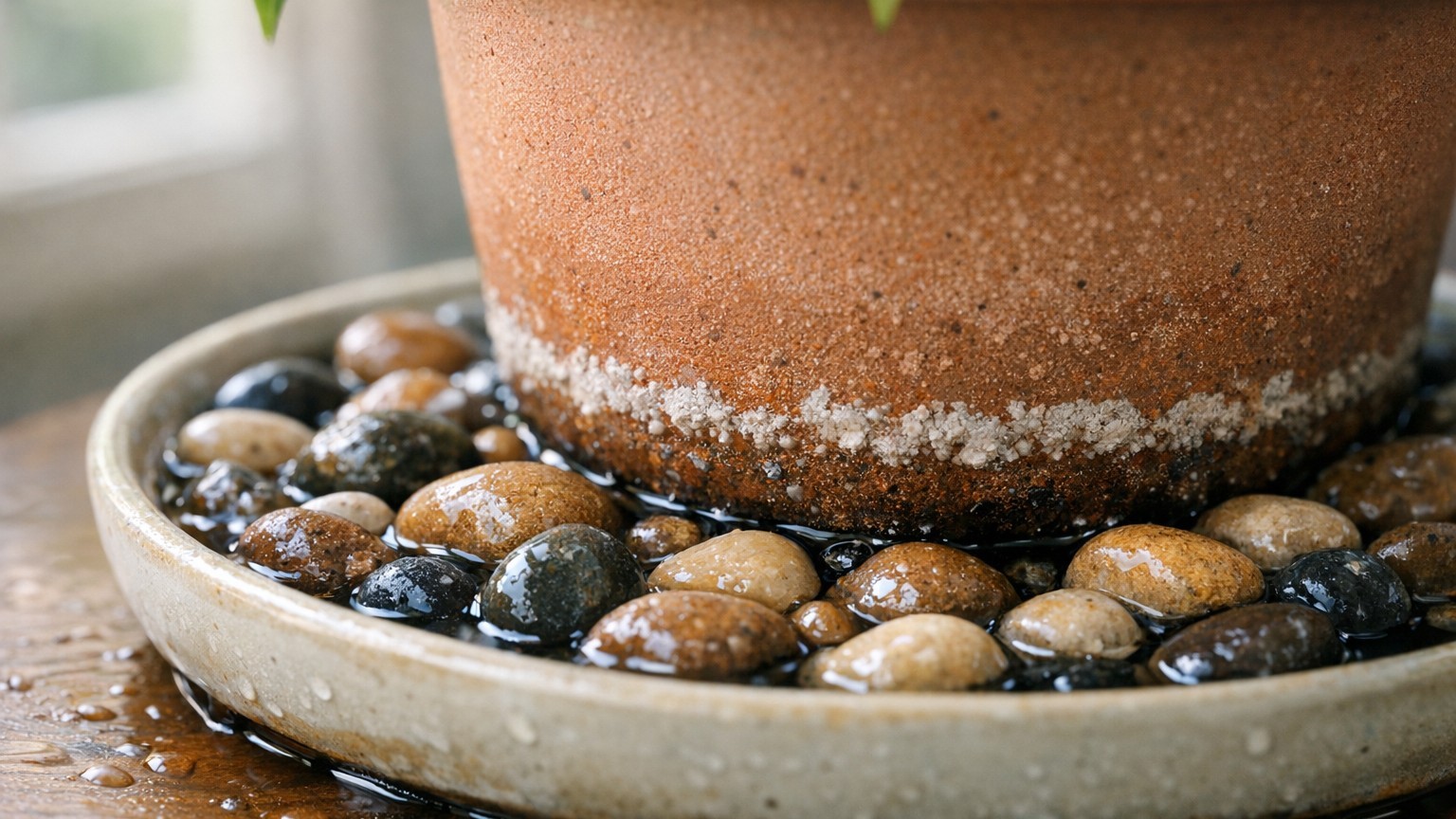
Pebble trays don’t raise humidity around your plants. They never did. If you’ve been filling a shallow dish with stones and water, setting it under your pothos or fiddle-leaf fig, and feeling quietly virtuous about your plant care routine, this article is going to sting a little.
For years, I did the same thing. The logic seemed airtight: water evaporates from the tray, moisture rises, plants benefit. It’s the kind of advice that gets passed down through gardening books, Pinterest boards, and well-meaning aunts. The pebble tray became a ritual. A marker of being a “serious” plant parent. Then a commercial grower walked through my setup and asked, with genuine curiosity, why I had wet rocks under everything.
Key takeaways
- A simple hygrometer test revealed pebble trays create zero humidity benefit at leaf level
- What they actually do is trap moisture around roots, creating perfect conditions for fungal pathogens and root rot
- The real humidity solutions are surprisingly different—and one involves your bathroom
The Physics Problem Nobody Talks About
Humidity is a measure of water vapor concentration in the air. For a plant to benefit from increased humidity, that vapor needs to surround its leaves, particularly the stomata on the undersides, where gas exchange actually happens. A pebble tray sitting on the floor, or even on a shelf below the foliage, releases a thin column of evaporating water that dissipates almost immediately into the room’s general air volume. Unless your living room is the size of a closet and completely sealed, that contribution is negligible.
The grower who corrected me pulled out a hygrometer, a small, inexpensive device that measures relative humidity, and held it six inches above my pebble tray. Then she held it at leaf level, about two feet higher. The readings were identical. The tray was doing precisely nothing for the plant above it. What it was doing, she pointed out, was creating a consistently moist surface right at the base of the pot.
What the Tray Was Actually Doing
Here’s the part that genuinely surprised me. Pebble trays, when the water level touches the bottom of the pot, create a wicking effect. The potting mix slowly draws that moisture upward, keeping the root zone perpetually damp. For plants that demand excellent drainage and dry-out periods between waterings, most tropical houseplants, and virtually all succulents and cacti — that’s a slow path to root rot. You water correctly from the top, the excess drains out, and then the tray quietly feeds it back in.
Even when the water level stays below the pot’s drainage holes, the problem doesn’t disappear. A wet surface directly under the pot restricts airflow to the bottom of the root ball. Roots need oxygen as much as moisture. Compacted, anaerobic conditions at the base of a container are exactly where fungal pathogens thrive. University of Maryland Extension notes that overwatering, broadly defined as roots sitting in too much moisture for too long — remains the single most common cause of houseplant decline.
The grower also pointed to something I’d ignored completely: the pebbles themselves. Wet stones in a warm indoor environment are a breeding ground for fungus gnats. The larvae of fungus gnats develop in moist organic material, but adults are drawn to any consistently damp surface near soil. My pebble tray, sitting faithfully under my plants, was essentially a welcome mat.
What Actually Raises Humidity, and What’s Worth Your Time
Grouping plants together genuinely works. Plants transpire, they release water vapor through their leaves as part of their normal metabolic process. A cluster of several plants in close proximity creates a microclimate with measurably higher humidity at leaf level, the only level that matters. This is why dense plant shelves and greenhouse-style setups tend to produce healthier foliage than single specimens scattered around a room.
A humidifier is the most direct solution for plants that truly need elevated humidity, like calatheas, anthuriums, or maidenhair ferns. A small ultrasonic humidifier pointed toward your plant collection, running for a few hours a day, will do more in a week than a pebble tray accomplishes in a lifetime. The catch is maintenance, humidifiers need regular cleaning to prevent mineral buildup and mold.
Misting gets complicated. The common practice of spraying leaves with water does temporarily raise humidity, but for seconds, not hours. Some growers argue it causes more harm than good by encouraging fungal leaf spots, particularly on plants with velvety or textured foliage. For smooth-leaved tropicals in a dry apartment, light morning misting is unlikely to hurt, but it’s not a substitute for a consistently humid environment.
Bathrooms with windows remain genuinely underrated. The natural humidity spikes from showers create real, measurable improvements for moisture-loving plants. A fern or orchid on a bathroom windowsill often outperforms the same species struggling in a dry living room despite elaborate care routines.
After I Threw Out the Tray
Removing the pebble trays took about ten minutes. Replacing them with simple saucers that I empty within an hour of watering took another five. Within a month, two plants that had been stubbornly declining, a peace lily and a nerve plant, started putting out new growth. Correlation isn’t causation, but the timing was hard to ignore.
What struck me most wasn’t the error itself. Gardening advice propagates through repetition, not evidence, and the pebble tray myth has been circulating since at least the 1970s. What struck me was how the ritual of it, the filling, the arranging, the visible effort, had substituted for asking whether it was working. A hygrometer costs about $10 on any home goods site. Measuring what’s actually happening around your plants, rather than assuming, turns out to be the single most useful upgrade a serious plant keeper can make.