
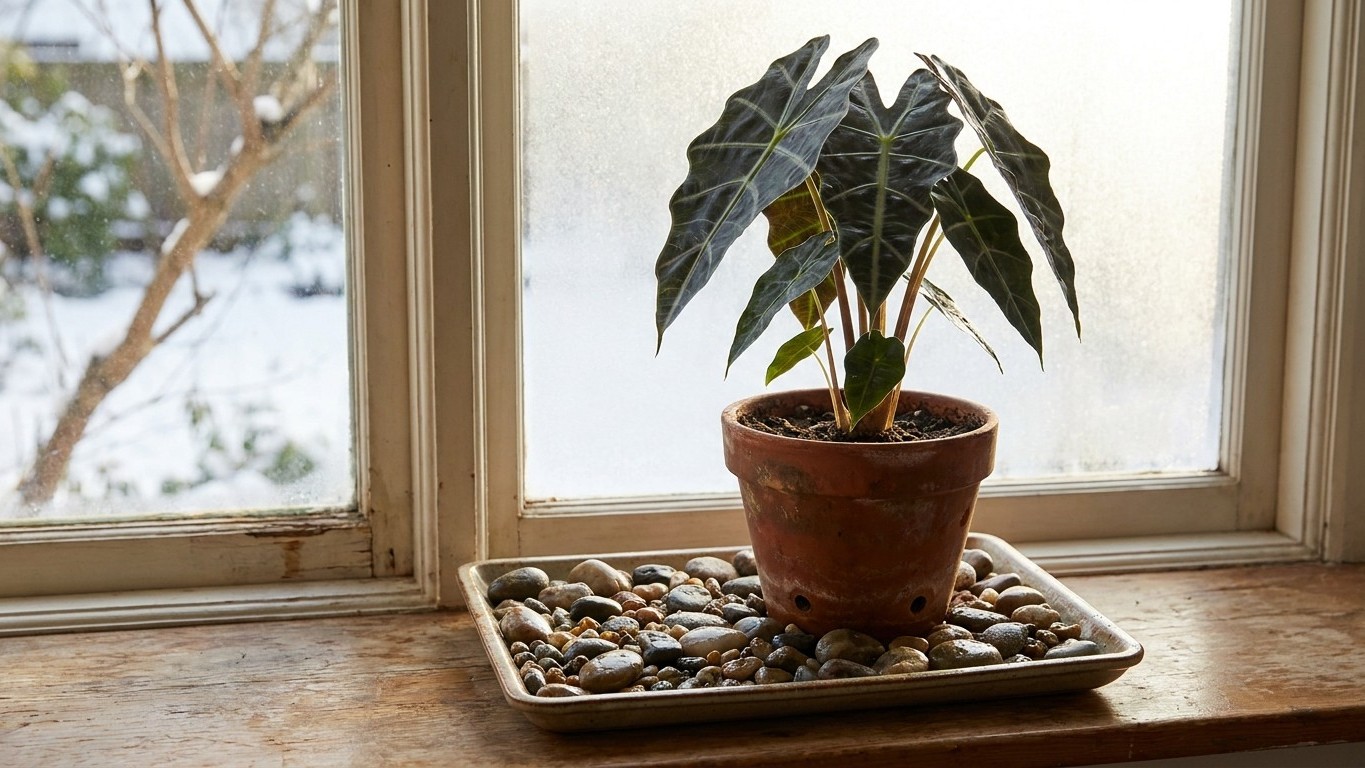
The moment the radiators click on for the season, my neighbor hauls out a stack of shallow trays, fills them with gravel, and sets every ficus and alocasia pot right on top. It looks like she’s babying her plants. She isn’t cutting back on the watering can at all. What she’s doing is fighting a battle that has nothing to do with soil moisture and Everything to do with the air itself.
Heating season is brutal on humidity, and most people don’t clock it until their skin starts flaking or their alocasia leaves curl at the edges. Furnaces and heat pumps don’t add moisture to the air, so as you heat cold, relatively dry outdoor air, indoor relative humidity can plummet to 15–25% without humidification. That’s a steep drop from the muggy summer months, and tropical houseplants notice long before you do.
Key takeaways
- Your furnace is secretly drying out the air to dangerous levels for tropical plants
- The popular pebble tray trick creates only a tiny humidity bubble—but there’s a catch that makes it work anyway
- Clustering multiple trays beats using just one, and a humidifier still wins for real results
Why Your Furnace Is Quietly Starving Your Plants
The mechanics are simple, even if the result feels unfair. In colder months, outdoor humidity levels drop sharply, and as heating systems run to keep interiors warm, they replace any lost moisture with air that contains very little water vapor, leading to a steady decline in relative humidity through winter. Your thermostat isn’t drying the air on purpose. It’s just circulating air that was already parched to begin with, and cranking it through ducts or radiators only compounds the problem.
Most HVAC professionals point to the same target: ideal winter indoor humidity sits between 30-50%, with 35-45% being optimal for most homes. Fall below that and the consequences stack up fast. When indoor humidity levels fall too low, typically below 30%, various health problems can arise, affecting skin, respiratory system, and overall well-being, with dry skin among the most common effects. Plants native to rainforest understories, where humidity rarely drops below 60%, get hit even harder than we do.
Alocasias in particular are famous for broadcasting their discomfort. Humidity trays help prevent dry air damage in plants like ferns, orchids, and calatheas by preventing brown leaf tips caused by dry indoor heat. Add alocasia, colocasia, and most aroids to that list, and you’ve got a fairly accurate map of which pots in my neighbor’s living room end up on gravel every October.
Does the Gravel Trick Actually Work?
Here’s where things get more complicated than the average plant blog admits. The pebble tray has been a houseplant staple for decades, but the science behind it is shakier than its reputation suggests.
One horticulturist tested this directly and found the effect fades within inches. In winter, the humidity at 1.5 inches above a pebble tray was 3% higher than the rest of the room, dropping to 2% at 4 inches and no increase at all a foot above the tray, and increasing humidity by 1% or 2% has no significant effect on plants. That’s a sobering number if you were expecting a tray of wet stones to transform your living room into a greenhouse.
Justin Hancock, a horticulturist at Costa Farms, doesn’t dismiss the method outright, but he’s clear about its limits. “Pebble trays can work, but there’s a catch,” he says. “Because our homes circulate air, the farther you get from the pebble tray, the more the humidity is dispersed throughout the room. That minimizes the effect of pebble trays, especially when relative humidity levels in our homes are already low.” Translation: the tray creates a tiny bubble of moisture right around the pot, not a humidity boost for the whole room.
Size and plant choice matter more than people assume. “Pebble trays work best if you use a very wide tray for a low-growing plant,” Hancock says, and the goal is for the plant to sit on top of the pebbles without its roots ever touching the water. A narrow saucer under a tall ficus barely creates enough surface area to matter. A wide, shallow tray under a squat alocasia is a different story, since the leaves sit closer to that thin humid layer hugging the gravel.
What Actually Moves the Needle
If a single tray only nudges humidity a percent or two, the fix is scale and clustering, not faith in one lonely dish of stones. Using multiple trays and grouping plants together amplifies the effect, creating a mini microclimate. That’s likely why my neighbor doesn’t stop at one tray. Every pot on gravel, pushed close together near the window, adds up to something closer to a genuine humid pocket than any single tray could manage alone.
For anyone with more than a handful of humidity lovers, though, a humidifier still wins on raw output. Using a humidifier is one of the most effective ways to raise indoor humidity, and it’s the better option for increasing humidity across a larger area rather than around just one plant. Pebble trays are the low-effort, no-electricity supplement. A humidifier is the tool that actually changes the room’s baseline.
There’s also a side benefit that has nothing to do with humidity percentages. These trays can assist with drainage, catching excess water from a planter with a drainage hole and stopping houseplants from sitting in oversaturated soil, which prevents root rot. That alone might be worth the gravel, even if the humidity boost is modest. A pot that drains cleanly onto stone rather than sitting in a puddle on a wood windowsill is one less thing to worry about when the heat is running and everything else in the house is drying out too fast to notice.
None of this means the gravel tray is a myth worth abandoning. It just means it’s one small tool in a bigger toolkit, best paired with grouped plants, an occasional humidifier, and a cheap hygrometer to actually measure whether any of it is working instead of guessing.
Sources : aol.com | treleaf.shop