
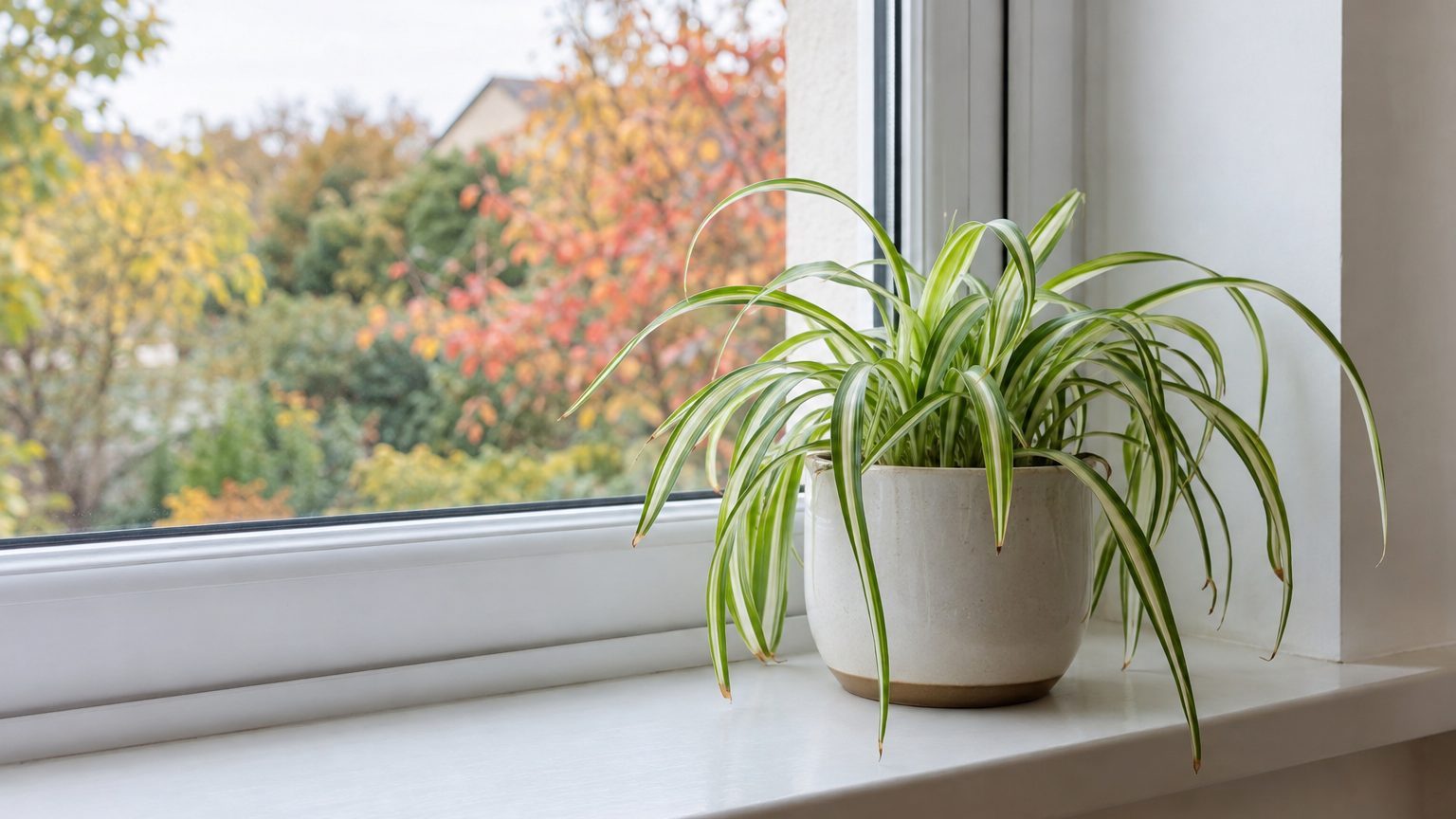
Fluoride is the most common reason spider plant tips turn brown, and it comes straight out of the tap. Chlorophytum comosum is one of the few houseplants known to be sensitive to it, along with dracaenas, peace lilies and prayer plants. The mineral accumulates in the leaf tips, where it kills tissue and leaves a crisp tan edge.
Fluoride isn’t the only culprit, though. Brown tips are a symptom, not a diagnosis, and the same dry, papery tip can come from half a dozen different problems.
- Fluoride in tap water is the most common cause of brown tips on spider plants.
- Brown tips that appear on every leaf with a yellow halo indicate dissolved minerals or salts.
- Flushing the pot with clean water every three to four months removes mineral buildup.
- Rainwater, distilled water, or reverse-osmosis water contains little to no fluoride.
Reading the browning before you reach for the scissors
Start with the pattern. Tips that brown evenly across every leaf, with a thin yellow halo between dead and green tissue, point to dissolved minerals or salts in the water or soil. A single leaf browning from the tip while the rest look fine usually means ordinary aging, since spider plants shed old foliage constantly.
Look at the roots, too.
Spider plants store water in thick, fleshy, tuberous roots, which is why they survive weeks of neglect. Lift the plant from its pot and check. If the roots are packed so tightly they form a solid mat, or bulge out of the drainage holes, the plant is rootbound and can’t move water efficiently to its leaf ends. White, firm roots are healthy, while mushy brown ones signal rot from overwatering, which also produces brown tips because damaged roots can’t deliver moisture upward.
Tip burn from underwatering looks different from the fluoride kind. The browning tends to be dry and wide, often with a scorched look, and the soil pulls away from the pot’s edge. Fertilizer burn shows up as brown tips combined with a white crust on the soil surface or around the drainage holes. That crust is salt, and it’s easy to confirm with a flashlight and a close look.
The water problem most owners never suspect
About 73% of the U.S. population served by community water systems receives fluoridated water, according to the Centers for Disease Control and Prevention. The recommended level is 0.7 milligrams per liter, a dose chosen for teeth rather than for foliage. For a spider plant, even that low concentration builds up over months, because the plant takes in fluoride through its roots and deposits it at the leaf margins.
Chlorine plays a smaller role, and letting water sit out overnight handles it. Fluoride does not evaporate. A glass of Tap Water Left on the counter will lose its chlorine and keep every bit of its fluoride, which is why the old advice to “let it sit” so often fails to fix the problem.
Hard water adds another layer. Calcium and magnesium salts accumulate in the potting mix and raise its electrical conductivity until roots struggle to absorb water at all. Plants in this situation behave as if they were drought-stressed while sitting in damp soil, a frustrating mismatch that leads many owners to water even more.
The fix is simple but needs consistency. Switch to rainwater, distilled water or reverse-osmosis water, any of which has little to no fluoride. A household filter pitcher won’t help much, since most standard carbon filters do not remove fluoride, so check the specifications before buying one. Collecting rain in a clean bucket costs nothing and plants tend to respond well to it.
Flushing, feeding and the other habits that matter
Once minerals have built up, clean water alone won’t clear them. Take the plant to a sink or tub and run water through the pot slowly for several minutes, roughly four times the volume of the pot, and let it drain completely. Do this every three to four months. It’s the closest thing houseplants have to a detox, and it works better than most people expect.
Feeding deserves restraint. Spider plants are light feeders, and a balanced Fertilizer at half the label strength once a month during spring and summer is plenty. In fall and winter, skip it altogether. Overfeeding is easy to do because the plant looks so vigorous, producing runners and plantlets with almost no help.
Humidity is the last variable. Most homes in winter drop to 20 or 30 percent relative humidity once the heat is on, well below what tropical foliage prefers. Spider plants tolerate it better than ferns do, but dry air still pulls moisture from the leaf tips first. Grouping plants together, or placing a small humidifier nearby, helps more than misting, which evaporates within minutes.
Light matters too. Direct afternoon sun through a south or west window scorches the leaf edges, producing brown streaks that can be mistaken for mineral damage. Bright, indirect light suits the plant best, and variegated types in particular fade and brown if they get too much.
What to do with the damage already there
Brown tips never turn green again.
You can trim them, and it’s worth doing for looks. Use clean, sharp scissors and cut along the leaf’s natural taper, leaving a hair-thin line of brown so you don’t open fresh tissue that will brown again. A blunt, straight cut across the tip draws attention to itself and often dies back further. Remove fully yellow or crisp leaves at the base instead of trimming them.
Keeping new growth clean
Patience is part of the cure. Leaves emerge from the center of the rosette, so new growth will look clean only after the water and soil conditions have changed, usually within four to eight weeks. Older leaves keep their scars for life, which can make a recovering plant look like it’s failing when it’s actually improving.
Repotting once a year, or whenever roots circle the pot, refreshes the soil and clears accumulated salts. Go up only one pot size, about an inch or two wider, since an oversized container holds too much wet soil around a root system that stores its own water. A standard, well-draining potting mix with a handful of perlite is all it needs.
The plantlets dangling from the mother plant offer a built-in reset. Pin one into a small pot of fresh mix while it’s still attached, or snip it off and root it in a glass of rainwater. A baby grown from the start on clean water and fresh soil often looks better than its parent, because it never inherited the buildup.
One last wrinkle: some spider plant owners report that the variegated cultivars brown faster than the solid green ones, and the pattern holds up in plenty of greenhouse experience. If you’ve fixed the water and the browning persists on a striped variety, swapping to a plain green plant may be the simplest solution.