
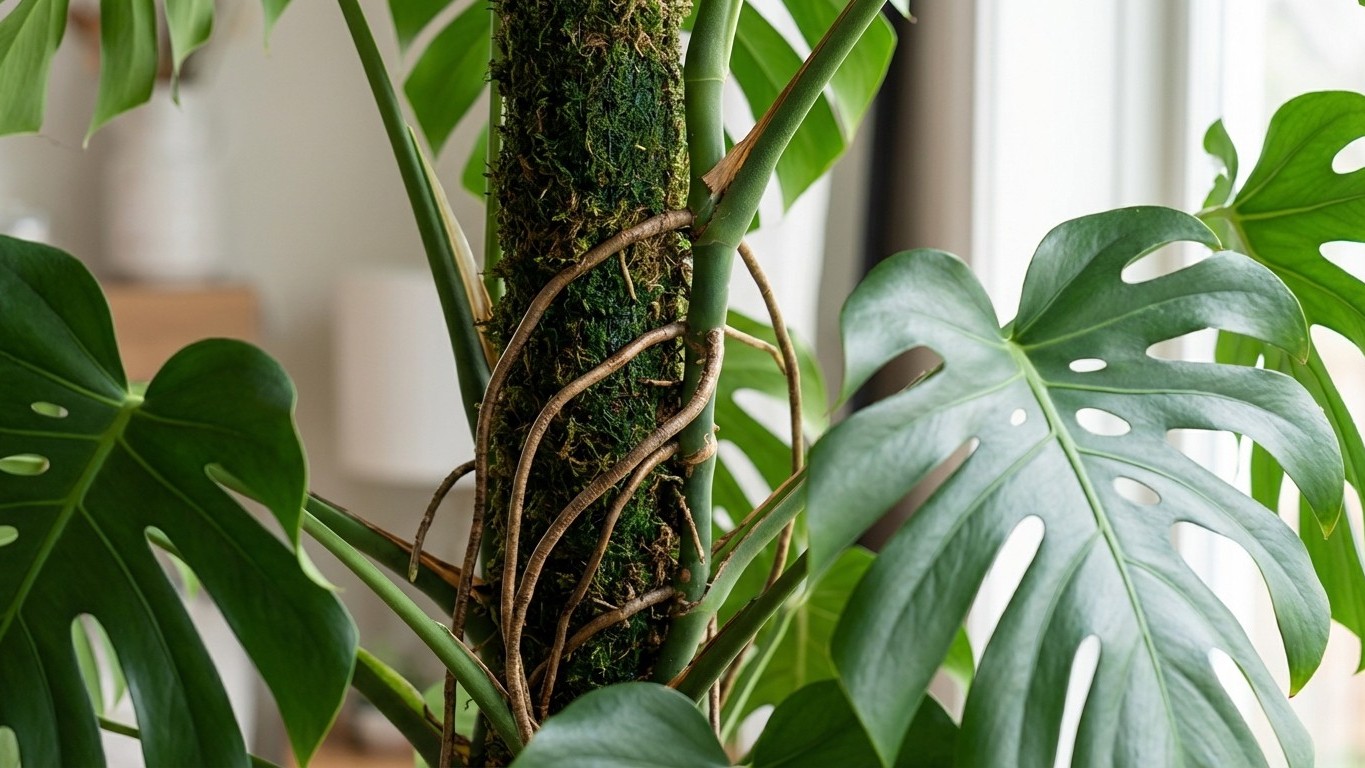
Those thick, brownish tendrils dangling from your Monstera’s stems aren’t an accident or a sign that something’s gone wrong. They’re one of the most sophisticated features of the plant, and snipping them off every time they appear might be the single most counterproductive thing you’re doing to your beloved Swiss cheese plant right now.
Key takeaways
- Your Monstera’s aerial roots function like a second pair of lungs, absorbing moisture and nutrients directly from the air
- Removing them regularly forces the plant to work harder, resulting in smaller leaves and growth cycles stretched from weeks to months
- A moss pole and consistent misting can redirect aerial roots while actually boosting plant vigor and leaf size
What aerial roots actually do (it’s more than you think)
Monstera deliciosa originates from the rainforests of Central America, where it spends its life climbing up tree trunks toward the forest canopy. In that environment, the plant never evolved to rely solely on soil. Aerial roots are its lifeline, structures that absorb moisture and trace nutrients directly from the humid air, anchor the plant to its climbing surface, and in some cases penetrate the ground to create a secondary root system entirely independent of the pot below.
The comparison that helps most people: think of aerial roots as a second pair of lungs. Your Monstera breathes and drinks through both its potted root system and these above-ground extensions. Cutting them off repeatedly doesn’t kill the plant outright, it just makes every biological process slightly harder, every single day. Over months, you’ll notice slower growth, smaller leaves, and that vague listlessness that’s hard to diagnose because it has no single dramatic cause.
There’s a number worth sitting with here: in optimal conditions, a healthy Monstera can produce a new leaf every four to six weeks. Plants with regularly trimmed aerial roots often stretch that to three or four months, because they’re channeling energy into compensating for lost absorption capacity rather than into new growth.
Why so many people remove them (and why the advice spread)
The trimming habit comes from a reasonable place. Aerial roots on a mature Monstera can grow long enough to trail across a shelf, poke into neighboring pots, or simply look unkempt. A lot of early houseplant advice, the kind passed down from the 1970s and 1980s, when Monsteras first became popular as interior plants — treated them like suckers on a tomato plant: tidy them up, keep the plant looking neat, no harm done.
Social media accelerated this. A clean, sculptural Monstera photograph well. Aerial roots are messy, sometimes sticky with sap, and they disrupt the aesthetic that gets the most engagement online. The result is a generation of plant owners who’ve inherited the trimming habit without the ecological context that would make them think twice.
The irony is that the most visually impressive Monsteras, the ones with leaves the size of dinner plates and deep, dramatic fenestrations — almost always have abundant, well-developed aerial roots. The two things are connected. Leaf size and split depth are partly a function of how efficiently the plant can take up water and nutrients, and roots, aerial or otherwise, are where that efficiency begins.
What to do instead
If the roots are the problem aesthetically, the solution isn’t the scissors, it’s redirection. Aerial roots are flexible enough, especially when young, to be gently guided. A moss pole or coir totem gives them something to grab onto and actually encourages them to become shorter and more structured, rather than sprawling outward. The roots will burrow into the damp moss, increasing surface area for moisture absorption, and the whole plant tends to respond within weeks with noticeably more vigorous growth.
For roots that have already grown long and stiff, a different approach works well. Coil the root loosely and tuck it into the soil of the same pot. It will begin to function as a regular root, drawing nutrients from the substrate, and effectively gives your Monstera a supplemental feeding system without you doing anything more than rerouting what’s already there.
Keeping the aerial roots hydrated also changes how they look. Dry aerial roots tend to be rough, brownish, and visually chaotic. Mist them two or three times a week, or place a small tray of water nearby so the ambient humidity rises, and they’ll develop a smoother, more compact texture, far less visually jarring in a styled space.
The one situation where trimming is genuinely acceptable: a root that has become brown, mushy, or shows signs of rot. That’s not a functional root anymore, and removing it cleanly with sterilized scissors prevents any potential spread. But a healthy aerial root, however inconvenient its trajectory, is doing work. Removing it is essentially asking the plant to do the same job with fewer resources.
Reading your plant’s response
Monsteras are communicative plants, once you know what to look for. A plant that’s been over-trimmed typically shows a specific pattern: new leaves emerge smaller than expected, unfurl slowly, and may lack the fenestrations (the characteristic holes and splits) that appear on more mature foliage. The splits, contrary to popular belief, aren’t purely decorative, they’re an adaptation to allow light to pass through the canopy in the wild, and they correlate directly with the plant’s overall vitality.
If this sounds familiar, the recovery plan is straightforward. Stop trimming. Add a moss pole. Mist the existing roots consistently for four to six weeks. Most healthy Monsteras will begin to show improved leaf size in the next growth cycle, though it won’t happen overnight, patience is the one tool no garden center sells.
There’s a broader question lurking underneath all of this: how much of standard houseplant advice was built around aesthetics and convenience rather than plant biology? The aerial root situation is a small example, but it points to a real gap between what looks good in a living room and what actually serves the organism growing inside it. Your Monstera has been around, in one form or another, for millions of years. It probably knows something about what it needs.