
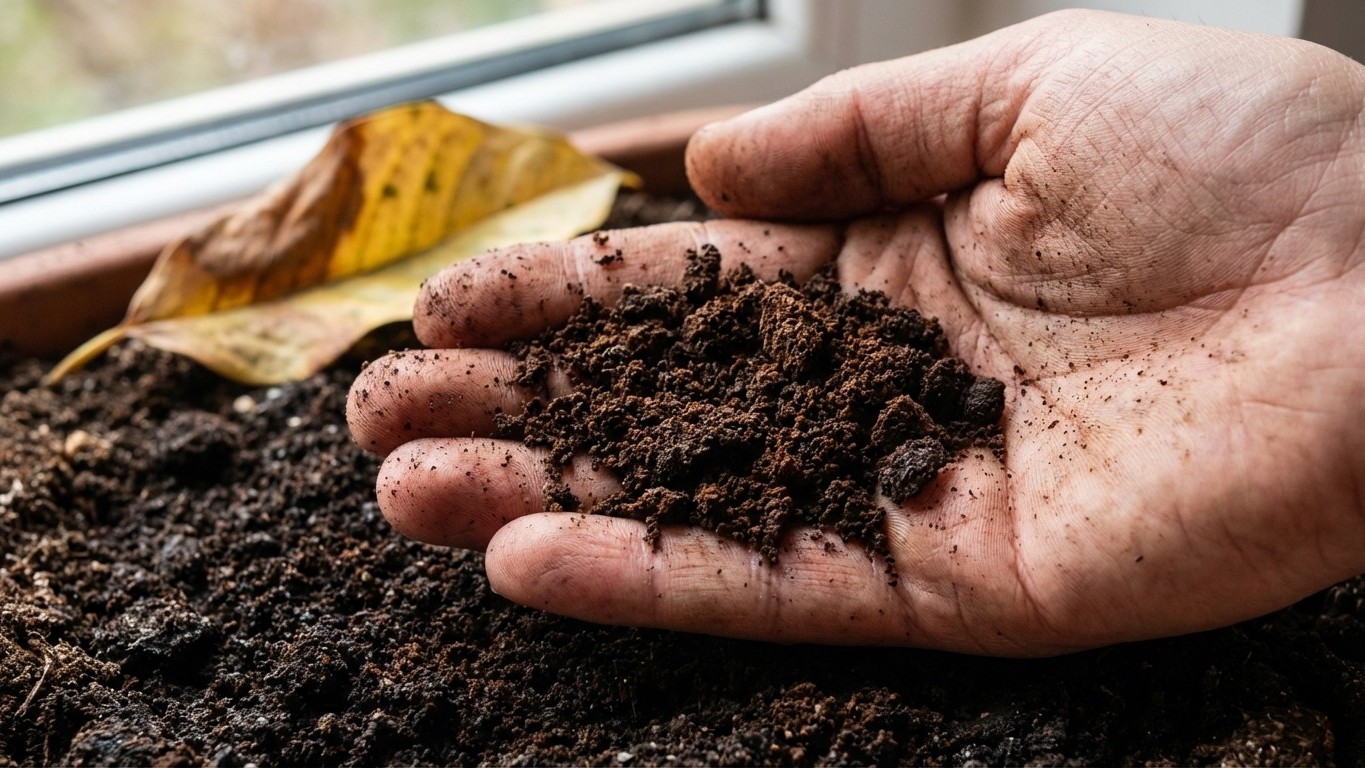
Every morning, millions of Americans dump their spent coffee grounds straight onto their houseplants or sprinkle them around garden beds, convinced they’re doing something smart and eco-conscious. The logic seems obvious: coffee is full of nutrients, your plants need nutrients, so connect the dots. Except, as soil scientists and botanists have been quietly trying to tell us, that logic has a serious flaw. The reality of what raw coffee grounds actually do to soil is considerably messier, and more interesting, than the gardening blogosphere would have you believe.
Key takeaways
- That acidic coffee myth? Brewing strips away the acid—grounds are actually pH neutral
- Coffee grounds compete with plants for nitrogen, leaving soil MORE depleted than before
- Caffeine in grounds acts as a natural herbicide, actively suppressing plant growth
The Acid Myth That Won’t Die
The most persistent claim about coffee grounds is that they acidify soil, making them a perfect amendment for acid-loving plants like blueberries, rhododendrons, and azaleas. Satisfying in theory. Wrong in practice. Contrary to popular belief, it is a myth that coffee grounds are acidic and will lower the pH of the soil. After brewing, the grounds are close to pH neutral, between 6.5 and 6.8. The acid that gives your cup of coffee its tang is water-soluble, meaning it washes out during the brewing process itself. What’s left in the filter is a largely spent material, stripped of most of its acidic character.
The research adds a layer of genuine weirdness to this. In scientific studies, adding coffee grounds to compost has shown wildly varying results, from creating a mildly acidic finished compost of 4.6 to a highly alkaline compost with a pH of 8.4. When composted coffee grounds were added directly to garden soil, researchers found that the pH of decomposing grounds was not stable. After showing an initial increase in acidity levels, the soil pH decreased shortly thereafter. any pH effect is temporary and unpredictable. Some plants like rhododendrons, azaleas, blueberries, gardenias, and blue-flowering hydrangeas require a lower soil pH to thrive and coffee grounds won’t do that. If you’ve been adding grounds specifically for those plants, you’ve been working for nothing.
The Nitrogen Paradox
Here’s where it gets genuinely counterintuitive. Coffee grounds contain around 2% nitrogen by weight, which is why gardeners assume they’re a useful fertilizer. But that nitrogen isn’t available to your plants when you dump raw grounds directly into the soil. The decomposition of the coffee grounds actually competes for the nitrogen that would otherwise be feeding your plants, so rather than adding nitrogen to the soil, coffee grounds may actually deplete it. Think about that for a moment: you’re adding what you think is a nitrogen source, and your plants end up with less nitrogen than before.
This process has a name, nitrogen immobilization, and it’s well-documented. The nitrogen that is available to the plant will be rapidly depleted by microorganisms as they break down the new carbon source. The soil microbes go to work on the fresh carbon-rich material, consuming surrounding nitrogen in the process. As the microorganisms break down the grounds, they temporarily tie up the nitrogen in the soil, which may result in yellowing and stunting of leaves. So the plant’s symptoms look like a nutrient deficiency, because that’s exactly what it is, one you accidentally caused.
The Invisible Problem on Your Soil Surface
Raw coffee grounds have one more trick that most gardeners never suspect. Used as mulch or applied in a thick layer on top of potting soil, they look great for about a week. Then something goes wrong. Applied too thickly, coffee grounds form a dense, water-repellent mat that suffocates roots. Always mix with coarser materials or limit layers to half an inch. This is the biggest problem with coffee grounds as mulch. The fine particles compact into a dense mat that can actually repel water rather than letting it through to plant roots.
That’s not a minor inconvenience, it’s the functional equivalent of covering your soil with a sheet of cardboard. Your plants look watered on the surface while their roots stay bone dry underneath. While raw spent coffee grounds are initially phytotoxic, upon composting, they can be utilized as a soil amendment. The word “phytotoxic” is doing a lot of work in that sentence. It means toxic to plants. A 2024 study on sunflowers confirmed it starkly: concentrations of raw coffee grounds at or above 35% caused large reductions in germination, plant height, and leaf emergence.
Caffeine is partially responsible. Those warnings about acidity ignore one big problem with spent coffee grounds: they’re full of caffeine. To understand why caffeine is bad for your garden, you need to understand why certain plants produce caffeine in the first place. Coffee and cacao both independently evolved the ability to produce it, a case of convergent evolution that strongly suggests caffeine serves a specific biological purpose. That purpose? Suppressing the growth of competing plants nearby. When you pour it into your own plant’s pot, you’re deploying a natural herbicide against the very thing you’re trying to grow.
Raw coffee grounds could improve certain soil health attributes, but plant growth is often limited owing to its phytotoxicity and induced nitrogen immobilization. Researchers at the University of Melbourne went further. They determined through experimentation that even limited amounts of coffee grounds in soil had a detrimental effect on the growth of broccoli, leek, radish, violas, and sunflowers, concluding that “all horticultural plants grew poorly in response to spent coffee grounds, regardless of soil type and fertilizer addition.” Regardless of soil type. That’s a damning conclusion.
What to Do Instead
None of this means coffee grounds belong in the trash. The science is clear that the problem is raw, direct application, not the material itself. Composting changes everything. Composting grounds before adding them to soil is the safest approach. The composting process breaks down residual caffeine and other potentially inhibitory compounds while concentrating the nutritional benefits. Through composting, the phytotoxic compounds are neutralized, the nitrogen becomes genuinely available, and the organic matter improves soil structure in the ways everyone hopes for when they reach for that bag of grounds.
The practical rules, drawn from soil scientists at Oregon State University and Washington State University, are simple. In compost, limit coffee ground content to no more than 20% of the total compost volume, more than 30% has often been detrimental. In a compost pile, mix three parts leaves to one part fresh grass clippings to one part coffee grounds by volume. If you want to apply them directly to garden beds rather than composting first, work in a half inch to a depth of 4 inches. Never pile them loose on the surface and walk away. Never use coffee grounds when planting seeds or on seedlings or very young plants. Grounds can inhibit seed germination; caffeine, even at low levels, stunts early growth.
There’s also one area where coffee grounds genuinely deliver: soil structure over time. Coffee grounds are best at improving soil. As the coffee grounds feed the soil microbes, microbial glues are released that promote good soil structure and improve drainage. And for anyone dealing with slugs, research shows that using a 1% to 2% solution mixed with water as a soil drench caused 100% of slugs to leave the treated soil. That’s a genuinely useful application most people overlook entirely.
The broader takeaway here isn’t really about coffee grounds. It’s about how gardening advice circulates, through blogs, social media, and word of mouth, completely detached from the underlying science. A tip sounds logical, it gets shared, and after enough repetition it becomes accepted wisdom that nobody questions. Coffee grounds are just one example. The question worth sitting with is: how many other things are you doing to your soil right now that seem obviously correct but have never been tested against what’s actually happening underground?
Sources : mdpi.com | news.oregonstate.edu