
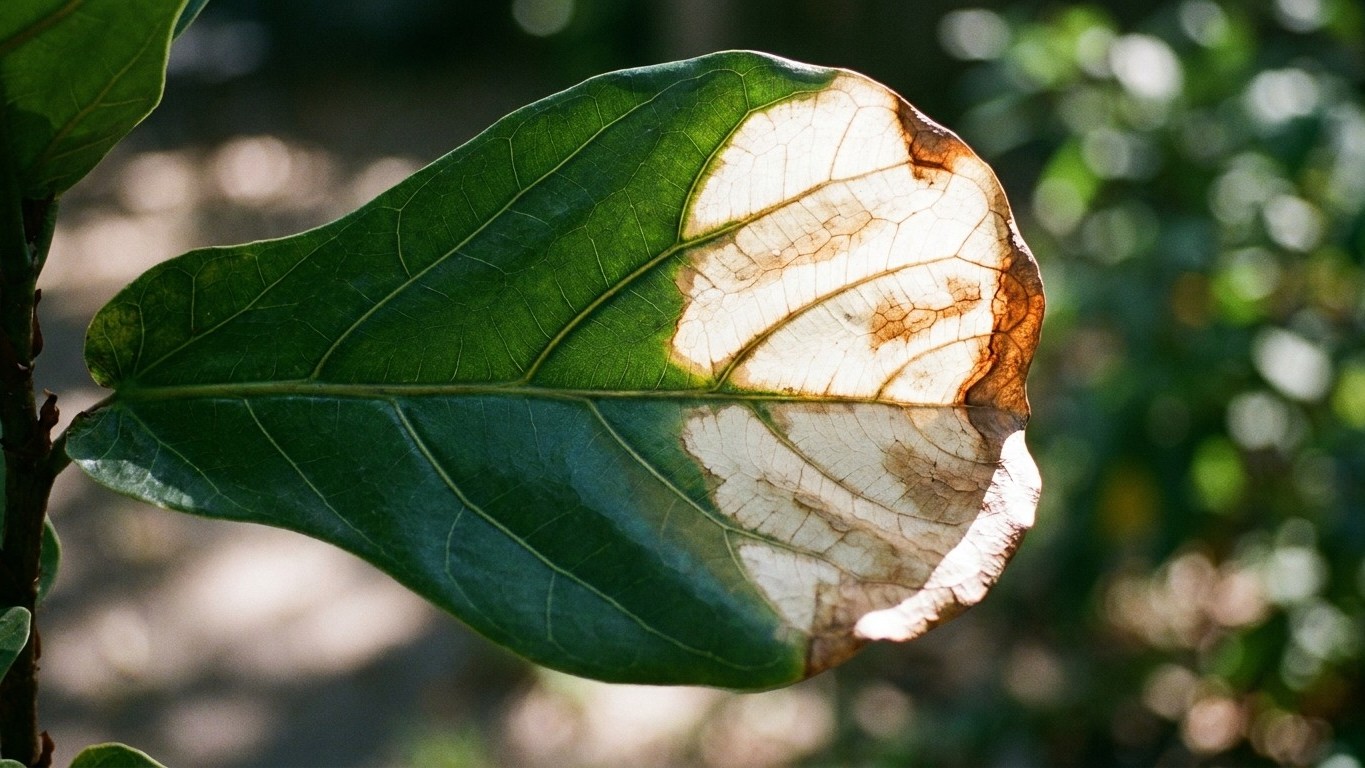
Three days. That’s all it took for a healthy fiddle leaf fig to go from glossy green centerpiece to a specimen covered in bleached, papery patches that never turned back. The damage wasn’t sunburn in the mild sense you can nurse back to health. It was permanent cellular death, the plant equivalent of a scar.
This happens every summer to thousands of indoor gardeners who make the same reasonable-sounding decision: the weather turns warm, the plants look like they could use “real sunlight,” and out they go onto the patio or balcony. Within 48 to 72 hours, leaves that spent months or years adapted to a window’s filtered glow start showing white or brown scorch marks, crispy edges, or a bleached, washed-out look that spreads fast. By the time most people notice, the tissue is already dead. There’s no reversing it.
Key takeaways
- Houseplant leaves develop fragile ‘shade morphology’ that collapses under outdoor sun intensity—sometimes within 48 hours
- Outdoor light can be 10 times more intense than a sunny windowsill, overwhelming a plant’s photosynthetic system
- The solution isn’t avoiding outdoors; it’s a gradual ‘hardening off’ process borrowed from vegetable gardening
Why indoor leaves can’t handle direct sun
Houseplant leaves grown indoors develop what horticulturists call “shade morphology.” Their cells are structured with fewer protective compounds, thinner cuticles, and chloroplasts arranged to capture as much of the weak, indirect light coming through a window as possible. That structure is efficient in low light. It’s a liability outdoors.
Direct sunlight outside is dramatically more intense than even a bright south-facing window. Research from horticulture extension programs, including guidance published by Penn State Extension, notes that light intensity outdoors on a clear summer day can exceed 10,000 foot-candles, while a sunny indoor windowsill typically delivers a few hundred to at most 1,000 foot-candles. That’s not a gradual step up. It’s closer to walking out of a dim theater into a stadium under floodlights, except the plant’s cells have no eyelids to squint with.
The result is a physiological injury: the leaf’s photosynthetic machinery gets overwhelmed, chlorophyll breaks down faster than it can be replaced, and cell walls in the exposed tissue collapse. Once that tissue turns white, tan, or crispy brown, it’s dead. Plants can’t “heal” scorched leaf tissue the way skin scabs over. The plant’s only real recovery mechanism is to grow new leaves and drop the damaged ones.
The mistake isn’t moving plants outside. It’s how fast.
Getting houseplants outdoors for the summer isn’t a bad idea. Many tropical species, pothos, philodendrons, even orchids, respond to a few months outside with a genuine growth spurt, thanks to higher humidity, better air circulation, and light levels that support more vigorous photosynthesis than any indoor spot can offer. The problem is the transition, not the destination.
Plants need what growers call “hardening off,” a gradual acclimation period borrowed from vegetable gardening. Tomato seedlings started indoors get the same treatment before transplanting: a few hours outside in shade, a little more each day, working up to full sun exposure over one to two weeks. Houseplants need the identical process, and skipping it is almost always what causes the scorch.
A succulent that’s spent all winter on a windowsill, a pothos vine trailing across a bookshelf, a snake plant tucked in a dim corner: none of them have any built-in defense against a sudden jump to full midday sun. Even naturally sun-loving plants like citrus trees or hibiscus, which can eventually thrive outdoors, will scorch if moved abruptly after a winter indoors.
What acclimation actually looks like
The safest approach starts with deep shade, not partial sun. Set plants under a porch roof, beneath a larger tree, or on a covered patio for the first three to four days, somewhere they get bright ambient light but no direct rays touching the leaves at any point in the day.
From there, introduce direct morning sun only, for an hour or two, keeping the rest of the day shaded. Morning light is gentler than the intensity that builds by early afternoon. Over the following one to two weeks, extend that direct exposure gradually, watching each plant’s response rather than following a fixed calendar, since a fern and a jade plant don’t acclimate at the same speed.
Weather matters too. Moving plants out on an overcast, mild day gives a gentler starting point than doing it during a heat wave with a cloudless sky. Wind is an underestimated factor as well: outdoor air moves moisture out of leaves far faster than indoor air, so a plant getting acclimated to sun also needs slightly more frequent watering checks during that first week, since sunburned tissue often gets compounded by dehydration stress happening at the same time.
Not every houseplant tolerates the same ceiling of light once fully acclimated. Snake plants, ZZ plants, and most philodendrons top out at bright shade to dappled sun and will scorch even after hardening off if pushed into full afternoon exposure. Succulents, geraniums, and citrus can handle several hours of direct sun once properly transitioned. Knowing which category a plant falls into before starting the process saves a lot of guesswork.
When the damage is already done
If leaves have already scorched, the instinct to rescue the plant by moving it back inside immediately or drenching it with water is understandable but not that useful for the damaged foliage itself. Bleached or crispy leaves won’t turn green again. The better move is to leave the plant in a shadier spot outside (not straight back into a dim indoor room, which just adds another abrupt transition), let it stabilize, and prune off the dead tissue once new growth appears elsewhere on the plant.
Removing scorched leaves too early, before new growth has established, can stress the plant further by cutting its available leaf surface for photosynthesis right when it needs it most. Patience matters more than speed here. Most houseplants, even ones that lose several leaves to sunburn, recover fully within a growing season once they’re given a properly shaded restart and time to push new foliage adapted to outdoor light from the start.
One detail surprises a lot of people: leaves that grow after the move, once a plant has adjusted, often look physically different from the ones it had indoors. They tend to be smaller, thicker, and slightly more matte, with a texture built for higher light rather than the soft, glossy shade-leaves the plant produced all winter. That’s not a sign of stress. It’s the plant doing exactly what it’s supposed to do, building tissue suited for the light it’s actually getting instead of the light it left behind.