
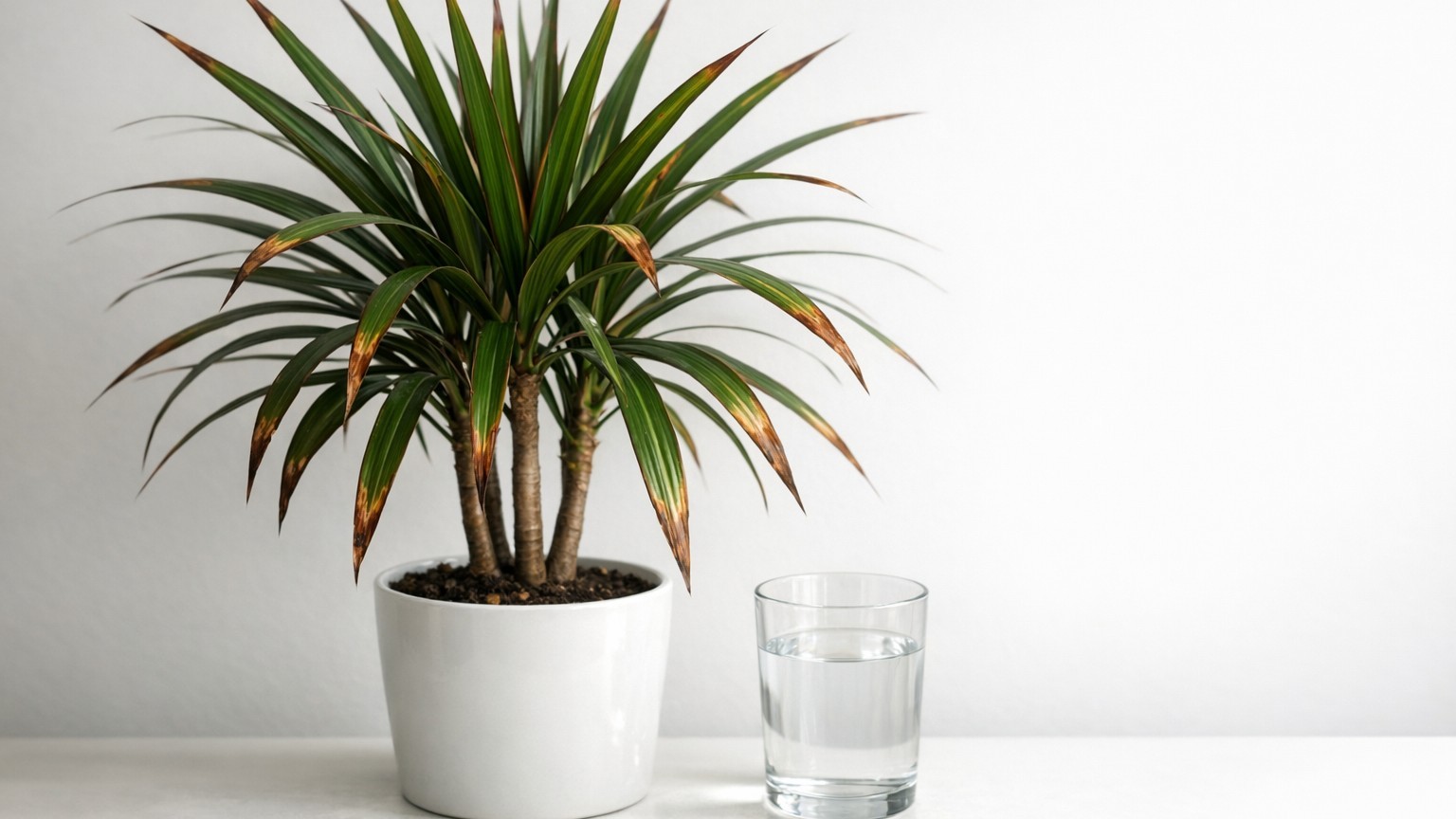
Brown tips on dracaena are one of the most common complaints among houseplant owners, and the cause is almost always the same: fluoride and salt accumulation in the soil. Tap water in most American cities contains fluoride at concentrations around 0.7 parts per million, added deliberately for dental health. That sounds harmless. But pour the same water into a pot week after week, year after year, and those minerals have nowhere to go. The soil becomes a slow-motion trap.
Key takeaways
- Fluoride in tap water doesn’t evaporate—it accumulates in soil and interferes with your dracaena’s photosynthesis at the cellular level
- A single pot watered twice weekly for three years receives 300+ mineral deposits, fundamentally altering soil chemistry
- Switching to distilled or rainwater, flushing the soil quarterly, or installing a reverse osmosis filter stops the damage before it spreads to your other plants
What tap water actually deposits in your pot
Dracaenas are famously sensitive to fluoride, far more than most common houseplants. The leaf damage isn’t cosmetic bad luck, it’s a physiological response. Fluoride interferes with photosynthesis at the cellular level, causing the outermost leaf tissue to die back. The tips go brown, then the browning creeps inward along the edges. By the time it’s visible, the buildup in the soil has been happening for months.
Chlorine is the other culprit, though it behaves differently. Unlike fluoride, chlorine does dissipate from standing water after 24 to 48 hours. Many plant owners swear by leaving tap water out overnight before using it, and for chlorine specifically, that works. But fluoride doesn’t evaporate. It stays in the water regardless of how long it sits, and it stays in your soil after every single watering.
Hard water adds another layer. Depending on where you live, your tap water may carry significant concentrations of calcium and magnesium salts. Cities like Phoenix, Las Vegas, and San Antonio regularly rank among the hardest water markets in the country. Those salts accumulate on the soil surface as a white or yellowish crust, the ring you sometimes see around the inner edge of a terracotta pot. Below the surface, the buildup alters soil chemistry and gradually raises the pH, making it harder for roots to absorb nutrients even when those nutrients are present.
The moment I understood what was happening
For years, my dracaena marginata sat in the same corner, getting the same tap water, looking mostly fine. A few brown tips here and there : I assumed it was low humidity or a draft from the window. Then one spring, the browning accelerated. Tips I’d trimmed clean came back brown within weeks. I repotted the plant and looked at the old soil: pale, crusty, almost powdery near the edges of the root ball. The smell was faintly mineral, like old pipes.
That visual, the white salt crust running through the soil like veins, made the problem concrete in a way reading about it never had. The pot had been functioning as an evaporation chamber for years, water going in and water evaporating out, but every dissolved mineral staying behind. A standard 6-inch pot watered twice a week for three years had received roughly 300 waterings. Each one left a microscopic deposit. Three hundred deposits later, the chemistry of that soil was nothing like what the plant needed.
How to actually fix the problem
The first and most direct solution is switching water sources. Distilled water contains essentially no dissolved minerals, making it the cleanest option for sensitive plants like dracaenas, spider plants, and peace lilies. Rainwater collected in a clean container works just as well and costs nothing. A reverse osmosis filter under your kitchen sink is a more permanent fix if you have multiple plants, it removes fluoride and most dissolved salts before the water reaches your glass or your watering can.
Flushing the soil is a short-term remedy that buys time. Run a large volume of distilled or filtered water through the pot, roughly three to four times the volume of the pot itself, and let it drain completely. This pushes accumulated salts out through the drainage holes. Do this once every three to four months if you’re still using tap water. It won’t undo years of buildup, but it interrupts the accumulation cycle.
Repotting with fresh, well-draining potting mix gives the plant a clean start. When you do, resist the urge to use soil amendments that contain fertilizer, dracaenas prefer lean soil, and added nutrients won’t help a plant already stressed by mineral toxicity. A standard indoor potting mix, slightly gritty, in a pot with good drainage is enough.
Trimming the brown tips is purely cosmetic, but it matters for the plant’s energy budget. Dead tissue doesn’t recover, and a clean cut with sterile scissors prevents the browning from spreading along the leaf edge. Cut at a slight angle to mimic the natural leaf shape, the result looks far less surgical than a blunt horizontal snip.
A longer view on water quality and plant health
The dracaena’s fluoride sensitivity makes it something of a canary in the coal mine for houseplant collections. If your dracaena is showing consistent tip burn despite stable humidity and proper light, there’s a good chance your other plants are silently accumulating the same minerals, they’re just more tolerant and won’t show symptoms as quickly. Calatheas and prayer plants, for instance, also react badly to fluoride, though their symptoms tend to show up as yellowing edges rather than brown tips.
There’s a practical footnote worth knowing: phosphorus-heavy fertilizers can make fluoride toxicity worse. Phosphate binds to calcium in the soil, releasing fluoride ions that become more available to roots. So the well-intentioned spring fertilizer routine can accelerate the exact damage you’re trying to prevent. If tip burn is an issue, pause fertilization, flush the soil, and switch water sources before reaching for any nutrient supplement.