
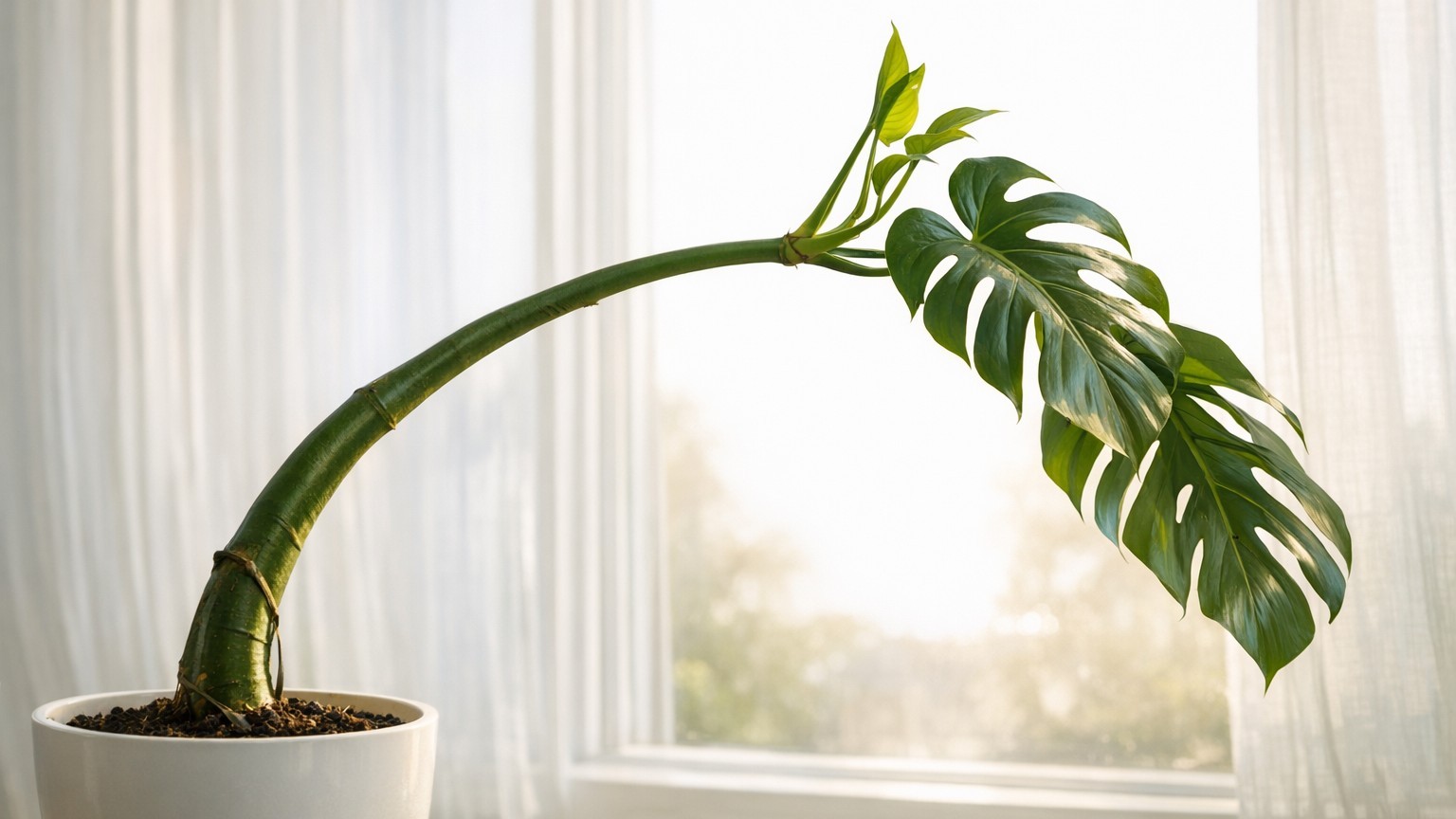
Plants lean toward light. Every gardener knows this, accepts it as background noise, and develops a weekly ritual to compensate: rotate the pot a quarter turn, keep the growth symmetrical, move on with the day. For years, that was my Sunday habit. Then life got complicated in February, and I forgot entirely for almost five weeks. What I came back to wasn’t what I expected.
The stems hadn’t just bent. They had reorganized. The longest branches had curved in precise, almost architectural arcs, with the newest growth angled sharply toward the window while the older growth held its original trajectory. The plant looked like it had been making decisions without me, because, in every biological sense, it had.
Key takeaways
- Plant stems undergo a hidden cellular reorganization when exposed to one-sided light, creating curves that are permanent once formed
- The weekly rotation ritual most gardeners follow might be timed all wrong—growth speed, not the calendar, should set the schedule
- Those architectural bends in neglected stems tell a story: each curve is evidence of how aggressively your plant is growing and adapting
What’s Actually Happening Inside the Stem
The process has a name most people learn once and forget: phototropism. But the mechanics behind it are more dynamic than a textbook diagram suggests. When light hits one side of a stem unevenly, a plant hormone called auxin migrates away from the bright side and accumulates on the shaded side. That higher concentration of auxin on the dark side causes those cells to elongate faster than the cells on the lit side. The stem bends toward the light not because it’s reaching for it, but because it’s growing unevenly at the cellular level.
Blue light wavelengths (roughly 400 to 500 nanometers) are the primary trigger. A morning window with direct or indirect sunlight delivers precisely that spectrum in abundance. What this means practically is that a plant sitting in front of a north-facing window will curve more aggressively, and faster, than the same species sitting in a bright south-facing room where light wraps around more evenly. The severity of the bend is a direct measure of how one-directional the light source is.
Here’s where it gets interesting: auxin doesn’t reset. Once a stem has bent and its cells have elongated on one side, that curve is structural. The plant can grow new straight tissue from the top, but the original curve stays. This is why a plant that has been severely neglected in this regard develops an S-curve or a corkscrew appearance over many months, layers of corrective growth stacked on previous ones, each generation of stems trying to aim itself better than the last.
Why the Rotation Ritual Actually Matters (and Where It Falls Short)
The weekly quarter-turn is good advice, but it’s advice built on a misunderstanding of timing. Most people rotate their plants on a fixed schedule regardless of growth rate. A fast-growing pothos or a philodendron in peak spring growth might need rotation every four to five days. A slow-growing snake plant in winter might genuinely be fine with a rotation every three weeks. The plant’s actual speed of bending, not the calendar, should set the schedule.
A practical way to calibrate this: place a small piece of tape on the pot to mark the “window-facing” side, then check after one week. If the newest leaf or stem tip has visibly angled more than about 15 degrees toward the window, your plant needs more frequent rotation. If there’s almost no movement, you have more flexibility. Slow-growers get more grace time.
The other thing rotation doesn’t fix is root architecture. Roots grow away from light (a separate process called negative phototropism), and in a pot that sits in one position for months, roots will shift their distribution accordingly. This rarely causes serious damage in healthy soil, but it can subtly affect how a plant drinks, roots concentrated on one side of the pot may leave parts of the root ball underwatered even when you pour evenly. After a long period of neglect, gently repotting or at minimum loosening the top layer of soil helps redistribute things.
What I Actually Changed After That Month
The immediate fix was less dramatic than the realization. The most bent stems, on a large monstera and a smaller rubber plant, were too structural to correct. Trying to rotate the plant back to “undo” the curve doesn’t work; it just starts bending in the new direction from the growth tip while the old curve remains. The plant ends up looking like a question mark over time if you’re not careful about where you stop.
What actually helped for the monstera was staking the main stem loosely against a bamboo cane while allowing the new growth to develop symmetrically. Over about eight weeks, the visual effect of the curve became less prominent as new leaves filled in above it. The older bent section is still there, but the plant now reads as upright because of where the fresh growth is heading.
For the rubber plant, the bend was mild enough that simple repositioning and more consistent rotation brought it back toward a cleaner silhouette within two months. These plants have a naturally upright, stiff stem structure that resists severe curving unless the neglect goes on much longer than a month.
The deeper shift was in how I think about rotation itself. It’s not maintenance in the way watering is maintenance. It’s a conversation with how the plant is actively growing, an intervention in an ongoing biological process rather than a routine chore. A plant that curves aggressively in a week is a plant growing fast and responding strongly to its environment. One that barely moves is either healthy-stable or quietly struggling. The lean, it turns out, carries more information than most people stop to read.