
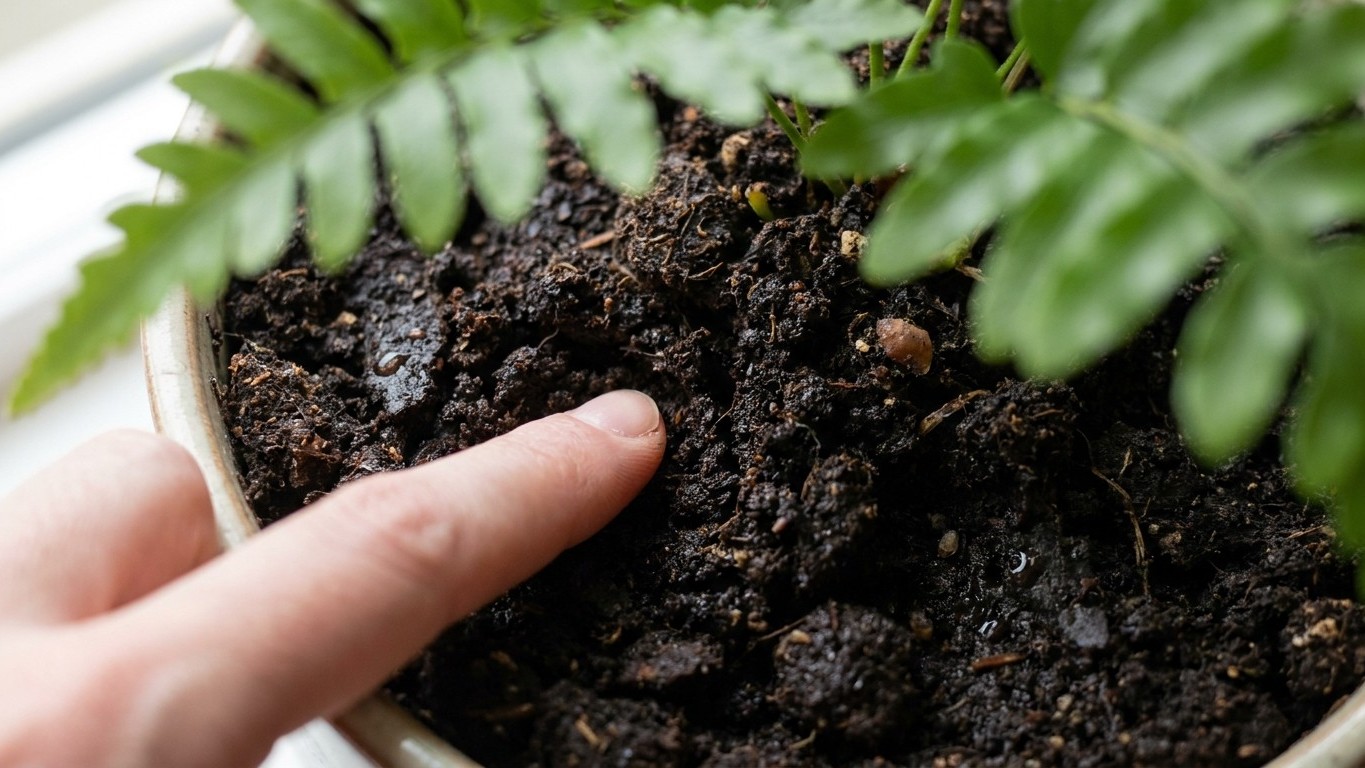
Adult fungus gnats floating over a fern aren’t the infestation. They’re the symptom. The real factory sits an inch below the surface, in the thin, damp layer of potting mix that almost nobody bothers to inspect, where adult females lay eggs just under the surface of damp potting soil, and once hatched, the white, legless larvae can be seen in the top inch of the soil. Hang all the sticky cards you want above the leaves. The maternity ward stays open.
This matters because most people fight the wrong stage of the bug. Sticky traps are genuinely useful, but they only intercept adults that are already flying around looking for a mate or a fresh patch of soil to colonize. Meanwhile, according to entomologists at the University of California’s Statewide IPM Program, fungus gnats infest soil, potting mix and other sources of organic decomposition, and their larvae primarily feed on fungi and organic matter in soil, but also chew roots. The trap catches the messenger. The nursery keeps producing new recruits.
Key takeaways
- A single fungus gnat female can trigger a complete new generation in as little as 17 days—and you’re probably dealing with multiple overlapping generations right now
- Sticky traps only catch what’s already flying; at any moment, most of the population is in the soil as eggs, larvae, or pupae waiting to emerge
- The real fix involves three simple moves: letting soil dry between waterings, a peroxide drench to kill larvae immediately, and a physical barrier to stop females from laying eggs
A Nursery That Runs on a Two-Week Clock
The math is almost embarrassing once you see it laid out. A single female doesn’t just lay a few eggs and call it a day. Research compiled by Colorado State University Extension notes that fungus gnat larvae are usually in the top 2 to 3 inches of the growing medium, depending on moisture level, and they primarily feed on fungi, algae, and decaying plant matter, though they will feed on plant roots and leaves resting on the surface. Those larvae aren’t idle passengers, either. Cornell’s integrated pest management program points out that you can find larvae in your houseplants’ soil, and plant damage and wilting may occur in severe infestations.
Speed is the real problem. A full generation, from freshly laid egg to a mating adult capable of starting the cycle over, can wrap up in roughly a month, sometimes faster. Industry pest specialists at Summit Chemical break the stages down precisely: fungus gnats go from egg (4-6 days) to larva (12-14 days) to pupa (4-6 days) to adult (8-10 days), and at 75ºF the eggs hatch, with the complete life cycle from egg to adult lasting around 4 weeks depending on temperature. Warmer homes, especially the ones with a radiator running under a shelf of pothos all winter, only speed things up. A generation can be produced in about 17 days, and the warmer it is, the faster the cycle and the more generations produced, resulting in many overlapping generations throughout the year. That overlap is exactly why an infestation feels endless. You’re never dealing with one wave of gnats. You’re dealing with three or four cohorts stacked on top of each other, all at different stages of growing up in the same square inch of soil.
Why the Sticky Card Isn’t Lying, It’s Just Late
Here’s the part that surprises most plant owners: placement changes Everything, and almost everyone gets it wrong. According to a detailed breakdown of trap mechanics from PlantFix, horizontal placement at soil level catches three times more gnats than a card standing upright above the pot. That’s because of a quirk in the insect’s biology. Adult gnats aren’t just wandering randomly. They’re strongly attracted to yellow wavelengths in the 550-590 nanometer range, and a bright yellow surface coated in adhesive catches every adult that lands on it when it’s positioned where they’re actually emerging from, not floating a few inches above their launch pad.
Even with perfect placement, a trap only removes what’s already airborne. As one detailed houseplant pest guide puts it plainly, sticky traps only catch adults, but most of the population at any moment is in the soil as eggs, larvae, or pupae, so without addressing the larvae, new adults emerge faster than traps can catch them. That’s the whole story in one sentence. You can empty a trap every three days and still watch the swarm regenerate, because the card was never the bottleneck.
Treating the Soil, Not Just the Symptom
The fix isn’t complicated, but it does require touching the part of the pot everyone avoids. Moisture is the single lever that controls everything, because larvae are shockingly fragile outside of damp conditions. Colorado State’s extension office is direct about it: the most important strategy to minimize fungus gnat problems is to allow the growing medium to dry between watering, especially the top 1 to 2 inches, since dry medium decreases survival of eggs and larvae and reduces the attractiveness of the soil to egg-laying females. No moisture, no maternity ward.
Beyond drying schedules, a direct larval assault works faster. A hydrogen peroxide drench is the go-to fast option because, as one plant care guide explains, mixing one part 3% hydrogen peroxide with four parts water and watering the plant as usual causes the peroxide to fizz on contact with organic matter in the soil, killing fungus gnat larvae on the spot. For a longer-term biological approach, Bacillus thuringiensis israelensis, sold in garden centers as mosquito dunks or bits, works differently: it’s a naturally occurring soil bacterium that produces a protein toxic to fungus gnat larvae but harmless to plants, pets, humans, beneficial insects, and worms. Many growers run both in sequence, hydrogen peroxide for a quick knockdown, then BTI for the weeks after, since BTi works more selectively and is better suited for ongoing maintenance, so starting with hydrogen peroxide for the first two to three weeks then switching to BTi gives you both speed and thoroughness.
A cheap, unglamorous trick seals the deal for good: a thin cap of coarse sand, aquarium gravel, or diatomaceous earth spread over the soil surface. It physically blocks egg-laying females from reaching moist soil and dries out fast under indoor light, which is why Cornell recommends that adding a 1-inch layer of sand to the soil surface, kept dry, will eventually stop reproduction. Combine that layer with a horizontal trap at soil level, a peroxide drench on move-in day, and a watering habit that actually lets the topsoil breathe, and the swarm doesn’t have anywhere left to hatch.
Sources : empressofdirt.net | plantfix.org