
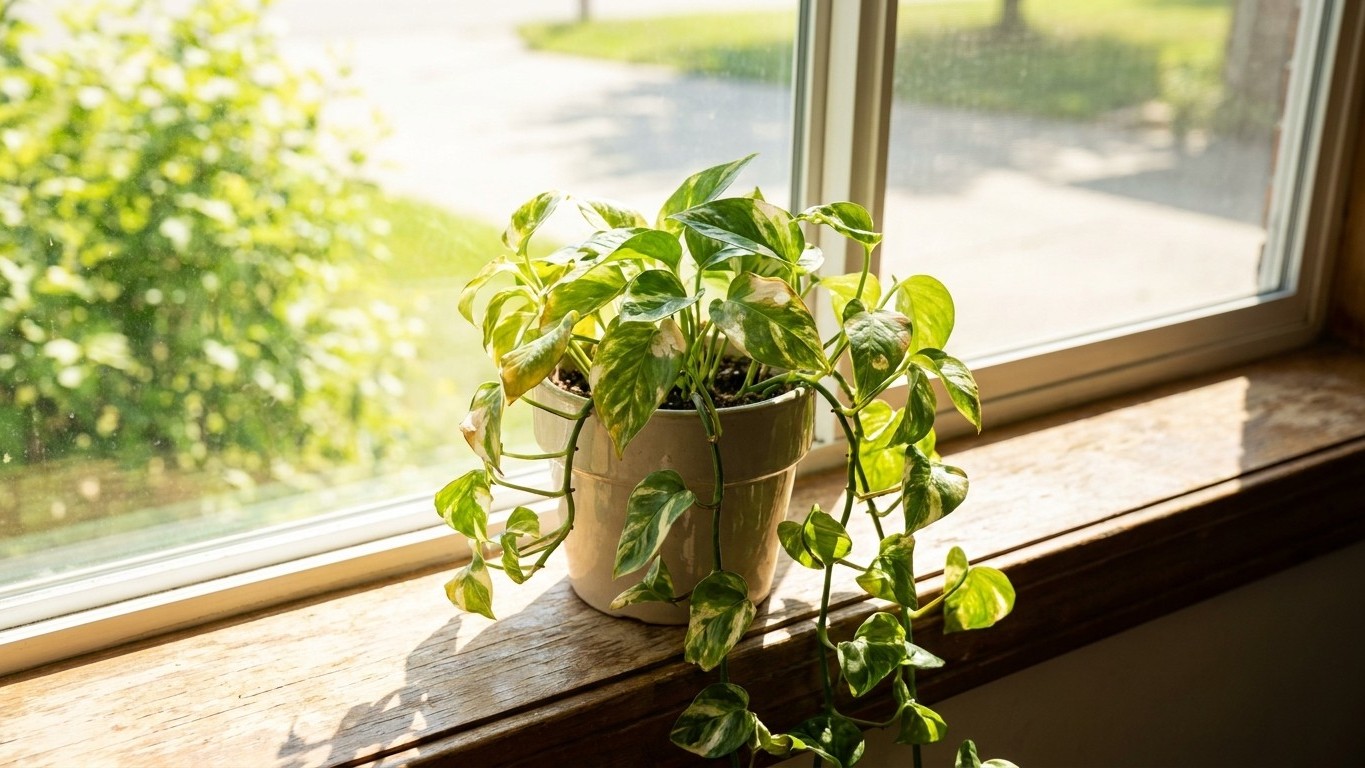
Move a fern three inches back from a sun-baked window and something remarkable happens on the underside of its leaves: a spider mite colony that would have taken three weeks to multiply now needs barely five days to double. The difference isn’t the plant. It’s the glass, and the invisible heat trap it creates every summer afternoon.
Key takeaways
- Window glass creates a heat pocket that’s perfect for spider mites but deadly for your plants
- Pest populations can complete multiple generations before you notice a single stippled leaf
- Predatory mites (the biological control solution) actually stop working in the exact heat conditions where spider mites thrive fastest
Why glass turns your windowsill into a mini greenhouse
Most houseplant owners treat the pane itself as a light filter, nothing more. But glass does something trickier: it lets short solar wavelengths in easily while making it harder for the resulting heat to escape. Many houseplants come from tropical parts of the world, but that does not mean they enjoy sitting in direct sunshine behind a window on a hot summer afternoon, since glass can magnify heat and light levels significantly. The result is a narrow strip along the sill that runs several degrees hotter than the rest of the room, even when the thermostat reads a stable 72°F.
That heat buildup is directional. In summer a south-facing window can trap heat, so heat-sensitive plants should be set back a few inches or moved to a cooler east or west exposure. West windows carry their own trap: the intense afternoon sun raises the temperature in west-facing windows, so plants that scorch easily may need to be placed a few feet away from the glass. A Fiddle Leaf Fig pushed tight against a south or west pane in July is a textbook example. Its broad leaves soak up radiant heat fast, and even the heat radiating off the glass can stress the plant significantly, with direct sun exposure for more than an hour or two causing leaf scorch in most cases. The brown, crispy patches that follow never green back up.
What actually doubles under the leaves
Here’s the part most people miss entirely: the pests riding out summer on your plants are reading that same thermometer, and they respond to it far faster than the plant does. Spider mites, the almost invisible arachnids responsible for the fine stippling and faint webbing on stressed foliage, are built for exactly this kind of heat spike. They reproduce rapidly in hot weather and commonly become numerous from June through September, and if temperature and food supplies are favorable, a full generation can be completed in less than a week. The two-spotted spider mite, the species most likely to show up on a ficus or a hibiscus parked against glass, is even quicker off the mark: it can mature in as little as five days and be ready to reproduce, which is why populations tend to rapidly increase, especially under favorable climatic conditions of hot and dry air.
Indoors, those favorable conditions are practically guaranteed by the window itself. Dry, dusty conditions and high heat are what spider mites love, and as the temperature approaches the upper end of the thermometer, spider mites go into overdrive. A plant pressed against hot glass sits in exactly that microclimate: warm, dry, still air, with almost no predators around to keep numbers in check. As one pest specialist put it plainly, spider mites in the home usually have ideal warm, dry conditions and a lack of natural predators, prime conditions to take over your prized pothos. The scary part isn’t that mites can appear. It’s how easy it is to miss the whole event, because indoor temperatures are stable and climates tend to be drier indoors, so house plants should be checked weekly for signs of spider mites. By the time stippled leaves are obvious to the naked eye, several generations have often already come and gone.
Small distance, real difference
The fix costs nothing and takes about thirty seconds per plant. Pulling a pot back from the glass, even by a few inches, drops it out of that concentrated heat pocket and back into the room’s ambient temperature, which is usually enough to slow mite reproduction back down to a manageable pace. For plants that still need the light but not the radiant heat, a sheer curtain or a light diffusing film does the heavy lifting: applying a window film that blocks UV rays can block out 45 to 85 percent of sunlight heat in summer, creating a more hospitable environment for house plants. That’s not a marginal improvement. That’s the difference between a windowsill that behaves like a greenhouse and one that behaves like, well, a windowsill.
Weekly inspection matters more in summer than at any other point in the year, and it doesn’t require expertise, just a flashlight and a flipped leaf. Look for fine webbing in leaf axils, tiny moving specks, or a dusty stippled texture on the upper leaf surface where chlorophyll has been sucked out cell by cell. If an infestation is already underway, a strong spray of water knocked directly onto the leaf undersides, followed by an insecticidal soap, remains the standard first response before reaching for anything stronger.
One detail worth keeping in mind before blaming every hot windowsill on neglect: predatory mites sold for biological pest control, the kind greenhouse growers use against spider mite outbreaks, actually stop reproducing themselves once temperatures climb much past 95°F, right around the point where the pests they’re meant to eat are still thriving. That mismatch is a big part of why a hot pane of glass tips the balance so decisively in the pest’s favor, and why a few inches of distance does more good than most people expect.
Sources : shuncy.com | houseplanthelp.com