
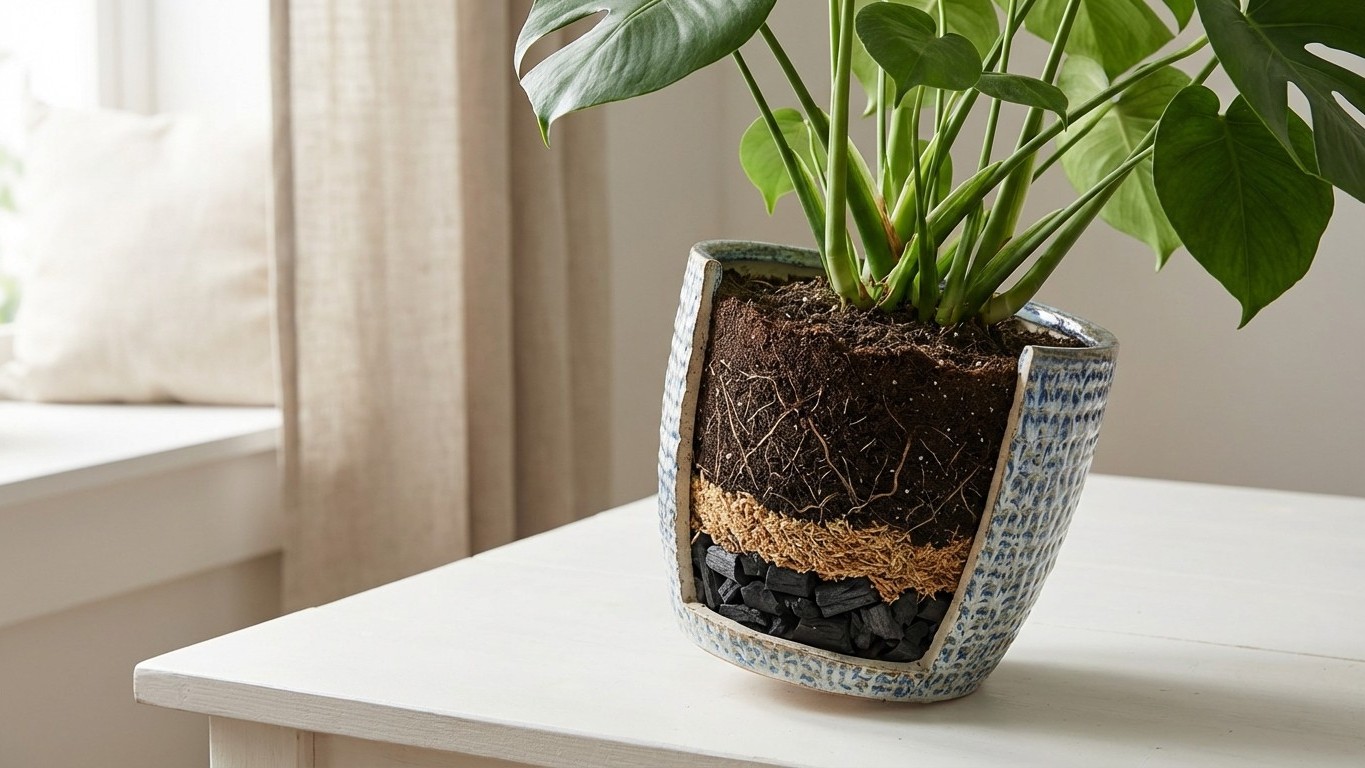
Root rot doesn’t announce itself. By the time you notice yellow leaves, wilting that doesn’t improve after watering, or a faint musty smell coming from the soil, the damage is often already done. And the culprit, more often than not, isn’t overwatering, it’s the pot setup. Specifically, the absence of a drainage layer inside decorative pots that don’t have holes at the bottom.
This is one of the most common silent killers of Houseplants in American homes. Beautiful ceramic cachepots, handmade terracotta bowls without drainage, woven baskets lined with plastic, they look great on a shelf or a windowsill, but they trap water with remarkable efficiency. Without intervention, the roots of your fiddle leaf fig, your pothos, your beloved monstera sit in stagnant water every time you reach for the watering can.
Key takeaways
- Most houseplant deaths in decorative pots aren’t from overwatering—they’re from what’s missing at the bottom
- A surprising discovery about gravel: it might actually trap water instead of preventing it
- The exact materials and simple 5-minute setup that keeps roots breathing while stopping rot dead
What’s actually happening at the bottom of that pot
Soil doesn’t drain evenly. When water moves through a potting mix, it follows the path of least resistance and collects at the lowest point available. In a pot with drainage holes, that point is the opening at the bottom. In a sealed decorative container, that point is a compressed, waterlogged zone right where the roots are most vulnerable, the base of the root ball.
Roots need oxygen as much as they need water. When the lower portion of the soil stays saturated for more than 24 to 48 hours, the oxygen is displaced and anaerobic bacteria begin to take over. Those bacteria produce the compounds that cause root rot, a fungal and bacterial condition that essentially liquefies root tissue. The plant can’t absorb nutrients from damaged roots, which is why the symptoms look like drought stress, even though the soil is soaking wet.
A thin layer of the right material at the bottom of the container changes that equation entirely. It creates a physical buffer between the soil and any accumulated water, allowing the root zone to breathe while excess moisture settles below the root ball rather than around it.
The drainage layer: what works, what doesn’t
The traditional advice was always to use a layer of gravel or pebbles. Here’s where it gets counterintuitive: horticultural research, including work cited by the University of Vermont Extension, has shown that a layer of coarse material beneath fine soil can actually create what’s called a “perched water table.” Water doesn’t flow freely from fine particles into coarser ones until the finer layer is completely saturated. So a gravel layer can, paradoxically, make the problem worse in certain conditions.
The solution isn’t to abandon the drainage layer, it’s to choose the right materials. Horticultural charcoal is one of the best options available. It absorbs excess moisture, resists compaction over time, and has natural antimicrobial properties that slow the growth of the bacteria responsible for root rot. A one-inch layer at the bottom of most small to medium containers is enough.
Perlite, the small white volcanic glass particles you often see mixed into potting soil, works well too. Because its particle size can be matched more closely to the soil above it, it avoids the perched water table issue while still improving drainage and aeration. Leca (lightweight expanded clay aggregate) is another option that’s gained traction among plant enthusiasts, it holds some moisture but allows water to drain freely around it, and it can be rinsed and reused indefinitely.
A layer of sphagnum moss placed just above the charcoal or perlite serves a secondary purpose: it prevents the potting mix from sifting down into the drainage layer over time, keeping the two zones distinct. Think of it as a filter between departments.
The right setup, from the bottom up
Setting up a decorative pot correctly takes about five minutes and can add years to a plant’s life. Start with a one-inch layer of horticultural charcoal or leca at the very bottom. Follow with a thin layer of sphagnum moss to act as a barrier. Then add your potting mix, chosen specifically for your plant type, not just whatever generic blend was on sale — and plant as usual.
One thing most guides skip: even with this setup, you still need to be mindful of how much water you’re adding. The drainage layer buys you margin, not immunity. A simple trick is to lift the pot after watering; with practice, you’ll learn how heavy “wet but not waterlogged” feels versus “sitting in a reservoir.” Some plant owners keep their actual nursery pot (the plastic one with drainage holes) inside the decorative cachepot, which makes it easy to remove and check for standing water. It’s not as seamless aesthetically, but it’s virtually foolproof.
If you suspect a plant is already suffering from root rot, the drainage layer conversation becomes urgent. Unpot the plant, shake off as much old soil as possible, and trim any roots that are black, mushy, or smell fermented. Let the roots air dry for a few hours, then repot with fresh mix into a container set up correctly from the start. Some plants recover. Some don’t. But the odds improve dramatically when they’re not placed back into the same conditions that caused the problem.
A question worth asking every time you repot
The houseplant industry has done an extraordinary job of selling us on aesthetics, the hunt for the perfect pot to match the couch, the shelf, the vibe. What it’s less good at communicating is that the interior architecture of that pot matters as much as the exterior finish. A gorgeous hand-thrown ceramic container without a single drainage hole is, from your plant’s perspective, a slow-motion trap.
The fix is cheap, takes minutes, and is available at any garden center. The harder shift is remembering to do it before the plant goes in, not after the leaves start turning. And maybe that’s the real question worth sitting with: how many of the plants you’ve “failed” over the years were actually victims of a setup that never gave them a fair chance?