
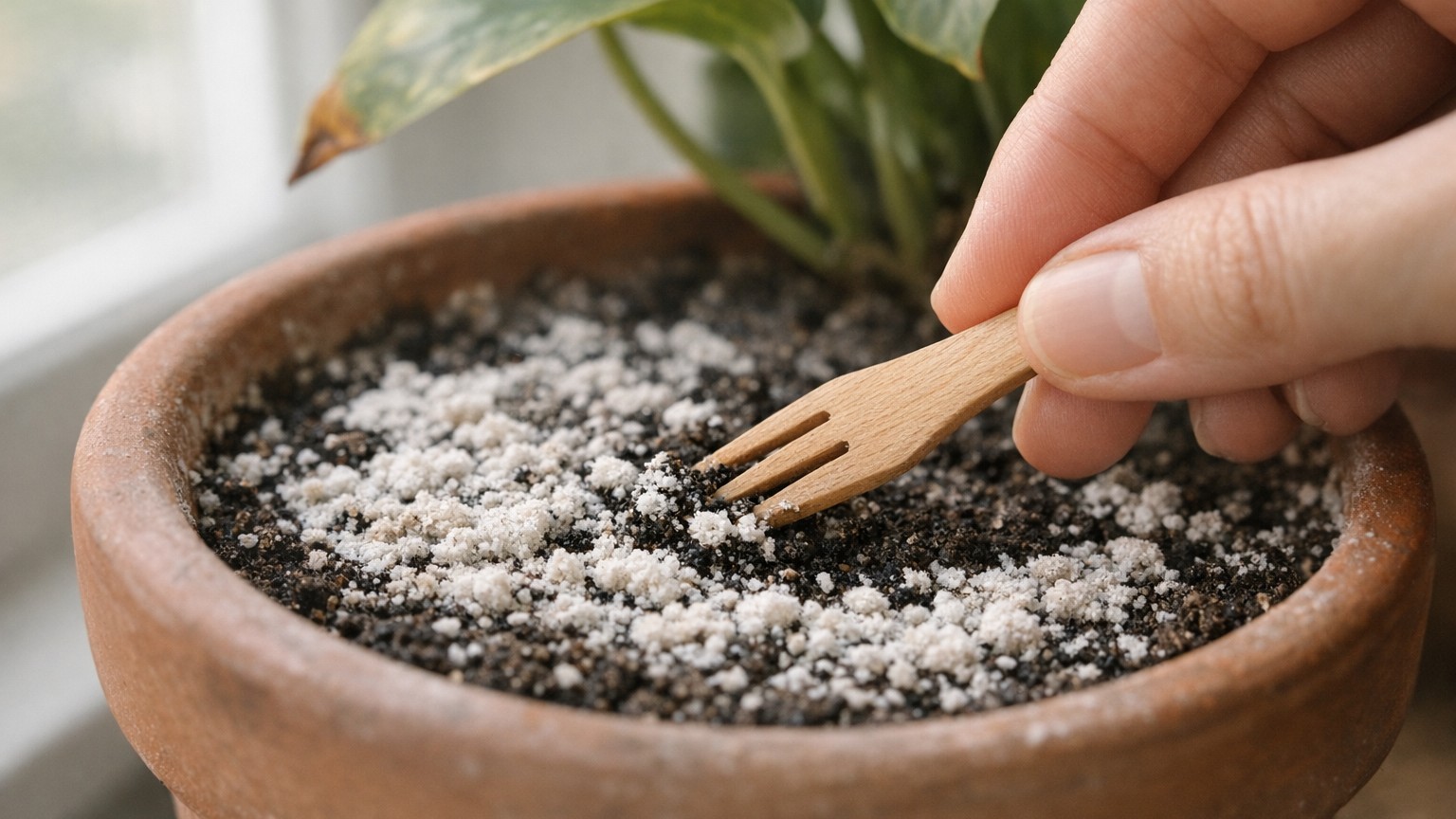
That white crust on top of your potting soil isn’t decorative. It’s a slow-burning problem, and most plant owners, myself included for longer than I’d like to admit, treat it like a cosmetic issue and water right around it. The day I finally scraped it off and looked at what was underneath, I found compacted, salt-caked soil that had been slowly poisoning my pothos for months.
Key takeaways
- That white crust isn’t just sitting there—it’s actively pulling water OUT of your plant’s roots instead of letting them absorb it
- The compacted salt layer creates a moisture barrier that traps water along pot edges while the root zone stays bone dry
- Watering around the crust makes the problem worse, creating a cycle that looks like underwatering but is actually salt stress
What that white crust actually is
The short version: mineral salts. Every time you water a houseplant, you’re delivering dissolved minerals, calcium, magnesium, sodium, and chlorine, that come naturally from tap water. Plants absorb some of these, but a significant portion gets left behind in the soil. As water evaporates from the surface, those minerals crystallize, forming the chalky white or yellowish crust you see. Fertilizers accelerate the process dramatically, because synthetic plant foods are essentially concentrated salt compounds.
Hard water makes this worse faster. If you live in a city like Phoenix, Dallas, or Indianapolis, where tap water hardness routinely exceeds 200 mg/L of dissolved minerals — that white layer can build up visibly within a few weeks of consistent watering. The crust isn’t just sitting on top, either. It extends into the first inch or two of soil, binding particles together and creating a near-impermeable layer.
The real damage happening below the surface
Here’s what changes the conversation: salt buildup doesn’t just sit there passively. It actively pulls moisture away from roots through osmotic pressure. Plant roots absorb water because the concentration of minerals inside the root cells is higher than in the surrounding soil, water moves toward the higher concentration, into the root. Flood the soil with excess salt and that gradient reverses. Water moves out of the roots instead of in. The plant shows symptoms that look exactly like underwatering: wilting, yellowing leaves, brown leaf tips. So you water more. Which adds more minerals. Which makes the problem worse.
This cycle is sometimes called “fertilizer burn” or “salt stress,” and it’s one of the more common reasons houseplants decline despite attentive care. A 2019 study from the University of Florida’s Institute of Food and Agricultural Sciences confirmed that chronic salt accumulation in container soil significantly reduces root mass and nutrient uptake efficiency in common tropical houseplants, the exact species most people keep indoors.
The compaction layer compounds this further. When the top of the soil hardens, water doesn’t penetrate evenly. Instead, it channels along the sides of the pot, you see it drain out the bottom quickly, and assume the soil got a thorough soaking. The middle and lower root zone can stay bone dry while you think you’ve watered adequately. Your plant is simultaneously salt-stressed and drought-stressed, and neither condition is obvious until the damage is advanced.
How to actually fix it, not just scrape the surface
Scraping off the crust is the first step, not the solution. Use a chopstick, a fork, or a small trowel to remove the top inch to inch-and-a-half of soil, including the crusted material. Don’t go deeper without caution, you risk severing surface roots, which many tropical plants keep close to the top of the pot. Once removed, that layer should be replaced with fresh potting mix.
Then flush the soil. Set the pot in your sink and water it slowly and thoroughly, far more than you normally would, letting the water run freely out of the drainage holes for several minutes. This leaches dissolved salts out through the bottom of the pot. Do this once every two to three months as routine maintenance, not just when you see crust forming. The salts are always accumulating; the crust is just their visible announcement.
Switching to filtered or distilled water eliminates the problem at the source for sensitive plants, ferns, calatheas, peace lilies, that react badly to mineral-heavy tap water. Rainwater works beautifully if you can collect it. For most hardier plants, simply letting tap water sit uncovered overnight reduces chlorine (though not hardness), and that alone can help slow crust formation.
Fertilizer habits matter more than most guides acknowledge. Overfertilizing is among the top contributors to salt stress, and the standard instructions on fertilizer packaging tend to be more aggressive than necessary for container plants growing in typical indoor light conditions. Cutting the recommended dose in half and fertilizing less frequently during winter, when plants grow slowly and uptake is minimal, reduces buildup without starving the plant.
The plants most likely to suffer in silence
Not all Houseplants signal salt stress at the same pace. Peace lilies and spider plants show brown tips relatively early, which is a useful warning. Pothos, philodendrons, and ZZ plants are tougher and mask the problem longer, which is part of why they’re marketed as “unkillable”, they tolerate mistreatment until they suddenly don’t. Succulents and cacti, despite being adapted to arid conditions, are actually quite sensitive to salt accumulation because their native soils have very low mineral content and flush naturally with infrequent but heavy rainfall.
Terracotta pots add an interesting wrinkle. Because terracotta is porous, salts migrate through the pot wall and crystallize on the outside as the familiar white streaks you see on aged clay pots. That exterior crust is actually a sign your terracotta is doing its job, pulling excess minerals away from the root zone. Glazed ceramic and plastic pots don’t allow this migration, so all salt accumulation stays concentrated in the soil. Same plant, same water, meaningfully different dynamics depending on the container material.