
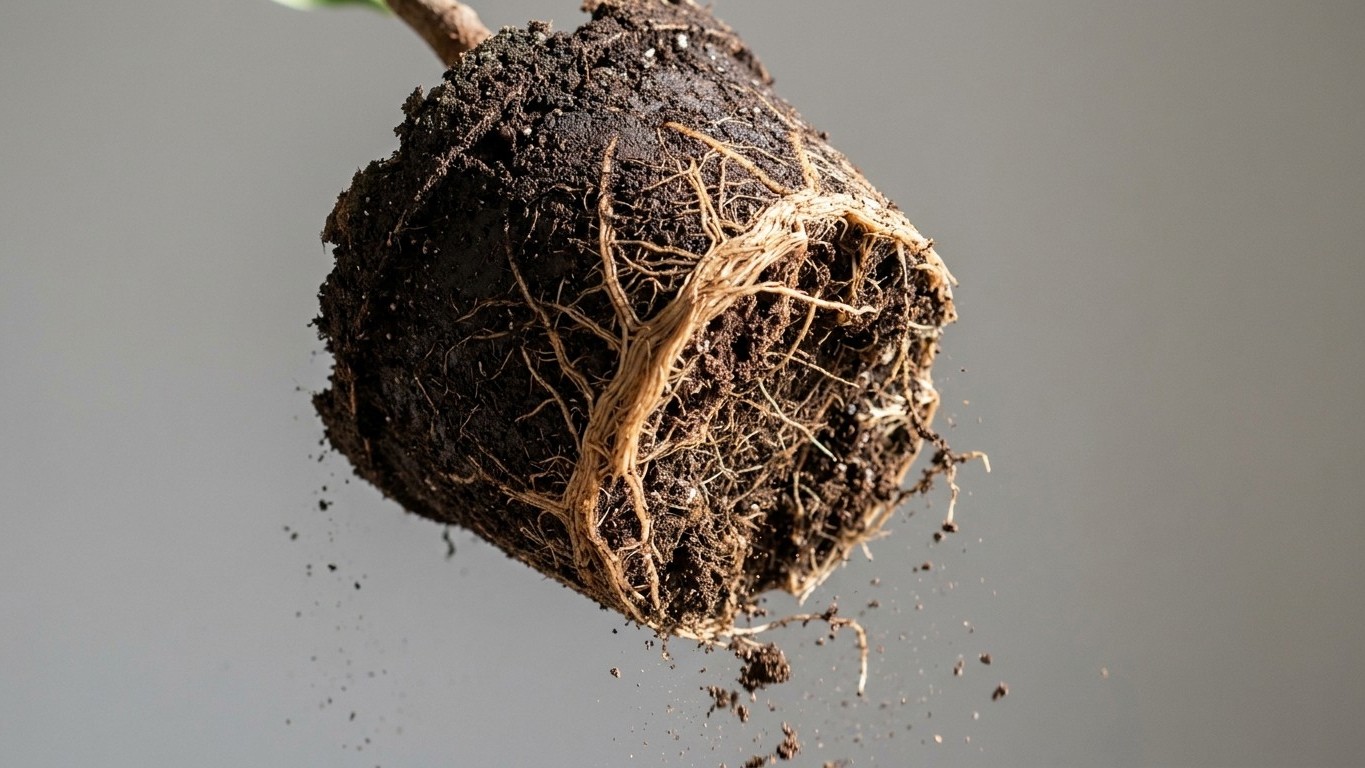
Three months ago the idea seemed foolproof: skip the annual repotting ritual, jump the ficus straight into a pot three sizes larger, and buy myself a couple of years of peace. A month later, tipping the root ball out to check on things, the picture inside told a different story than expected.
The rootball sat like a small island in the center of the container. Around it, a thick ring of soil, barely touched by roots, had gone from crumbly to compacted and faintly sour-smelling. That outer band wasn’t feeding the plant. It was drowning it slowly, one watering at a time.
Key takeaways
- Extra soil doesn’t mean extra room—it means extra water sitting where roots can’t reach it
- Dense, sour-smelling soil at the pot’s edge is a warning sign most growers miss until root rot starts
- The one rule that stops this: pot diameter should be only 2 inches wider than the previous one, not multiple sizes up
Why extra soil isn’t extra room to grow
The math behind pot sizing has nothing to do with generosity and Everything to do with water physics. Roots pull moisture from the soil directly around them; anything beyond that reach just sits there, wet, waiting. As one nursery guide puts it, when you repot into a much larger container, the roots are surrounded by soil and can’t pull the water from it fast enough, leaving it wet too long and drowning the roots. A ficus doesn’t experience a bigger pot as an invitation to expand. It experiences it as a swamp.
That’s the opposite of what most people assume, myself included before this experiment. The instinct is to picture a plant like a teenager finally getting their own bedroom, sprawling out to fill the new space. Reality works differently. A common myth is that plants will grow larger if potted in a larger pot, like a goldfish in a fishbowl. This seems logical, but actually most houseplants prefer a snugger fit. Roots do not quickly fill a space when given room, but rather grow when and where they want to, usually rather slowly. Meanwhile the soil sitting in that gap keeps holding water long after the roots nearby have had their fill.
Horticulture extension offices have been saying this for years, and the consensus number keeps landing in the same narrow range. Choose a pot of only the next larger size. The soil in pots that are too large tends to stay excessively moist for too long and can lead to root rot. Purdue’s consumer horticulture program isn’t alone here. A Connecticut extension article makes a similar point about compaction and nutrient depletion over time, but the oversized-pot warning shows up almost everywhere repotting gets discussed seriously.
What that outer ring was actually holding
Pulling the ficus back out after a month confirmed exactly what the guides warn about. The soil at the edges was dense, slightly gray in patches, and cool to the touch in a way that fresh potting mix never should be weeks after watering. It wasn’t dry-and-waiting. It was saturated-and-stagnant, the kind of environment fungal pathogens treat like an open invitation.
The reasoning tracks with what plant scientists have documented about container volume and root health. The American Society for Horticultural Science actually notes that excessive pot volume can lead to poor aeration and increased risk of fungal diseases, which lines up precisely with what that dense outer band looked and smelled like. Aeration isn’t a minor detail for ficus. This is a genus notorious for leaf drop the moment roots go anaerobic, and an oversized pot manufactures exactly those conditions without a single overwatering mistake on the owner’s part.
Fiddle leaf figs, the ficus family’s most dramatic member, illustrate the stakes well. Fiddle leaf figs are very prone to root rot, so keeping the container free from moisture is crucial. That means the pot you choose should only be one size larger than its current one. Too big a pot means too much excess soil that can hold moisture and drown the plant’s roots. The same physics apply to a standard ficus benjamina or an elastica, just with slightly more forgiveness built in.
The sizing guidance from most professional sources converges on something modest. When repotting the size of the pot should only be slightly larger than the existing pot, maybe 2 inches across the diameter larger. New soil should then be added around the circumference and lightly pressed in to eliminate air pockets. Two inches. Not two pot sizes. Not three. The temptation to shortcut future work by oversizing now runs directly against how root systems actually expand.
Fixing it without starting over
Catching the problem at the one-month mark, rather than six months in, made the fix straightforward rather than a full plant rescue. The move was to lift the whole rootball out, gently break up that outer compacted ring, and transfer everything into a container that actually matched the root mass, roughly two inches wider in diameter than the original pot, not the oversized one.
Anyone in the same spot, having already up-potted too aggressively, has a clear path forward. If you’ve already planted in a too-large pot, it’s best to repot it into a smaller, appropriately-sized pot as soon as possible. This will reduce the risk of root rot caused by excess wet soil. The recommended size is a two-thirds plant to one-third pot ratio. That ratio is worth writing down somewhere, because it works as a quick visual gut-check at the garden center, long before anyone gets home and realizes the container swallows the plant whole.
The watering routine matters just as much as the downsizing itself. Rather than resuming a normal schedule right away, letting the root zone actually dry down protects against reinfecting fresh soil with the same problem. Root rot in Fiddle Leaf Fig plants is caused by too much moisture in the soil from over-watering. Do not water again until you’re sure the roots have had a chance to dry out. For a ficus that’s already been sitting in a soggy margin for weeks, that patience isn’t optional.
The uncomfortable lesson in all this: the “save myself a repotting” logic backfires almost every time, and not just for ficus. A pothos owner who tried the identical shortcut on a rootbound plant ended up with an explosion of fungus gnats that took a couple of months to solve, plus the exact repotting job they’d hoped to avoid, done twice instead of once. Skipping ahead a size or two rarely buys the time it promises. It just moves the work to later, with interest.
Sources : quora.com | fiddleleaffigplant.com