
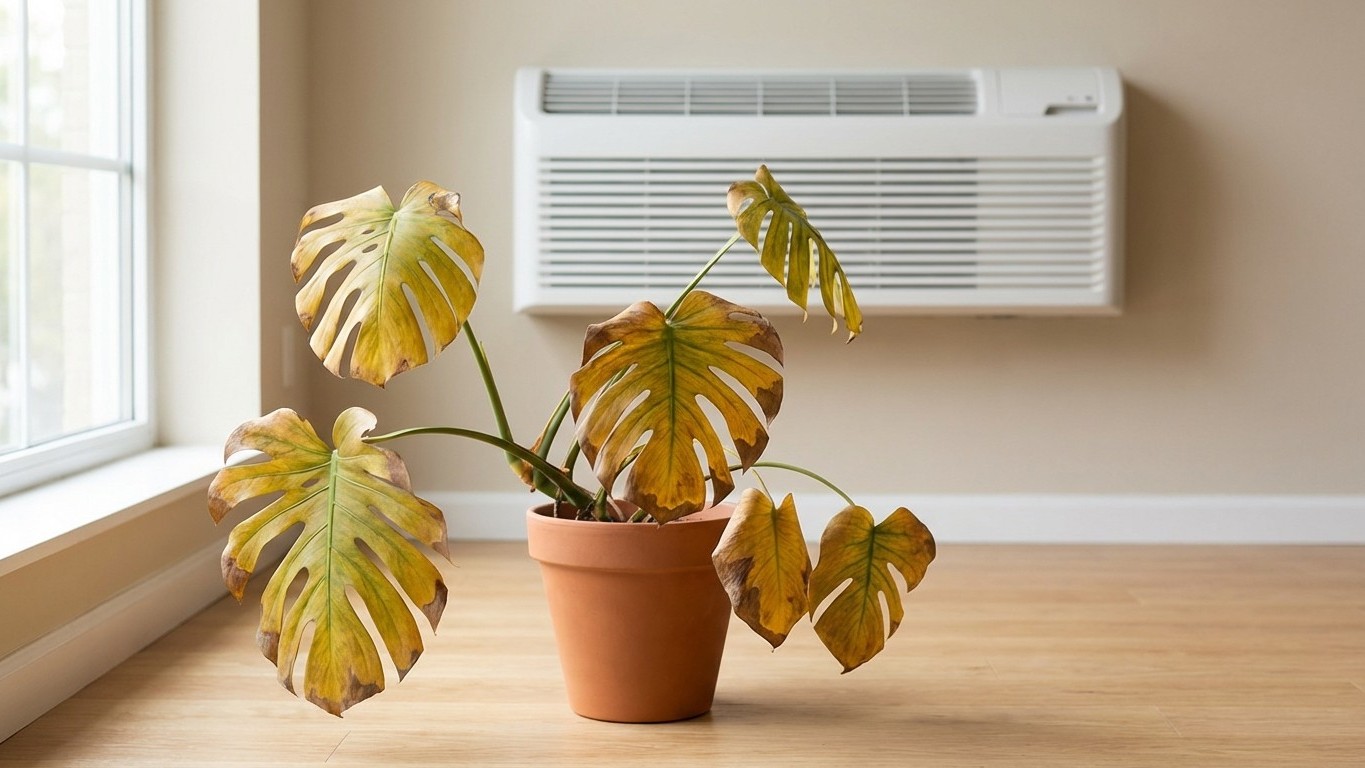
Your monstera looks fine. Until it doesn’t. And by the time you notice the drooping leaves, the crispy brown edges, or that weirdly papery texture creeping across the foliage, the damage has been building for weeks, silently, steadily, right there in your living room. The culprit isn’t underwatering or overwatering or even insufficient light. It’s the air conditioning vent three feet away.
Key takeaways
- AC vents create a microclimate that tropical plants can’t survive—but the damage takes weeks to show up
- Fiddle-leaf figs, calatheas, and peace lilies are hit hardest; even tough monsteras start to struggle
- The real fix isn’t more watering—it’s moving your plant away from the vent before summer stress becomes permanent
The AC Problem Nobody Talks About
Most houseplant advice focuses on light and water. Reasonable enough. But temperature consistency and airflow, the two things central air systems actively destroy, barely get a mention on plant care labels. Air conditioners create a microclimate near the vents that bears almost no resemblance to the rest of the room. We’re talking sudden cold drafts, rapid humidity drops, and repeated cycles of warm-then-cold air that stress tropical plants in ways that don’t show up for days or even weeks after the fact.
Tropical houseplants, monsteras, pothos, peace lilies, snake plants, fiddle-leaf figs — are the ones we gravitate toward because they’re widely available and relatively forgiving. But “tropical” also means they evolved in environments with stable warmth, high humidity, and gentle air movement. A central AC unit cycling on and off ten times a day is basically the opposite of that. Every blast of conditioned air strips moisture from the leaf surface faster than the roots can compensate, a process called transpiration stress. The plant loses water through its leaves, can’t replace it quickly enough, and starts to shut down non-essential functions, which means stopping growth, dropping leaves, or developing those telltale brown tips.
Which Plants Are Getting Hit the Hardest
The fiddle-leaf fig has become something of a cultural shorthand for “difficult houseplant,” and its reputation is somewhat deserved. But a lot of fiddle-leaf failures trace back not to mysterious fickleness but to placement. Put one near an AC vent and you’ll see leaf drop within two to three weeks. The plant doesn’t adjust gradually; it reacts dramatically to cold air disruptions, shedding leaves the way a tree drops them in autumn.
Calatheas and prayer plants are even more sensitive. Their large, paper-thin leaves have almost no buffer against dry air. An AC-adjacent calathea will curl its leaves upward (a self-protection response to conserve moisture), develop brown edges, and eventually look so bad that owners assume they’ve been overwatering. So they water less. The plant gets worse. The cycle continues until the whole thing is composted.
Monsteras, by contrast, are tougher, but even they show signs if placed directly in the line of a vent. New growth stalls, leaves emerge smaller than usual, and aerial roots dry out before they can anchor anywhere useful. Snake plants are among the most tolerant, but even they’ll develop scarring and discoloration from repeated cold drafts over a full summer.
Peace lilies are perhaps the most dramatic canaries in the AC coal mine. They wilt visibly when stressed, almost theatrically, and will droop and yellow in response to cold airflow even when the soil moisture is perfectly adequate. If your peace lily keeps looking sad despite regular watering, check what’s blowing on it before you do anything else.
What “Too Close” Actually Means
There’s no universal safe distance, but as a working rule, anything within four to five feet of a vent deserves scrutiny. The issue is that air from a typical wall or ceiling vent can travel twelve to fifteen feet before diffusing significantly. A plant across the room from the vent might still be catching the tail end of that airflow, especially in smaller apartments where air circulates quickly.
A simple test: hold a single sheet of tissue paper near your plant at leaf height when the AC kicks on. If it moves noticeably, the plant is feeling that airflow. Move it. Not eventually, now, before another summer goes by.
Humidity is the second dimension of this problem. Central air conditioning actively dehumidifies as it cools, and the average American home in summer can drop to 30-35% relative humidity indoors, well below the 50-60% range that tropical plants prefer. A plant near the vent experiences even lower localized humidity than the rest of the room. Grouping plants together helps (they create a small shared humid microclimate), and a small Humidifier placed nearby makes a real difference. Pebble trays with water can help marginally, though the effect is modest compared to a proper humidifier.
Fixing the Damage Before It’s Actually Too Late
Moving the plant is step one, and it sounds obvious, but it gets complicated by the fact that the best light spots and the most convenient AC vents often overlap near windows. If that’s the case, prioritize distance from the vent over proximity to the window, most tropical plants will adapt to slightly less light more gracefully than they’ll adapt to constant cold drafts.
Once relocated, resist the urge to immediately increase watering. A stressed plant from AC exposure is often in a state of reduced activity and doesn’t need more water; it needs stability. Keep the soil moisture consistent with what you’ve been doing, give it two to three weeks to settle into its new spot, and watch for new growth as the signal that it’s recovering.
Trimming damaged leaves (the brown-tipped, yellowed, or papery ones) is more about aesthetics than plant health, but it does reduce the energy the plant spends on hopeless tissue. Cut just outside the brown edge with clean scissors, and the plant can redirect that minimal effort toward new growth.
There’s a broader question worth sitting with here. We spend real money on plants, real time on watering schedules and fertilizing routines, and yet the placement decision, made once, in thirty seconds, because “it looks nice there”, undoes almost all of it. The irony is that the prettiest corner of the living room, lit by a south-facing window and styled to within an inch of its life, is often exactly where the HVAC duct runs overhead. Maybe the plant that belongs near the AC is a succulent in a ceramic pot. Let the tropicals breathe somewhere else.