
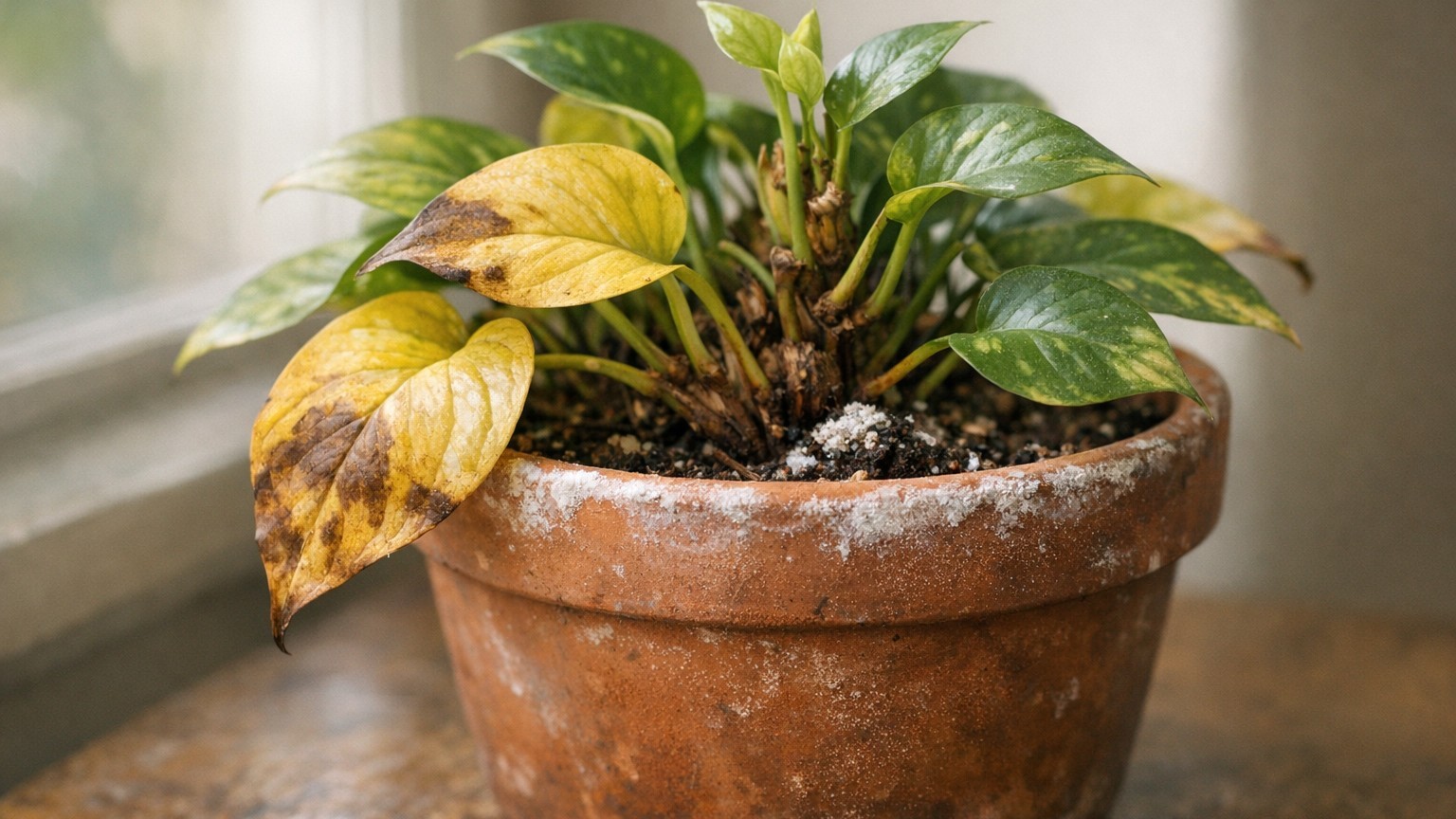
The roots were brown. Not soil-brown, not tanned from years underground, brown like something cooked. Brittle at the tips, shrunken away from the pot walls, sitting in a medium that smelled faintly chemical even after months of watering. That’s what I found when I finally unpotted my golden pothos, a plant I’d been “feeding” on a strict weekly schedule at the full dose printed on the bottle. I thought I was being a good plant parent. The roots told a different story.
Key takeaways
- A plant surrounded by water can still die of thirst when fertilizer salts flip the osmotic gradient
- Over-fertilization mimics underwatering, pests, and low light—which is why it goes undetected for months
- The label dose isn’t a recommendation; it’s a ceiling designed for greenhouse conditions, not your home
The label dose is not a recommendation, it’s a ceiling
Most liquid fertilizer labels are written with one assumption baked in: you’re a commercial grower trying to maximize yield in the shortest possible time. The “feed weekly at full strength” instruction that appears on countless bottles is calibrated for nurseries running plants in nearly inert growing media under greenhouse lighting, not for a philodendron sitting three feet from a north-facing apartment window. The chemistry doesn’t care about that distinction, though. The salts arrive either way.
Fertilizer salts, and nearly all plant nutrients are mineral salts in solution, work by osmosis. Roots absorb water because the concentration of dissolved minerals inside root cells is higher than in the surrounding soil. Apply too much fertilizer and you flip that gradient. The soil becomes saltier than the root tissue, and water moves outward instead of inward. The plant, surrounded by moisture it watered from a can, is effectively dying of thirst. Agronomists call this “fertilizer burn.” Houseplant owners usually just call it mysterious decline.
A 2019 review published by the Purdue University Extension on container plant nutrition noted that hobbyist growers consistently over-apply nitrogen relative to actual plant uptake, with excess salts accumulating in the root zone over successive applications. The white crust that forms on terracotta rims isn’t decorative, it’s the visible evidence of that buildup.
What over-fertilization actually looks like (and why it’s easy to miss)
The symptoms are maddeningly easy to misread. Yellowing leaves? Could be overwatering, underwatering, low light, or pest damage. Browning leaf tips? Usually blamed on dry air. Wilting despite moist soil? Sounds like root rot from overwatering. Over-fertilization mimics all of these, which is exactly why it persists for so long before anyone figures it out. The plant looks unwell, the owner adds more fertilizer to “support recovery,” and the cycle accelerates.
My pothos gave me every signal: the lower leaves yellowed faster than normal, the new growth was smaller and paler than it should have been, and the plant stopped expanding despite sitting in decent light. I treated each symptom in isolation, adjusting light, adjusting water, even repotting into fresh soil, then fertilizing again immediately after, which was perhaps the worst possible move. Fresh potting mix already contains a starter charge of nutrients. Adding a full-strength dose on top of that within days of repotting is the horticultural equivalent of taking two doses of a medication because the first one “didn’t work yet.”
The most reliable early indicator I’ve since learned to watch for is actually in the soil surface. A white or pale crust forming around the base of the stem, or on the inner rim of the pot, signals that soluble salts are accumulating faster than they’re being flushed out. By the time leaves are visibly damaged, the root system has often been compromised for weeks.
How to actually feed houseplants without burning them
The standard advice that holds up under scrutiny: dilute to a quarter of the label strength and apply every two to four weeks during the active growing season, stopping almost entirely from late fall through winter when most houseplants slow their metabolism. This isn’t timidity, it’s matching input to demand. A plant that’s barely growing in November doesn’t need feeding any more than a sleeping person needs a full breakfast every hour.
Flushing matters, too. Running water through the pot until it drains freely from the bottom, and continuing for a full minute after that, dissolves and removes accumulated salts from the root zone. Doing this every six to eight weeks prevents the compounding effect that turns minor over-fertilization into chronic root damage. Terracotta pots help here: their porosity allows salts to migrate outward and become visible on the surface before concentrations reach damaging levels inside.
Slow-release granular fertilizers behave differently from liquids and are worth understanding separately. Osmocote and similar products release nutrients gradually over three to six months, reducing the risk of acute salt spikes. The trade-off is less control: in summer heat, the release rate accelerates, which can cause over-delivery exactly when you’d expect the product to be predictable. For most indoor environments with stable temperatures, this is rarely a serious problem, but it’s worth knowing that “slow-release” doesn’t mean “set and forget.”
The pothos I unpotted that afternoon didn’t die. I trimmed the damaged roots back to healthy tissue, rinsed the root ball under lukewarm water for several minutes, and replanted it in fresh mix with no fertilizer for the following two months. It recovered, slowly, then all at once, as plants tend to do. The new growth that eventually came in was noticeably more vigorous than anything I’d seen from that plant in over a year of “proper” feeding.
One detail that surprised me during that recovery period: the plant’s leaves became a deeper, richer green once the fertilizer was removed from the equation. High nitrogen doses push fast, pale growth, lush-looking from a distance but structurally weaker and more susceptible to pests. The slower, unfertilized growth that followed was darker and more leathery. Less is genuinely more, at least until the roots are healthy enough to actually use what you’re offering them.