
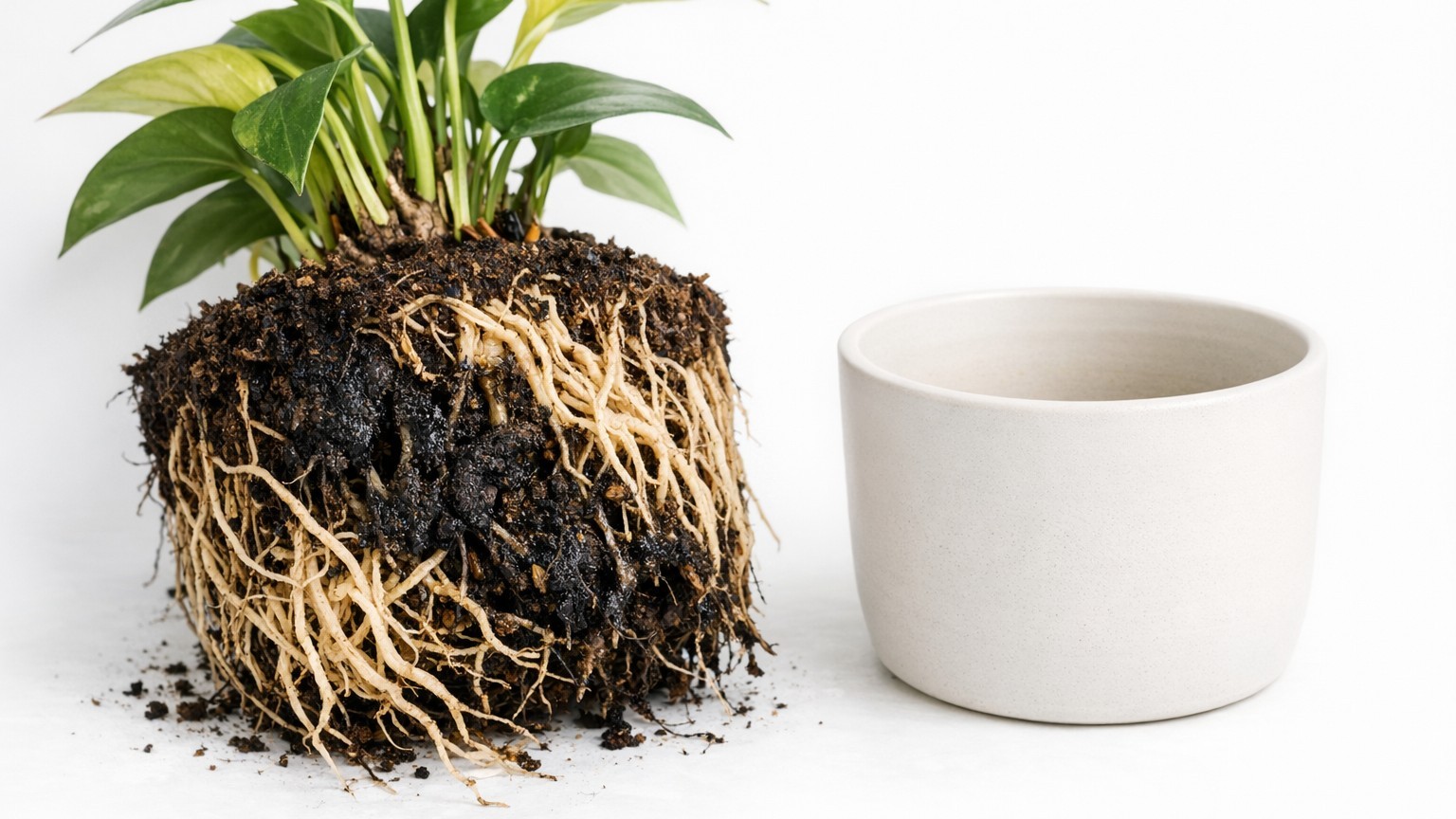
Root rot doesn’t announce itself. One day your plant looks slightly tired, maybe a little yellow around the edges, and then you repot it into something generous, something with space, thinking you’re doing it a favor. Three weeks later, you pull it out and find a blackened, mushy tangle where healthy roots should be. The plant wasn’t struggling because the pot was too small. It was struggling because you gave it too much room.
Key takeaways
- The intuitive logic of ‘bigger pot = more space to grow’ directly contradicts how plant root systems actually function
- Excess soil in oversized pots creates anaerobic zones where deadly root rot fungi thrive—and it happens invisibly underground
- The universal rule plant experts won’t stop repeating exists for one brutal biological reason
The Bigger Pot Logic That Backfires
The intuition makes sense on paper. Plants grow. Roots need space. A cramped pot restricts development. All true, up to a point. The problem is that a pot significantly larger than the root ball holds a disproportionate volume of soil that the roots can’t yet reach or use. That excess soil stays wet for far longer than it should, because there are no roots drinking from it, no biological activity drying it out from below. A 6-inch plant in a 12-inch pot isn’t thriving in open space. It’s sitting next to a reservoir of slow-draining, oxygen-depleted soil that will eventually kill it.
Horticulturalists call this “overpooting”, a term that rarely appears on beginner plant care guides but explains a huge proportion of mysterious plant deaths. The standard guidance is to size up by no more than 1 to 2 inches in diameter at a time. That sounds almost comically conservative, but it reflects a real biological constraint: root systems need to colonize their growing medium before the moisture balance stabilizes.
What Actually Happens Underground
Soil holds water in two ways: in the pores between particles (which drain relatively quickly) and in a thin film clinging to each particle’s surface (which drains very slowly). When roots are present and active, they pull that film moisture constantly. When roots are absent from a section of soil, that film stays saturated. Saturated soil becomes anaerobic, meaning oxygen gets displaced by water, and anaerobic conditions are precisely where the fungi and bacteria responsible for root rot thrive.
Pythium and Phytophthora, the two most common root rot pathogens, don’t require external infection. They exist in trace amounts in almost every bag of commercial potting mix. Under normal aerobic conditions, they remain dormant or outcompeted. Give them a wet, airless environment and they multiply rapidly, breaking down root tissue faster than the plant can replace it. By the time you see wilting or yellowing above the soil, the root system is often already 60 to 70 percent compromised.
There’s another factor most gardeners overlook: drainage holes don’t solve the problem. Water drains from the bottom of a pot through gravity, but the area immediately above the drainage layer can remain perched and saturated regardless, a phenomenon called the “perched water table.” A taller, larger pot actually creates a deeper perched water zone, not a smaller one. Gravel at the bottom, contrary to popular belief, makes this worse by raising the saturation zone higher into the root area.
How to Repot Without Setting Your Plant Up to Fail
The single most effective change you can make is choosing the right pot size from the start. When transitioning a plant, select a pot with roughly 1 to 2 inches of extra space around the root ball on all sides, no more. If the plant is particularly sensitive to moisture (succulents, snake plants, most tropicals with thick rhizomes), err toward the smaller end of that range.
Soil mix matters as much as pot diameter. Standard potting soil retains too much moisture for most houseplants when used alone. Blending it with perlite, typically at a 60/40 or 70/30 ratio of soil to perlite, dramatically improves aeration and speeds up drying between waterings. For succulents and cacti, a true fast-draining mix (often 50 percent inorganic material or more) is the correct baseline, not a modification.
Watering behavior also needs to adjust after a repot. A freshly repotted plant in new, lightly moist soil doesn’t need immediate deep watering. Many experienced growers wait 3 to 5 days before the first post-repot water, allowing any damaged roots to callous slightly and reducing the risk of introducing moisture to already-stressed tissue. The plant isn’t dying of thirst in that window. It’s recovering.
One useful habit: before watering, lift the pot. A pot that still feels heavy has moisture remaining in the lower layers, even if the surface soil appears dry. Weight is a more reliable indicator than touch for medium-to-large containers. Over time, you develop an instinct for the difference between a properly dry pot and one that’s still holding water in the bottom third.
Rescuing a Plant With Root Rot
If you’ve already pulled out a plant and found the damage, recovery is possible but not guaranteed. The first step is removing all affected roots, anything brown, black, soft, or with no resistance when pinched. Healthy roots are white to tan and firm. Cut back to clean tissue, sterilizing your scissors between cuts with isopropyl alcohol.
Let the exposed root system air dry for 30 minutes to an hour before replanting. Some growers dust cut ends with powdered cinnamon, which has mild antifungal properties, though the evidence for its effectiveness is largely anecdotal. What isn’t anecdotal: replanting into fresh, clean, well-draining mix in an appropriately sized pot, smaller than what it came out of, if the root ball has been significantly reduced.
Place the recovering plant in bright indirect light (direct sun stresses already-compromised plants), hold off on fertilizer for at least 4 to 6 weeks, and water sparingly until new growth signals that the root system has rebuilt enough to handle normal care. The turnaround timeline varies widely by species: a pothos can bounce back in two weeks, while a monstera with severe rot may take two to three months to show meaningful recovery.
One thing the research on container horticulture consistently confirms: plants in slightly snug pots almost always outperform plants in generously oversized ones when care conditions are otherwise equal. The root system concentrates, strengthens, and colonizes efficiently. What feels like restriction from the outside is, for the plant, simply the right amount of world to manage at once.